---
title: [BCM] [JCUS] [E3] [BCS] [T3] [CBF] [1] Teaching and Learning Delivery
description: [BCM] [JCUS] [E3] [BCS] [T3] [CBF] [1] Teaching and Learning Delivery
image: https://blog.bcm-institute.org/hubfs/JCU%20Graphic%20Folder/JCU%20CBF%201%20Morepost/%5BBCM%5D%20%5BJCU%5D%20%5BE3%5D%20%5BBCS%5D%20%5BT3%5D%20%5BCBF%5D%20%5B1%5D%20Teaching%20and%20Learning%20Delivery.jpg
---
. .
[](http://www.bcm-institute.org/)
- [Home](https://www.bcm-institute.org/)
- [About Us](https://www.bcm-institute.org/about-us-3/)
- [A President’s Perspective](https://www.bcm-institute.org/about-us/a-presidents-perspective/)
- [Our History](https://www.bcm-institute.org/about-us/our-history/)
- [Our Advisory Council](https://www.bcm-institute.org/about-us/our-advisory-council/)
- [Customers’ Testimonials](https://www.bcm-institute.org/about-us/customers-testimonials/)
- [Credential Verification](https://www.bcm-institute.org/about-us/credential-verification/)
- [Courses](https://blog.bcm-institute.org/blog/course-fees-for-blended-learning-courses-master-catalog)
- [ISO 22301 Business Continuity Management System Audit](https://blog.bcm-institute.org/audit/business-continuity-management-audit-courses)
- [ISO 22301 Business Continuity Management](https://blog.bcm-institute.org/bcm/business-continuity-management-courses)
- [Crisis Communication](https://blog.bcm-institute.org/crisis-communication/crisis-communication-courses)
- [Crisis Management](https://blog.bcm-institute.org/en/crisis-management/courses)
- [IT Disaster Recovery](https://blog.bcm-institute.org/it-disaster-recovery/courses)
- [Operational Resilience](https://blog.bcm-institute.org/operational-resilience/courses)
- [Operational Resilience Audit](https://blog.bcm-institute.org/operational-resilience-audit/courses)
- [Certification](https://blog.bcm-institute.org/certification/types-of-certifications-offered)
- [ISO 22301 BCMS Audit Certification](https://blog.bcm-institute.org/certification/business-continuity-management-audit-certification)
- [ISO22301 Business Continuity Management Certification](https://blog.bcm-institute.org/bcm/business-continuity-management-certification)
- [Crisis Communication Certification](https://blog.bcm-institute.org/crisis-communication/crisis-communication-certification)
- [Crisis Management Certification](https://blog.bcm-institute.org/en/crisis-management/crisis-management-certification)
- [IT Disaster Recovery Planning Certification](https://blog.bcm-institute.org/it-disaster-recovery/it-disaster-recovery-certification)
- [Operational Resilience Certification](https://blog.bcm-institute.org/operational-resilience/operational-resilience-certification)
- [Operational Resilience Audit Certification](https://blog.bcm-institute.org/operational-resilience-audit)
- [Seminars](https://blog.bcm-institute.org/meet-the-expert/mte-webinar-mainpage)
- [Store](https://www.bcm-institute.org/store-2/)
- [Contact Us](http://www.bcm-institute.org/about-us/contact-us/)
-
-
##### Institutional Resilience in Action: Business Continuity Management Implementation at JCU Singapore
# \[BCM\] \[JCUS\] \[E3\] \[BCS\] \[T3\] \[CBF\] \[1\] Teaching and Learning Delivery
[![\[BCM\] \[JCU\] \[Full Banner\] Business Continuity Management Implementation at JCU Singapore](https://no-cache.hubspot.com/cta/default/3893111/c28ce2ee-dfaa-4e23-b28a-6ae8ca285f06.png)](https://cta-redirect.hubspot.com/cta/redirect/3893111/c28ce2ee-dfaa-4e23-b28a-6ae8ca285f06)
The purpose of identifying minimum recovery resources is to establish the smallest practical level of people, workplace, technology, communications, equipment and supporting capability required to continue **CBF-1 Teaching and Learning Delivery** during a disruptive incident.
The objective is not to recreate James Cook University Singapore's normal teaching environment immediately.
Instead, recovery arrangements should provide sufficient capability to achieve the approved **Minimum Business Continuity Objective (MBCO)** until additional resources become available or normal operations can be restored.
Minimum resource planning converts the results of the **Business Impact Analysis (BIA)** and the selected **Recovery Strategies** into tangible operational requirements.
The BIA identifies activity priorities, disruption impacts, recovery requirements, dependencies, and recovery time expectations.
Recovery Strategy development determines how those activities will be continued or recovered.
This chapter completes the resource-planning element by determining what is actually required at each recovery location to implement those strategies.
The BCM methodology distinguishes minimum recovery resources from normal operating resources.
Resources should therefore be established for the activities that must continue during the disruption and rationalised where resources can be shared between functions or recovery locations.
### [![Banner \[BCM\] \[E3\] \[BCS\] \[T3\] Minimum Resources Required during a Disaster](https://no-cache.hubspot.com/cta/default/3893111/8969ce47-38c2-4b89-88da-727979f12c39.png)](https://cta-redirect.hubspot.com/cta/redirect/3893111/8969ce47-38c2-4b89-88da-727979f12c39)
[Dr Goh Moh Heng](https://blog.bcm-institute.org/ebook/author/dr-goh-moh-heng) Oct 2, 2026
###### Business Continuity Management Certified Planner-Specialist-Expert
[![x \[BCM\] \[JCU\] Legal Disclaimer Banner](https://no-cache.hubspot.com/cta/default/3893111/e57030e6-3c63-46cc-988b-1eabb945de75.png)](https://cta-redirect.hubspot.com/cta/redirect/3893111/e57030e6-3c63-46cc-988b-1eabb945de75)
[](https://cta-redirect.hubspot.com/cta/redirect/3893111/2473a6fd-c3f8-42a1-9622-442761ec98fe)
[![Banner \[BCM\] \[E3\] \[BCS\] \[T3\] Minimum Resources Required during a Disaster](https://no-cache.hubspot.com/cta/default/3893111/8969ce47-38c2-4b89-88da-727979f12c39.png)](https://cta-redirect.hubspot.com/cta/redirect/3893111/8969ce47-38c2-4b89-88da-727979f12c39)
### CBF-1 Teaching and Learning Delivery
[![\[BCM\] \[JCU\] \[E3\] \[BCS\] \[T3\] \[CBF\] \[1\] Teaching and Learning Delivery](https://no-cache.hubspot.com/cta/default/3893111/d2ec73f8-a65d-473f-9a70-afa20ac0b990.png)](https://cta-redirect.hubspot.com/cta/redirect/3893111/d2ec73f8-a65d-473f-9a70-afa20ac0b990)
The purpose of identifying minimum recovery resources is to establish the smallest practical level of people, workplace, technology, communications, equipment and supporting capability required to continue **CBF-1 Teaching and Learning Delivery** during a disruptive incident.
The objective is not to recreate James Cook University Singapore's normal teaching environment immediately.
Instead, recovery arrangements should provide sufficient capability to achieve the approved **Minimum Business Continuity Objective (MBCO)** until additional resources become available or normal operations can be restored.
Minimum resource planning converts the results of the **Business Impact Analysis (BIA)** and the selected **Recovery Strategies** into tangible operational requirements.
The BIA identifies activity priorities, disruption impacts, recovery requirements, dependencies, and recovery time expectations. Recovery Strategy development determines how those activities will be continued or recovered.
This chapter completes the resource-planning element by determining what is actually required at each recovery location to implement those strategies.
The BCM methodology distinguishes minimum recovery resources from normal operating resources. Resources should therefore be established for the activities that must continue during the disruption and rationalised where resources can be shared between functions or recovery locations.
For Teaching and Learning Delivery, this principle is particularly important because normal academic operations can involve large numbers of academic staff, classrooms, laboratories, students, teaching technologies and support personnel.
Attempting to reproduce normal capacity immediately following a disruption would consume scarce resources and could delay recovery of the most important teaching activities.
JCUS should therefore determine minimum resources according to four considerations:
- **MBCO** — the minimum acceptable level of teaching and learning that must be maintained.
- **Recovery Time Objective (RTO)** — when the relevant activity and supporting resources must become available.
- **Recovery Strategy** — how the activity will be delivered during disruption, such as remote teaching, alternate facilities, hybrid delivery or prioritised physical teaching.
- **Recovery Location** — where the activity will be performed and therefore what physical and technological resources must be provisioned.
The estimates below represent an **initial planning baseline**.
Validate them against actual enrolment, class size, academic staffing, timetable, technology architecture, room capacity, laboratory requirements, accessibility needs, and the approved BIA and recovery strategy.
Where several Sub-CBFs operate concurrently, JCUS should rationalise shared resources rather than simply adding every row together.
#### [![Banner \[Table\] \[BCM\] \[E3\] \[BCS\] \[T3\] Minimum Resources Required during a Disaster](https://no-cache.hubspot.com/cta/default/3893111/7456e7dd-9e1f-4c07-a6f9-a39e58f74746.png)](https://cta-redirect.hubspot.com/cta/redirect/3893111/7456e7dd-9e1f-4c07-a6f9-a39e58f74746)
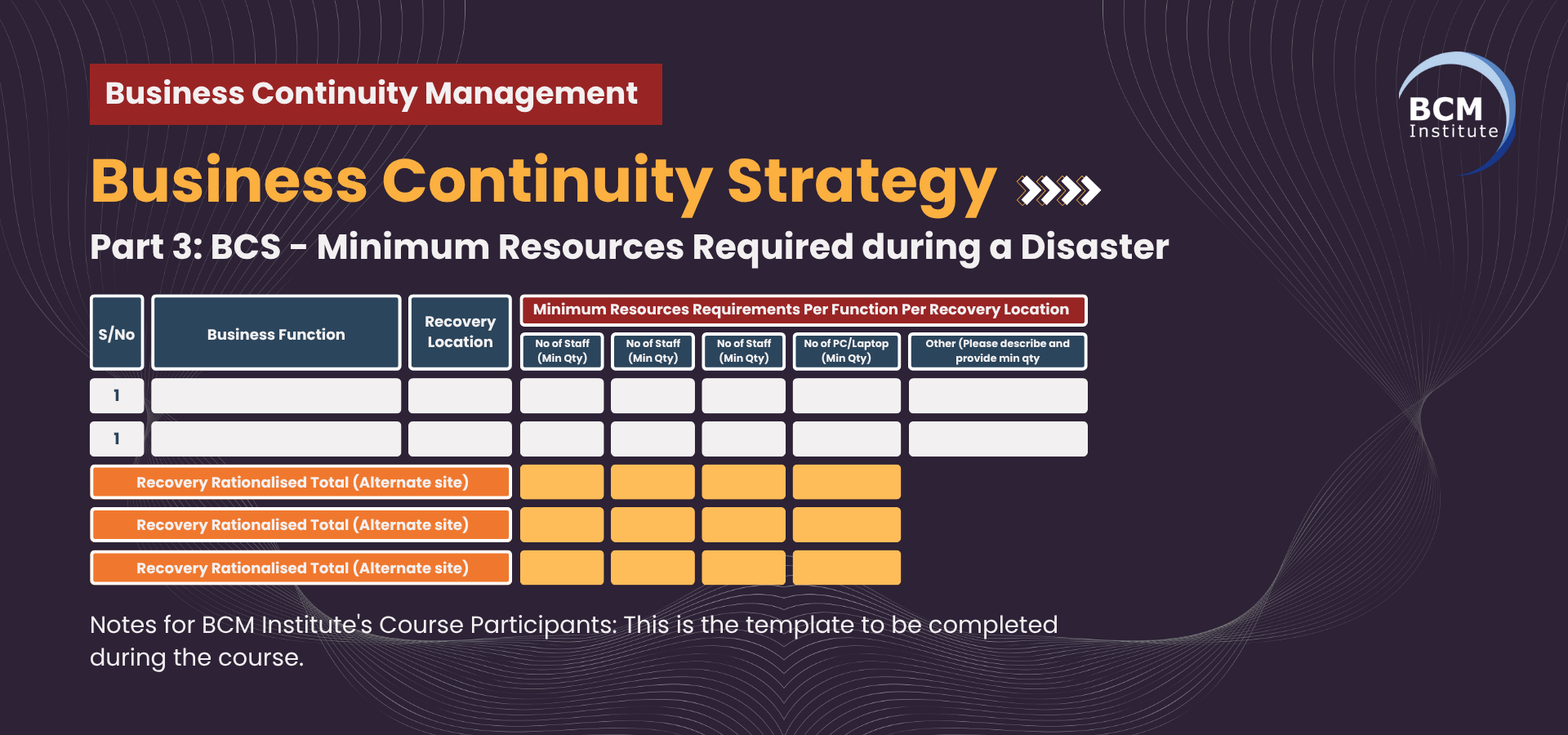
Table BCS P3: Minimum Resources Required during a Disaster for CBF-1 Teaching and Learning Delivery
| Sub-CBF Code | Sub-Critical Business Function | Recovery Location | Minimum Resource Requirements per Function per Recovery Location | Number of Staff (Minimum) | Number of Seats (Minimum) | Number of Telephones (Minimum) | Number of PCs/ Laptops (Minimum) | Other Resources (Description and Minimum Quantity) |
| --- | --- | --- | --- | --- | --- | --- | --- | --- |
| 1.1 | Determine Teaching Delivery Requirements | Remote Working | Academic planning lead and coordinator with access to programme requirements, teaching plans, enrolment information and collaboration systems. | 2 | 2 | 2 | 2 | VPN/secure remote access ×2; collaboration accounts ×2; academic planning repository ×1; secure internet connections ×2 |
| 1.2 | Confirm Subject and Class Offerings | Remote Working | Academic decision-maker and programme administrator with access to curriculum, subject availability, enrolment and timetable information. | 2 | 2 | 2 | 2 | VPN ×2; student/academic administration access ×2; approved subject catalogue ×1; collaboration platform ×1 |
| 1.3 | Determine Student Teaching Demand | Remote Working | An academic administrator with access to enrolment and registration data, and a programme representative to validate priorities. | 2 | 2 | 2 | 2 | Student information system access ×2; VPN ×2; reporting/analytics access ×1; secure internet connections ×2 |
| 1.4 | Allocate Academic Teaching Staff | Remote Working | Academic manager and scheduling coordinator can review staff availability, competency, workload, and replacement options. | 2 | 2 | 2 | 2 | Staff availability register ×1; scheduling system access ×2; VPN ×2; collaboration accounts ×2 |
| 1.5 | Develop and Maintain Teaching Timetable | Remote Working | Timetabling coordinator supported by academic representative with access to timetable, staff, room and class information. | 2 | 2 | 2 | 2 | Timetabling software licences ×2; VPN ×2; room availability data ×1; secure internet ×2 |
| 1.6 | Allocate Teaching Rooms and Facilities | Alternate Office | Facilities/timetabling coordinator and academic representative to prioritise available teaching spaces. | 2 | 2 | 2 | 2 | Facilities/room booking access ×2; emergency room inventory ×1; building access credentials ×2; radio/mobile communications ×2 |
| 1.7 | Prepare Teaching and Learning Materials | Remote Working | Minimum academic staff needed to prepare priority teaching content with access to approved source materials and authoring applications. | 2 | 2 | 2 | 2 | Office/productivity software ×2; cloud/document repository ×1; VPN ×2; secure internet ×2 |
| 1.8 | Publish Digital Learning Materials | Cloud-based Virtual Workplace | Academic staff member and digital-learning/LMS support resource can upload and validate priority materials. | 2 | 2 | 2 | 2 | LMS privileged/user access ×2; MFA tokens ×2; cloud storage ×1; high-speed internet ×2 |
| 1.9 | Prepare Teaching Technology and Classroom Resources | Alternate Office | ICT/AV technician and teaching support resource to configure minimum classroom technology for priority classes. | 2 | 2 | 2 | 2 | Projector/display ×1; conferencing camera ×1; microphone ×1; portable speakers ×1; network kit ×1; spare cables/adapters ×1 kit |
| 1.10 | Deliver Face-to-Face Lectures and Classes | Alternate Office | One lecturer and one teaching/operational support resource for each prioritised teaching session. | 2 | 2 | 1 | 2 | Teaching room ×1; projector/display ×1; lecturer microphone ×1; secure Wi-Fi ×1 service; attendance mechanism ×1 |
| 1.11 | Deliver Online or Remote Teaching | Remote Working | Lecturer supported by an on-call digital learning/ICT capability; only lecturer needs to be continuously assigned. | 1 | 1 | 1 | 1 | Video-conferencing licence ×1; LMS account ×1; headset ×1; webcam ×1; broadband connection ×1; MFA token ×1 |
| 1.12 | Deliver Hybrid Teaching Activities | Alternate Office | Lecturer plus teaching/AV support to maintain simultaneous physical and online delivery. | 2 | 2 | 1 | 2 | Hybrid-enabled room ×1; conferencing camera ×1; microphone system ×1; display/projector ×1; conferencing licence ×1; secure internet ×1 |
| 1.13 | Deliver Tutorials, Workshops and Interactive Learning | Alternate Office | Tutor/facilitator and minimum teaching support where interactive activities cannot be delivered fully online. | 2 | 2 | 1 | 2 | Flexible teaching room ×1; display ×1; collaboration platform ×1; portable teaching kit ×1; secure Wi-Fi ×1 |
| 1.14 | Deliver Laboratory and Practical Teaching | Alternate Specialist Facility | Qualified academic/laboratory instructor plus laboratory technician for priority practical activities that cannot safely be deferred. | 2 | 2 | 1 | 2 | Approved laboratory/practical space ×1; specialist equipment ×1 minimum teaching set; PPE ×1 set per participant; safety equipment ×1 set; first-aid kit ×1 |
| 1.15 | Provide Academic Consultation and Learning Guidance | Remote Working | Academic adviser/lecturer capable of handling priority student consultations remotely. | 1 | 1 | 1 | 1 | Video-conferencing account ×1; headset ×1; student/academic records access ×1; VPN ×1 |
| 1.16 | Monitor Student Attendance and Participation | Remote Working | Academic/administrative resource with access to attendance information and teaching platforms. | 1 | 1 | 1 | 1 | Attendance system/LMS access ×1; VPN ×1; reporting tool ×1; secure internet ×1 |
| 1.17 | Monitor Teaching Delivery and Class Completion | Remote Working | Academic coordinator with consolidated timetable, delivery status and exception-reporting capability. | 1 | 1 | 1 | 1 | Timetable access ×1; teaching status tracker ×1; collaboration platform ×1; VPN ×1 |
| 1.18 | Manage Academic Staff Unavailability | Remote Working | The academic manager and HR/workforce coordinator identify absences, replacements, and teaching priorities. | 2 | 2 | 2 | 2 | Emergency staff contact list ×1; competency/skills register ×1; scheduling access ×2; VPN ×2 |
| 1.19 | Manage Teaching Facility Disruption | Alternate Office | Facilities representative and academic/timetabling coordinator to assess affected rooms and reallocate priority teaching. | 2 | 2 | 2 | 2 | Facilities status dashboard ×1; alternate facility inventory ×1; building plans ×1 set; emergency contact directory ×1 |
| 1.20 | Manage Digital Learning or ICT Disruption | Disaster Recovery Site / Remote Working | ICT incident specialist and digital-learning application specialist to coordinate restoration or workaround for teaching services. | 2 | 2 | 2 | 2 | ICT monitoring access ×2; incident management tool ×1; administrator credentials ×2; MFA tokens ×2; alternate communications channel ×1 |
| 1.21 | Communicate Teaching Changes to Students and Staff | Cloud-based Virtual Workplace | Communications/academic administrator authorised to issue validated teaching disruption information. | 1 | 1 | 1 | 1 | Mass notification platform ×1; email access ×1; LMS announcement capability ×1; approved contact lists ×1; message templates ×1 set |
| 1.22 | Provide Accessible and Alternative Teaching Arrangements | Remote Working | The academic coordinator and accessibility/student-support resource will establish appropriate alternative delivery arrangements. | 2 | 2 | 2 | 2 | Accessibility software licence ×1; video-conferencing accounts ×2; accessible-document tools ×1; student support records access ×1 |
| 1.23 | Prioritise Teaching During Major Disruption | Alternate Office / Remote Working | Senior academic decision-maker and BCM/academic coordination representative to determine recovery priorities and approve changes. | 2 | 2 | 2 | 2 | BIA/BCP access ×1; priority teaching schedule ×1; incident management platform ×1; secure conferencing capability ×1 |
| 1.24 | Recover Missed or Interrupted Teaching | Remote Working / Alternate Office | The academic coordinator and lecturer will schedule and deliver priority replacement teaching using available channels. | 2 | 2 | 1 | 2 | Recovery timetable ×1; LMS access ×2; conferencing licence ×1; alternate room booking access ×1 |
| 1.25 | Reconcile and Confirm Teaching Completion | Remote Working | Academic administrator and programme representative to verify delivery records, outstanding classes and completion status. | 2 | 2 | 1 | 2 | Teaching completion register ×1; timetable/LMS access ×2; reconciliation report ×1; VPN ×2 |
| 1.26 | Return Teaching Operations to Normal | Primary Office | Academic operations coordinator, ICT/facilities representative and academic decision-maker to coordinate controlled transition to normal operations. | 3 | 3 | 2 | 3 | Restoration checklist ×1; incident/action log ×1; facilities status report ×1; ICT service status report ×1; communications platform ×1 |
### **Resource Planning Considerations**
Do not automatically total the values in the table to determine the recovery-site capacity for CBF-1.
Many Sub-CBFs will not operate simultaneously, and individual staff, seats, devices and communications resources can support several activities.
BCM resource planning should therefore determine a **rationalised recovery requirement** based on concurrent activity, recovery sequence, recovery location and the disruption scenario.
This avoids excessive provisioning while ensuring sufficient capability is available when needed.
For example, the same academic coordinator may support timetable maintenance, staff allocation, teaching monitoring and recovery scheduling at different stages of the incident.
Similarly, laptops, alternate-office seats, conferencing facilities and communications devices may be shared across several activities.
The underlying BCM methodology recognises this need to rationalise shared resources instead of treating each function's requirements as automatically cumulative.
#### **People**
Minimum staffing should focus on **roles and competencies rather than named individuals**.
Cross-training and designated alternates should enable a smaller number of multi-skilled personnel to perform several essential activities.
JCUS should identify primary and alternate personnel for critical academic coordination, timetabling, ICT, facilities, student communications and specialist teaching roles.
Give special consideration to activities where competency cannot readily be substituted.
Laboratory teaching, specialist practical instruction, application administration and certain academic decision-making roles may require specifically qualified or authorised personnel.
#### **Workplace and Seats**
Remote working should be the preferred recovery arrangement for activities that do not require physical teaching facilities, provided appropriate security, connectivity and system access are available.
Physical recovery seats should consequently be prioritised for functions requiring on-site coordination, specialist technology or face-to-face delivery.
Treat teaching rooms and laboratories separately from ordinary office seats because their capacity and technical requirements differ substantially.
#### **Technology**
The recovery strategy for Teaching and Learning Delivery depends heavily on technology.
Minimum ICT capability should therefore include secure laptops, internet connectivity, identity and access management, multi-factor authentication, remote access, learning platforms, communications services and collaboration technologies.
Technology requirements should be coordinated with the recovery requirements of the relevant ICT-supported CBFs.
This avoids creating a teaching recovery strategy that assumes applications or infrastructure will be available earlier than their approved ICT recovery targets.
#### **Communications**
During a disruption, communications capability should support both operational coordination and timely notification to students and staff.
Softphones, secure mobile devices, email, collaboration applications and mass-notification capabilities can reduce dependence on dedicated fixed-line telephones.
The telephone quantities shown in the table should consequently be interpreted as the **minimum concurrent communications capability**, rather than a requirement to procure a separate physical telephone for every function.
#### **Specialist Teaching Resources**
Face-to-face, hybrid, laboratory and practical teaching require additional planning because these activities cannot always be transferred directly to remote working.
JCUS should maintain an inventory of priority teaching spaces, portable audiovisual equipment, specialist laboratory equipment, safety resources and potential alternate facilities.
Where specialist resources cannot be economically duplicated, the recovery strategy may instead use rescheduling, prioritisation, temporary substitution, shared facilities, or controlled deferment within the approved MBCO.
#### **Resource Rationalisation**
Once JCUS has established individual Sub-CBF requirements, it should perform a second-stage **resource rationalisation exercise**.
The exercise should identify resources that are:
- dedicated to a single essential activity;
- shared across several Sub-CBFs;
- required simultaneously;
- required only at different recovery stages;
- dependent upon a particular recovery location;
- available through remote working;
- available from another JCUS function or location; or
- dependent on an external provider.
For example, it would be inappropriate to provision 26 separate recovery workspaces simply because 26 Sub-CBFs have been identified.
The actual requirement should reflect the maximum number of activities expected to operate concurrently at the particular recovery location within the applicable recovery time horizon.
The same principle applies to staff.
A small academic recovery team comprising appropriately authorised and cross-trained personnel may initially coordinate several planning, monitoring and communication activities.
Additional academic staff can subsequently be mobilised as teaching capacity increases toward normal operating levels.
#### **Validation of Minimum Resources**
Validate the proposed resource requirements through exercises and actual operational experience.
Tabletop exercises can determine whether decision-making and coordination resources are adequate, while technical recovery exercises can validate remote access, learning platforms, communications and authentication.
Teaching simulations should additionally test whether priority face-to-face, remote and hybrid classes can operate with the minimum proposed staffing and technology configuration.
JCUS should revise the resource baseline whenever there are material changes to:
- student numbers or teaching models;
- academic programmes;
- critical applications or learning platforms;
- campus or teaching facilities;
- staffing structures;
- third-party teaching dependencies;
- BIA recovery requirements;
- recovery strategies;
- ICT architecture; or
- disruption experience and exercise findings.
#### [![Banner \[BCM\] \[E3\] \[BCS\] \[Summing Up\] \[T3\] Minimum Resources Required during a Disaster](https://no-cache.hubspot.com/cta/default/3893111/6cebfa28-ed8a-49d6-8978-797c3a577f9e.png)](https://cta-redirect.hubspot.com/cta/redirect/3893111/6cebfa28-ed8a-49d6-8978-797c3a577f9e)
Identifying minimum recovery resources converts Business Continuity planning from a conceptual recovery strategy into an **executable operational capability**.
For CBF-1 Teaching and Learning Delivery, it establishes the people, workplace, technology, communications and specialist resources that must be available for priority teaching activities to continue at their approved MBCO.
Resource optimisation is essential because disruptive incidents frequently create simultaneous constraints on personnel, facilities, technology and external services.
Allocating normal-operating levels of resources to every activity would be inefficient and may divert scarce recovery capacity from activities with more urgent recovery requirements.
Minimum resource planning therefore enables JCUS to concentrate available capacity on the teaching activities that must be maintained first.
The MBCO, Recovery Strategy, Recovery Location, and Minimum Recovery Resources are directly related.
The MBCO establishes the required minimum service level.
The Recovery Strategy determines how to achieve that service level.
The Recovery Location determines where the recovered activity will operate.
Minimum resource planning then specifies the capacity required to make that arrangement operational.
Consider these requirements alongside the RTO.
Resources required to support early recovery must be available, accessible, and tested within the relevant recovery timeframe.
A resource that exists but cannot be mobilised within the RTO does not provide an effective continuity capability.
For JCUS, documenting these requirements creates a practical basis for preparing alternate workplace arrangements, remote-working capacity, technology recovery, academic staffing contingencies, teaching-facility alternatives and supplier arrangements.
It also enables management to identify resource gaps before an incident occurs rather than discovering them during recovery.
The resulting resource baseline should be maintained as part of the Business Continuity Plan and reviewed following BIA updates, strategy changes, exercises, incidents and significant organisational or technological changes.
Through this approach, JCUS can progressively recover Teaching and Learning Delivery from its MBCO toward normal operating capacity while using scarce recovery resources efficiently and maintaining a structured, risk-based BCM capability consistent with recognised business continuity management principles.
[](https://cta-redirect.hubspot.com/cta/redirect/3893111/3aefb2d2-3110-47c1-ad4f-d3e6e5381066)
[![\[BCM\] \[JCU\] \[3/4 Banner\] Business Continuity Management Implementation at JCU Singapore](https://no-cache.hubspot.com/cta/default/3893111/d81098d9-9f30-4c17-a897-2fc202440adc.png)](https://cta-redirect.hubspot.com/cta/redirect/3893111/d81098d9-9f30-4c17-a897-2fc202440adc)
| **eBook 3: Starting Your BCM Implementation** | | | | | | |
| --- | --- | --- | --- | --- | --- | --- |
| **MBCO** | **P&S** | **RAR T1** | **RAR T2** | **RAR T3** | **BCS T1** | **CBF** |
| [![\[BCM\] \[JCU\] \[E3\] \[BIA\] MBCO Corporate MBCO](https://no-cache.hubspot.com/cta/default/3893111/37db16b1-9a61-4815-adbb-527771b7bd35.png)](https://cta-redirect.hubspot.com/cta/redirect/3893111/37db16b1-9a61-4815-adbb-527771b7bd35) | [![\[BCM\] \[JCU\] \[E3\] \[BIA\] \[PS\] Key Product and Services](https://no-cache.hubspot.com/cta/default/3893111/3117a3bf-33fd-4522-a373-4ce343e253a6.png)](https://cta-redirect.hubspot.com/cta/redirect/3893111/3117a3bf-33fd-4522-a373-4ce343e253a6) | [![\[BCM\] \[JCU\] \[E3\] \[RAR\] \[T1\] List of Threats](https://no-cache.hubspot.com/cta/default/3893111/de614923-e16d-4c4b-878e-60b97f56183f.png)](https://cta-redirect.hubspot.com/cta/redirect/3893111/de614923-e16d-4c4b-878e-60b97f56183f) | [![\[BCM\] \[JCU\] \[E3\] \[RAR\] \[T2\] Treatment and Control](https://no-cache.hubspot.com/cta/default/3893111/71606f66-523b-41e0-af99-19f5e4cc2f37.png)](https://cta-redirect.hubspot.com/cta/redirect/3893111/71606f66-523b-41e0-af99-19f5e4cc2f37) | [![\[BCM\] \[JCU\] \[E3\] \[RAR\] \[T3\] Risk Impact and Likelihood Assessment](https://no-cache.hubspot.com/cta/default/3893111/0192071d-0c49-4a20-a2a8-f0894418f873.png)](https://cta-redirect.hubspot.com/cta/redirect/3893111/0192071d-0c49-4a20-a2a8-f0894418f873) | [![\[BCM\] \[JCU\] \[E3\] \[BCS\] \[T1\] Mitigation Strategies and Justification](https://no-cache.hubspot.com/cta/default/3893111/12b9c723-7ba3-4523-a1c2-0e75dc09a4e3.png)](https://cta-redirect.hubspot.com/cta/redirect/3893111/12b9c723-7ba3-4523-a1c2-0e75dc09a4e3) | [![\[BCM\] \[JCU\] \[E1\] \[C10\] Identifying Critical Business Functions](https://no-cache.hubspot.com/cta/default/3893111/b7aaf4cf-e4f4-4e31-bb8f-6885a5f2203d.png)](https://cta-redirect.hubspot.com/cta/redirect/3893111/b7aaf4cf-e4f4-4e31-bb8f-6885a5f2203d) |
| **CBF-1 Teaching and Learning Delivery** | | | | | | |
| **DP** | **BIAQ P1** | **BIAQ P2** | **BIAQ P3** | **BIAQ P4** | **BIAQ P5** | **BIAQ P6** |
| [![\[BCM\] \[JCU\] \[E3\] \[BIA\] \[DP\] \[CBF\] \[1\] Teaching and Learning Delivery](https://no-cache.hubspot.com/cta/default/3893111/87dc20a3-b9ed-454a-90ee-2ca3e2419322.png)](https://cta-redirect.hubspot.com/cta/redirect/3893111/87dc20a3-b9ed-454a-90ee-2ca3e2419322) | **[![\[BCM\] \[JCU\] \[E3\] \[BIA\] \[T1\] \[CBF\] \[1\] Teaching and Learning Delivery](https://no-cache.hubspot.com/cta/default/3893111/c0d85e4b-2df7-44ee-9c25-4112e99a64f3.png)](https://cta-redirect.hubspot.com/cta/redirect/3893111/c0d85e4b-2df7-44ee-9c25-4112e99a64f3)** | **[![\[BCM\] \[JCU\] \[E3\] \[BIA\] \[T2\] \[CBF\] \[1\] Teaching and Learning Delivery](https://no-cache.hubspot.com/cta/default/3893111/3d5d03b2-0465-4e70-8920-efbaf80a835c.png)](https://cta-redirect.hubspot.com/cta/redirect/3893111/3d5d03b2-0465-4e70-8920-efbaf80a835c)** | **[![\[BCM\] \[JCU\] \[E3\] \[BIA\] \[T3\] \[CBF\] \[1\] Teaching and Learning Delivery](https://no-cache.hubspot.com/cta/default/3893111/4107cc4d-b5ca-486c-bca0-d2a049b8c752.png)](https://cta-redirect.hubspot.com/cta/redirect/3893111/4107cc4d-b5ca-486c-bca0-d2a049b8c752)** | **[![\[BCM\] \[JCU\] \[E3\] \[BIA\] \[T4\] \[CBF\] \[1\] Teaching and Learning Delivery](https://no-cache.hubspot.com/cta/default/3893111/e9bd80ac-aa4d-4da0-873e-92bb036ae9c9.png)](https://cta-redirect.hubspot.com/cta/redirect/3893111/e9bd80ac-aa4d-4da0-873e-92bb036ae9c9)** | **[![\[BCM\] \[JCU\] \[E3\] \[BIA\] \[T5\] \[CBF\] \[1\] Teaching and Learning Delivery](https://no-cache.hubspot.com/cta/default/3893111/7c619369-8c50-4876-a478-749b847adee0.png)](https://cta-redirect.hubspot.com/cta/redirect/3893111/7c619369-8c50-4876-a478-749b847adee0)** | **[![\[BCM\] \[JCU\] \[E3\] \[BIA\] \[T6\] \[CBF\] \[1\] Teaching and Learning Delivery](https://no-cache.hubspot.com/cta/default/3893111/bdb520b6-bc53-40cf-bc72-5e4eb5c2d1ae.png)](https://cta-redirect.hubspot.com/cta/redirect/3893111/bdb520b6-bc53-40cf-bc72-5e4eb5c2d1ae)** |
| | | **BCS T2** | **BCS T3** | **PD** | | |
| | | [![\[BCM\] \[JCU\] \[E3\] \[BCS\] \[T2\] \[CBF\] \[1\] Teaching and Learning Delivery](https://no-cache.hubspot.com/cta/default/3893111/10a04273-213c-4b93-a69a-966039c382bb.png)](https://cta-redirect.hubspot.com/cta/redirect/3893111/10a04273-213c-4b93-a69a-966039c382bb) | [![\[BCM\] \[JCU\] \[E3\] \[BCS\] \[T3\] \[CBF\] \[1\] Teaching and Learning Delivery](https://no-cache.hubspot.com/cta/default/3893111/d2ec73f8-a65d-473f-9a70-afa20ac0b990.png)](https://cta-redirect.hubspot.com/cta/redirect/3893111/d2ec73f8-a65d-473f-9a70-afa20ac0b990) | [![\[BCM\] \[JCU\] \[E3\] \[PD\] \[CBF\] \[1\] Teaching and Learning Delivery](https://no-cache.hubspot.com/cta/default/3893111/41fe68b0-13dc-4690-bd61-369c6da03192.png)](https://cta-redirect.hubspot.com/cta/redirect/3893111/41fe68b0-13dc-4690-bd61-369c6da03192) | | |
| | | | | | | |
#### More Information About Business Continuity Management Courses
To learn more about the course and schedule, click the buttons below for the BCM-300 Business Continuity Management Implementer \[BCM-3\] and the BCM-5000 Business Continuity Management Expert Implementer \[BCM-5\].
| [](https://cta-redirect.hubspot.com/cta/redirect/3893111/f3922b80-e96a-46d6-8993-dc150a5de2d5) | [](https://cta-redirect.hubspot.com/cta/redirect/3893111/9ff8a3dc-e39a-465b-929f-72e232cdd5fb) | [![Register \[BL-B-3\]\*](https://no-cache.hubspot.com/cta/default/3893111/ac6cf073-4cdd-4541-91ed-889f731d5076.png)](https://cta-redirect.hubspot.com/cta/redirect/3893111/ac6cf073-4cdd-4541-91ed-889f731d5076) |
| --- | --- | --- |
| [](https://cta-redirect.hubspot.com/cta/redirect/3893111/21525c10-4003-4934-95fc-fe218174bc5b) | [](https://cta-redirect.hubspot.com/cta/redirect/3893111/46460171-c91a-4936-9bb2-8dc5928a0e02) | [](https://cta-redirect.hubspot.com/cta/redirect/3893111/1cb17ac7-50b2-4f88-bc4b-c7444e4b57b5) |
| [![FAQ \[BL-B-3\]](https://no-cache.hubspot.com/cta/default/3893111/b3824ba1-7aa1-4eb6-bef8-94f57121c5ae.png)](https://cta-redirect.hubspot.com/cta/redirect/3893111/b3824ba1-7aa1-4eb6-bef8-94f57121c5ae) | Please feel free to send us a note if you have any questions. [![Email to Sales Team \[BCM Institute\]](https://no-cache.hubspot.com/cta/default/3893111/3c53daeb-2836-4843-b0e0-645baee2ab9e.png)](https://cta-redirect.hubspot.com/cta/redirect/3893111/3c53daeb-2836-4843-b0e0-645baee2ab9e) | [](https://cta-redirect.hubspot.com/cta/redirect/3893111/9c199ae8-c470-4bb7-9612-73c7a084e94c) |
| [](https://cta-redirect.hubspot.com/cta/redirect/3893111/8999211a-2c51-4be7-bf49-c393f6c67974) | [](https://cta-redirect.hubspot.com/cta/redirect/3893111/5c1aa95d-f6dd-4067-a95c-5cc0c32d7ed8) | [](https://cta-redirect.hubspot.com/cta/redirect/3893111/086ab3b9-4d66-4a95-b2f7-1148e9803a9c) |
#### **Your Comments Here:**
### More Posts
[](https://cta-redirect.hubspot.com/cta/redirect/3893111/839787f4-a4fd-456f-accf-54c947026558)

All rights reserved. Copyright 2026
```json
{
"@context" : "https://schema.org",
"@type" : "BlogPosting",
"author" : {
"@type" : "Person",
"name" : "Dr Goh Moh Heng",
"url" : "https://blog.bcm-institute.org/ebook/author/dr-goh-moh-heng"
},
"dateModified" : "2026-10-02T12:32:07.075Z",
"datePublished" : "2026-10-02T08:50:19.000Z",
"headline" : "[BCM] [JCUS] [E3] [BCS] [T3] [CBF] [1] Teaching and Learning Delivery",
"mainEntityOfPage" : {
"@id" : "https://blog.bcm-institute.org/ebook/bcm-jcus-e3-bcs-t3-cbf-1-teaching-and-learning-delivery",
"@type" : "WebPage"
},
"publisher" : {
"@type" : "Organization",
"logo" : {
"@type" : "ImageObject",
"url" : "https://blog.bcm-institute.org/hubfs/BCMI%20Logo.png"
},
"name" : "BCMI Pte Ltd"
}
}
```