---
title: [BCM] [Damanat] [E3] [BIA] [P1] [CBF] [1] Identification of Sub-Critical Business Functions (Detailed Processes)
description: [BCM] [E3] [Damanat] [BIA] [P1] [CBF] [1] Identification of Sub-Critical Business Functions (Detailed Processes)
image: https://blog.bcm-institute.org/hubfs/Damanat%20Graphic%20Folder/Damanat%20CBF%201%20Morepost/%5BBCM%5D%20%5BDamanat%5D%20%5BE3%5D%20%5BBIA%5D%20%5BT1%5D%20%5BCBF%5D%20%5B1%5D%20Mortgage%20Guarantee%20Origination.jpg
---
. .
[](http://www.bcm-institute.org/)
- [Home](https://www.bcm-institute.org/)
- [About Us](https://www.bcm-institute.org/about-us-3/)
- [A President’s Perspective](https://www.bcm-institute.org/about-us/a-presidents-perspective/)
- [Our History](https://www.bcm-institute.org/about-us/our-history/)
- [Our Advisory Council](https://www.bcm-institute.org/about-us/our-advisory-council/)
- [Customers’ Testimonials](https://www.bcm-institute.org/about-us/customers-testimonials/)
- [Credential Verification](https://www.bcm-institute.org/about-us/credential-verification/)
- [Courses](https://blog.bcm-institute.org/blog/course-fees-for-blended-learning-courses-master-catalog)
- [ISO 22301 Business Continuity Management System Audit](https://blog.bcm-institute.org/audit/business-continuity-management-audit-courses)
- [ISO 22301 Business Continuity Management](https://blog.bcm-institute.org/bcm/business-continuity-management-courses)
- [Crisis Communication](https://blog.bcm-institute.org/crisis-communication/crisis-communication-courses)
- [Crisis Management](https://blog.bcm-institute.org/en/crisis-management/courses)
- [IT Disaster Recovery](https://blog.bcm-institute.org/it-disaster-recovery/courses)
- [Operational Resilience](https://blog.bcm-institute.org/operational-resilience/courses)
- [Operational Resilience Audit](https://blog.bcm-institute.org/operational-resilience-audit/courses)
- [Certification](https://blog.bcm-institute.org/certification/types-of-certifications-offered)
- [ISO 22301 BCMS Audit Certification](https://blog.bcm-institute.org/certification/business-continuity-management-audit-certification)
- [ISO22301 Business Continuity Management Certification](https://blog.bcm-institute.org/bcm/business-continuity-management-certification)
- [Crisis Communication Certification](https://blog.bcm-institute.org/crisis-communication/crisis-communication-certification)
- [Crisis Management Certification](https://blog.bcm-institute.org/en/crisis-management/crisis-management-certification)
- [IT Disaster Recovery Planning Certification](https://blog.bcm-institute.org/it-disaster-recovery/it-disaster-recovery-certification)
- [Operational Resilience Certification](https://blog.bcm-institute.org/operational-resilience/operational-resilience-certification)
- [Operational Resilience Audit Certification](https://blog.bcm-institute.org/operational-resilience-audit)
- [Seminars](https://blog.bcm-institute.org/meet-the-expert/mte-webinar-mainpage)
- [Store](https://www.bcm-institute.org/store-2/)
- [Contact Us](http://www.bcm-institute.org/about-us/contact-us/)
-
-
##### Implementing Business Continuity Management for The Saudi Mortgage Guarantees Services Company: An Enterprise Implementation Guide

# \[BCM\] \[Damanat\] \[E3\] \[BIA\] \[P1\] \[CBF\] \[1\] Identification of Sub-Critical Business Functions (Detailed Processes)
[![\[BCM\] \[Damanat\] \[Full Banner\] Implementing BCM for The Saudi Mortgage Guarantees Services Company](https://no-cache.hubspot.com/cta/default/3893111/221734db-8c33-48bd-8147-fc740eecaf83.png)](https://cta-redirect.hubspot.com/cta/redirect/3893111/221734db-8c33-48bd-8147-fc740eecaf83)
The first stage of a Business Impact Analysis (BIA) is to identify the detailed business functions that collectively enable a Critical Business Function (CBF).
Mortgage Guarantee Origination involves decomposing the end-to-end guarantee process into individual Sub-Critical Business Functions (Sub-CBFs) that can be analysed independently.
This structured approach allows Business Continuity Management (BCM) practitioners to understand how each operational activity contributes to the overall service, identify process dependencies, and determine the consequences of disruption at a granular level.
A key output of this stage is the establishment of the Business Unit Minimum Business Continuity Objective (BU MBCO) for each Sub-CBF.
The BU MBCO defines the minimum level of operational capability that must remain available during a disruption to ensure that the overall Critical Business Function continues to deliver essential services.
Rather than aiming for full operational capacity, the BU MBCO identifies the minimum acceptable service level that meets regulatory obligations, maintains stakeholder confidence, and supports business continuity until normal operations are restored.
### [![Banner \[BCM\] \[E3\] \[BIA\] \[P1\] Identification of Business Functions](https://no-cache.hubspot.com/cta/default/3893111/206ddd7e-615a-42c8-aa2a-3416a1ad06b3.png)](https://cta-redirect.hubspot.com/cta/redirect/3893111/206ddd7e-615a-42c8-aa2a-3416a1ad06b3)
[Dr Goh Moh Heng](https://blog.bcm-institute.org/ebook/author/dr-goh-moh-heng) Jul 20, 2026
###### Business Continuity Management Certified Planner-Specialist-Expert
### [](https://cta-redirect.hubspot.com/cta/redirect/3893111/e63c5a0c-d1f3-4aec-af9d-64741979c92c)
[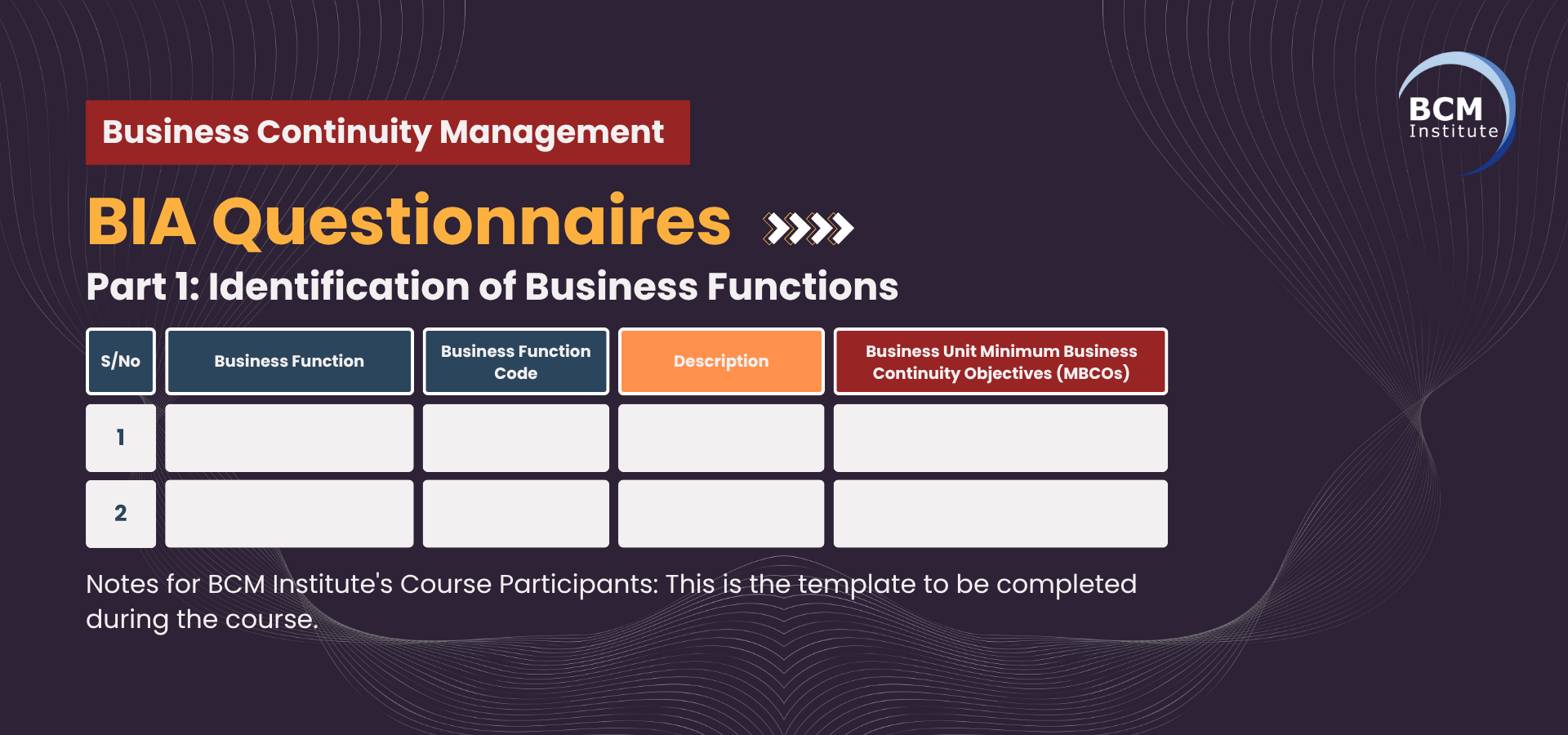](https://cta-redirect.hubspot.com/cta/redirect/3893111/7ca79bbb-3795-4d02-8291-f7f6c33552b4)
### **BIA Part 1: Identification of Sub-Critical Business Functions (Detailed Processes)**
[![Banner \[BCM\] \[E3\] \[BIA\] \[P1\] Identification of Business Functions](https://no-cache.hubspot.com/cta/default/3893111/206ddd7e-615a-42c8-aa2a-3416a1ad06b3.png)](https://cta-redirect.hubspot.com/cta/redirect/3893111/206ddd7e-615a-42c8-aa2a-3416a1ad06b3)
CBF-1 Mortgage Guarantee Origination
[![\[BCM\] \[Damanat\] \[E3\] \[BIA\] \[T1\] \[CBF\] \[1\] Mortgage Guarantee Origination](https://no-cache.hubspot.com/cta/default/3893111/18bd642b-a00d-4b9a-838e-ce92c067a908.png)](https://cta-redirect.hubspot.com/cta/redirect/3893111/18bd642b-a00d-4b9a-838e-ce92c067a908)The first stage of a **Business Impact Analysis (BIA)** is to identify the detailed business functions that collectively enable a Critical Business Function (CBF).
Mortgage Guarantee Origination involves decomposing the end-to-end guarantee process into individual **Sub-Critical Business Functions (Sub-CBFs)** that can be analysed independently.
This structured approach allows Business Continuity Management (BCM) practitioners to understand how each operational activity contributes to the overall service, identify process dependencies, and determine the consequences of disruption at a granular level.
A key output of this stage is the establishment of the **Business Unit Minimum Business Continuity Objective (BU MBCO)** for each Sub-CBF.
The BU MBCO defines the minimum level of operational capability that must remain available during a disruption to ensure that the overall Critical Business Function continues to deliver essential services.
Rather than aiming for full operational capacity, the BU MBCO identifies the minimum acceptable service level that meets regulatory obligations, maintains stakeholder confidence, and supports business continuity until normal operations are restored.
The information developed in this section forms the foundation for subsequent BIA activities, including determining Recovery Time Objectives (RTOs), identifying resource requirements, evaluating operational impacts, selecting appropriate continuity strategies, and developing practical Business Continuity Plans (BCPs).
Together, these outputs strengthen Damanat's ability to maintain essential mortgage guarantee services during disruptive events while supporting its regulatory responsibilities within Saudi Arabia's housing finance sector.
[![Banner \[Table\] \[BCM\] \[E3\] \[BIA\] \[P1\] Identification of Critical Business Functions](https://no-cache.hubspot.com/cta/default/3893111/4fe499c9-0c19-46b4-8b6f-75450dba07d8.png)](https://cta-redirect.hubspot.com/cta/redirect/3893111/4fe499c9-0c19-46b4-8b6f-75450dba07d8)
##### Table BIA P1: Identification of Sub-CBF for CBF-1 Mortgage Guarantee Origination
| Sub-CBF Code | Sub-Critical Business Function | Description of Business Function | Business Unit Minimum Business Continuity Objective (BU MBCO) |
| --- | --- | --- | --- |
| 1.1 | Mortgage Guarantee Application Intake | Receive, register, and acknowledge guarantee applications submitted by participating financial institutions. | Maintain the capability to receive, register, and acknowledge all priority guarantee applications through at least one approved submission channel, with manual registration available if automated systems are unavailable. |
| 1.2 | Application Validation | Verify that submitted applications are complete and contain all mandatory supporting documentation. | Validate all priority applications for completeness and identify missing mandatory documents before progressing to assessment, using manual verification where necessary. |
| 1.3 | Borrower Eligibility Assessment | Assess borrower eligibility against programme rules and guarantee criteria. | Continue assessing high-priority applications to confirm borrower eligibility using essential customer information and approved eligibility criteria. |
| 1.4 | Property Eligibility Assessment | Determine whether the mortgaged property satisfies guarantee programme requirements. | Complete eligibility reviews for priority properties using available valuation and property information to support urgent guarantee decisions. |
| 1.5 | Mortgage Risk Assessment | Evaluate financial, credit, operational, and portfolio risks associated with guarantee applications. | Perform essential risk assessments for priority guarantee applications to support informed approval decisions, while deferring lower-risk analytical activities as needed. |
| 1.6 | Guarantee Policy Compliance Review | Confirm compliance with internal guarantee policies, governance standards, and regulatory requirements. | Maintain the capability to conduct mandatory compliance reviews of all priority guarantee applications prior to approval. |
| 1.7 | Financial Institution Verification | Verify that participating lenders remain authorised and eligible to submit guarantee applications. | Confirm the accreditation status of participating financial institutions for all priority applications using available internal or regulatory records. |
| 1.8 | Guarantee Approval Decision | Obtain authorised approval or rejection of guarantee applications based on completed assessments. | Ensure that delegated approval authorities remain available to make timely decisions on all priority guarantee applications in accordance with established emergency approval procedures. |
| 1.9 | Guarantee Certificate Generation | Produce official mortgage guarantee certificates following approval. | Generate and issue guarantee certificates for approved priority applications using either standard or contingency document-generation processes. |
| 1.10 | Guarantee Registration | Register approved guarantees within enterprise guarantee management systems and official records. | Maintain the capability to record all approved guarantees in an authorised register, including temporary manual records where required for subsequent reconciliation. |
| 1.11 | Stakeholder Notification | Communicate approval, rejection, or requests for additional information regarding guarantees to participating lenders and relevant stakeholders. | Notify participating financial institutions of all priority guarantee decisions through approved communication channels within agreed operational timeframes. |
| 1.12 | Documentation and Record Management | Maintain secure records of guarantee applications, approvals, supporting documents, and audit evidence. | Preserve secure access to essential guarantee records and ensure all priority transactions are documented to maintain auditability and regulatory compliance. |
| 1.13 | Guarantee Fee Administration | Calculate, verify, record, and administer guarantee fees associated with approved guarantees. | Continue calculating and recording guarantee fees for priority transactions, with deferred invoicing or reconciliation permitted where necessary. |
| 1.14 | Post-Issuance Quality Assurance | Review completed guarantee files to verify process quality, accuracy, and compliance. | Conduct quality assurance reviews for high-risk or priority guarantee cases while scheduling routine quality reviews for completion after service stabilisation. |
| 1.15 | Management Reporting and Regulatory Monitoring | Produce operational reports, performance metrics, and regulatory information relating to guarantee origination activities. | Continue producing essential operational and regulatory reports required for executive oversight and regulatory reporting using available operational data. |
[![Banner \[BCM\] \[E3\] \[BIA\] \[Summing Up\] \[P1\] Identification of Critical Business Functions](https://no-cache.hubspot.com/cta/default/3893111/22330ab3-0a0f-4efd-9da7-43032e1e6573.png)](https://cta-redirect.hubspot.com/cta/redirect/3893111/22330ab3-0a0f-4efd-9da7-43032e1e6573)
The identification of Sub-Critical Business Functions provides the detailed operational framework required to conduct an effective Business Impact Analysis (BIA).
By analysing each component of the Mortgage Guarantee Origination process independently, Damanat can better understand process dependencies, assess the impact of disruption, identify critical resources, and prioritise recovery activities based on business importance rather than treating the function as a single operational process.
The Business Unit Minimum Business Continuity Objectives (BU MBCOs) establish the minimum operational capability that each Sub-CBF must maintain during a disruption to ensure that essential mortgage guarantee services continue.
These objectives become key inputs for defining Recovery Time Objectives (RTOs), identifying recovery priorities, selecting appropriate continuity strategies, allocating personnel and technology resources, and developing practical Business Continuity Plans (BCPs).
Together, these outputs enhance operational resilience by ensuring that Damanat can sustain critical mortgage guarantee services, fulfil regulatory obligations, and support the stability of Saudi Arabia's housing finance ecosystem during periods of disruption.
| **eBook 3: Starting Your BCM Implementation** | | | | | | |
| --- | --- | --- | --- | --- | --- | --- |
| **MBCO** | **P&S** | **RAR T1** | **RAR T2** | **RAR T3** | **BCS T1** | ** CBF** |
| [![\[BCM\] \[Damanat\] \[E3\] \[BIA\] MBCO Corporate MBCO](https://no-cache.hubspot.com/cta/default/3893111/be2d62c7-973a-489a-8556-d73428e73448.png)](https://cta-redirect.hubspot.com/cta/redirect/3893111/be2d62c7-973a-489a-8556-d73428e73448) | [![\[BCM\] \[Damanat\] \[E3\] \[BIA\] \[PS\] Key Product and Services](https://no-cache.hubspot.com/cta/default/3893111/db1b84bd-ff7f-4d59-8efb-d610b612a861.png)](https://cta-redirect.hubspot.com/cta/redirect/3893111/db1b84bd-ff7f-4d59-8efb-d610b612a861) | [![\[BCM\] \[Damanat\] \[E3\] \[RAR\] \[T1\] List of Threats](https://no-cache.hubspot.com/cta/default/3893111/3c267477-b524-461e-982d-1218d6bcac5b.png)](https://cta-redirect.hubspot.com/cta/redirect/3893111/3c267477-b524-461e-982d-1218d6bcac5b) | [![\[BCM\] \[Damanat\] \[E3\] \[RAR\] \[T2\] Treatment and Control](https://no-cache.hubspot.com/cta/default/3893111/683192aa-bac0-4658-981a-a392b104aa51.png)](https://cta-redirect.hubspot.com/cta/redirect/3893111/683192aa-bac0-4658-981a-a392b104aa51) | [![\[BCM\] \[Damanat\] \[E3\] \[RAR\] \[T3\] Risk Impact and Likelihood Assessment](https://no-cache.hubspot.com/cta/default/3893111/0cbb6459-eaf8-44bb-8d84-8071cc4c1028.png)](https://cta-redirect.hubspot.com/cta/redirect/3893111/0cbb6459-eaf8-44bb-8d84-8071cc4c1028) | [![\[BCM\] \[Damanat\] \[E3\] \[BCS\] \[T1\] Mitigation Strategies and Justification](https://no-cache.hubspot.com/cta/default/3893111/65dcb68f-d4c9-4517-94f6-8d6df193c7bd.png)](https://cta-redirect.hubspot.com/cta/redirect/3893111/65dcb68f-d4c9-4517-94f6-8d6df193c7bd) | [![BCM\] \[Damanat\] \[E1\] \[C10\] Identifying Critical Business Functions](https://no-cache.hubspot.com/cta/default/3893111/09f61f4b-0a96-4099-90ad-ec4db212874e.png)](https://cta-redirect.hubspot.com/cta/redirect/3893111/09f61f4b-0a96-4099-90ad-ec4db212874e) |
| **CBF-1 Mortgage Guarantee Origination** | | | | | | |
| **DP** | **BIAQ P1** | **BIAQ P2** | **BIAQ P3** | **BIAQ P4** | **BIAQ P5** | **BIAQ P6** |
| [![\[BCM\] \[Damanat\] \[E3\] \[BIA\] \[DP\] \[CBF\] \[1\] Mortgage Guarantee Origination](https://no-cache.hubspot.com/cta/default/3893111/922eb796-9683-4aa6-9471-5ef4862d9578.png)](https://cta-redirect.hubspot.com/cta/redirect/3893111/922eb796-9683-4aa6-9471-5ef4862d9578) | **[![\[BCM\] \[Damanat\] \[E3\] \[BIA\] \[T1\] \[CBF\] \[1\] Mortgage Guarantee Origination](https://no-cache.hubspot.com/cta/default/3893111/18bd642b-a00d-4b9a-838e-ce92c067a908.png)](https://cta-redirect.hubspot.com/cta/redirect/3893111/18bd642b-a00d-4b9a-838e-ce92c067a908)** | **[![\[BCM\] \[Damanat\] \[E3\] \[BIA\] \[T2\] \[CBF\] \[1\] Mortgage Guarantee Origination](https://no-cache.hubspot.com/cta/default/3893111/a00cb0ca-17d9-4d77-b74b-11660784732d.png)](https://cta-redirect.hubspot.com/cta/redirect/3893111/a00cb0ca-17d9-4d77-b74b-11660784732d)** | **[![\[BCM\] \[Damanat\] \[E3\] \[BIA\] \[T3\] \[CBF\] \[1\] Mortgage Guarantee Origination](https://no-cache.hubspot.com/cta/default/3893111/31906e0e-a002-4c91-bced-54501492e3a9.png)](https://cta-redirect.hubspot.com/cta/redirect/3893111/31906e0e-a002-4c91-bced-54501492e3a9)** | **[![\[BCM\] \[Damanat\] \[E3\] \[BIA\] \[T4\] \[CBF\] \[1\] Mortgage Guarantee Origination](https://no-cache.hubspot.com/cta/default/3893111/0b04f274-b2cf-462a-ae6b-9b2ab1a6e3ac.png)](https://cta-redirect.hubspot.com/cta/redirect/3893111/0b04f274-b2cf-462a-ae6b-9b2ab1a6e3ac)** | **[![\[BCM\] \[Damanat\] \[E3\] \[BIA\] \[T5\] \[CBF\] \[1\] Mortgage Guarantee Origination](https://no-cache.hubspot.com/cta/default/3893111/ded68384-4acd-48d2-b207-9636e70d8dd2.png)](https://cta-redirect.hubspot.com/cta/redirect/3893111/ded68384-4acd-48d2-b207-9636e70d8dd2)** | **[![\[BCM\] \[Damanat\] \[E3\] \[BIA\] \[T6\] \[CBF\] \[1\] Mortgage Guarantee Origination](https://no-cache.hubspot.com/cta/default/3893111/44ef6c34-65d4-45fc-9fad-022299a3dadc.png)](https://cta-redirect.hubspot.com/cta/redirect/3893111/44ef6c34-65d4-45fc-9fad-022299a3dadc)** |
| | | **BCS T2** | **BCS T3** | **PD** | | |
| | | [![\[BCM\] \[Damanat\] \[E3\] \[BCS\] \[T2\] \[CBF\] \[1\] Mortgage Guarantee Origination](https://no-cache.hubspot.com/cta/default/3893111/f078ca35-bf4a-4d2f-b39e-69e0576c200d.png)](https://cta-redirect.hubspot.com/cta/redirect/3893111/f078ca35-bf4a-4d2f-b39e-69e0576c200d) | [![\[BCM\] \[Damanat\] \[E3\] \[BCS\] \[T3\] \[CBF\] \[1\] Mortgage Guarantee Origination](https://no-cache.hubspot.com/cta/default/3893111/5156fd60-0fb8-4aaa-b0ba-59b81e84ada6.png)](https://cta-redirect.hubspot.com/cta/redirect/3893111/5156fd60-0fb8-4aaa-b0ba-59b81e84ada6) | [![\[BCM\] \[Damanat\] \[E3\] \[PD\] \[CBF\] \[1\] Mortgage Guarantee Origination](https://no-cache.hubspot.com/cta/default/3893111/a2ccb9fe-5d57-4872-8b20-68759098ee0c.png)](https://cta-redirect.hubspot.com/cta/redirect/3893111/a2ccb9fe-5d57-4872-8b20-68759098ee0c) | | |
| | | | | | | |
#### More Information About Business Continuity Management Courses
To learn more about the course and schedule, click the buttons below for the BCM-300 Business Continuity Management Implementer \[BCM-3\] and the BCM-5000 Business Continuity Management Expert Implementer \[BCM-5\].
| [](https://cta-redirect.hubspot.com/cta/redirect/3893111/f3922b80-e96a-46d6-8993-dc150a5de2d5) | [](https://cta-redirect.hubspot.com/cta/redirect/3893111/9ff8a3dc-e39a-465b-929f-72e232cdd5fb) | [![Register \[BL-B-3\]*](https://no-cache.hubspot.com/cta/default/3893111/ac6cf073-4cdd-4541-91ed-889f731d5076.png)](https://cta-redirect.hubspot.com/cta/redirect/3893111/ac6cf073-4cdd-4541-91ed-889f731d5076) |
| --- | --- | --- |
| [](https://cta-redirect.hubspot.com/cta/redirect/3893111/21525c10-4003-4934-95fc-fe218174bc5b) | [](https://cta-redirect.hubspot.com/cta/redirect/3893111/46460171-c91a-4936-9bb2-8dc5928a0e02) | [](https://cta-redirect.hubspot.com/cta/redirect/3893111/1cb17ac7-50b2-4f88-bc4b-c7444e4b57b5) |
| [![FAQ \[BL-B-3\]](https://no-cache.hubspot.com/cta/default/3893111/b3824ba1-7aa1-4eb6-bef8-94f57121c5ae.png)](https://cta-redirect.hubspot.com/cta/redirect/3893111/b3824ba1-7aa1-4eb6-bef8-94f57121c5ae) | Please feel free to send us a note if you have any questions. [![Email to Sales Team \[BCM Institute\]](https://no-cache.hubspot.com/cta/default/3893111/3c53daeb-2836-4843-b0e0-645baee2ab9e.png)](https://cta-redirect.hubspot.com/cta/redirect/3893111/3c53daeb-2836-4843-b0e0-645baee2ab9e) | [](https://cta-redirect.hubspot.com/cta/redirect/3893111/9c199ae8-c470-4bb7-9612-73c7a084e94c) |
| [](https://cta-redirect.hubspot.com/cta/redirect/3893111/8999211a-2c51-4be7-bf49-c393f6c67974) | [](https://cta-redirect.hubspot.com/cta/redirect/3893111/5c1aa95d-f6dd-4067-a95c-5cc0c32d7ed8) | [](https://cta-redirect.hubspot.com/cta/redirect/3893111/086ab3b9-4d66-4a95-b2f7-1148e9803a9c) |
#### **Your Comments Here:**
### More Posts
[](https://cta-redirect.hubspot.com/cta/redirect/3893111/839787f4-a4fd-456f-accf-54c947026558)

All rights reserved. Copyright 2026
```json
{
"@context" : "https://schema.org",
"@type" : "BlogPosting",
"author" : {
"@type" : "Person",
"name" : "Dr Goh Moh Heng",
"url" : "https://blog.bcm-institute.org/ebook/author/dr-goh-moh-heng"
},
"dateModified" : "2026-07-30T15:32:01.440Z",
"datePublished" : "2026-07-20T08:38:44.000Z",
"headline" : "[BCM] [Damanat] [E3] [BIA] [P1] [CBF] [1] Identification of Sub-Critical Business Functions (Detailed Processes)",
"mainEntityOfPage" : {
"@id" : "https://blog.bcm-institute.org/ebook/bcm-damanat-e3-bia-p1-cbf-1-identification-of-sub-critical-business-functions-detailed-processes",
"@type" : "WebPage"
},
"publisher" : {
"@type" : "Organization",
"logo" : {
"@type" : "ImageObject",
"url" : "https://blog.bcm-institute.org/hubfs/BCMI%20Logo.png"
},
"name" : "BCMI Pte Ltd"
}
}
```