---
title: [BCM] [ALPS] [E3] [BIA] [P1] [CBF] [2] Pharmaceutical Procurement and Supply Management
description: [BCM] [ALPS] [E3] [BIA] [P1] [CBF] [2] Pharmaceutical Procurement and Supply Management
image: https://blog.bcm-institute.org/hubfs/ALPS%20Graphic%20Folder/ALPS%20Morepost/ALPS%20CBF/ALPS%20CBF%202/%5BBCM%5D%20%5BALPS%5D%20%5BE3%5D%20%5BBIA%5D%20%5BT1%5D%20%5BCBF%5D%20%5B2%5D%20Pharmaceutical%20Procurement%20and%20Supply%20Management.jpg
---
. .
[](http://www.bcm-institute.org/)
- [Home](https://www.bcm-institute.org/)
- [About Us](https://www.bcm-institute.org/about-us-3/)
- [A President’s Perspective](https://www.bcm-institute.org/about-us/a-presidents-perspective/)
- [Our History](https://www.bcm-institute.org/about-us/our-history/)
- [Our Advisory Council](https://www.bcm-institute.org/about-us/our-advisory-council/)
- [Customers’ Testimonials](https://www.bcm-institute.org/about-us/customers-testimonials/)
- [Credential Verification](https://www.bcm-institute.org/about-us/credential-verification/)
- [Courses](https://blog.bcm-institute.org/blog/course-fees-for-blended-learning-courses-master-catalog)
- [ISO 22301 Business Continuity Management System Audit](https://blog.bcm-institute.org/audit/business-continuity-management-audit-courses)
- [ISO 22301 Business Continuity Management](https://blog.bcm-institute.org/bcm/business-continuity-management-courses)
- [Crisis Communication](https://blog.bcm-institute.org/crisis-communication/crisis-communication-courses)
- [Crisis Management](https://blog.bcm-institute.org/en/crisis-management/courses)
- [IT Disaster Recovery](https://blog.bcm-institute.org/it-disaster-recovery/courses)
- [Operational Resilience](https://blog.bcm-institute.org/operational-resilience/courses)
- [Operational Resilience Audit](https://blog.bcm-institute.org/operational-resilience-audit/courses)
- [Certification](https://blog.bcm-institute.org/certification/types-of-certifications-offered)
- [ISO 22301 BCMS Audit Certification](https://blog.bcm-institute.org/certification/business-continuity-management-audit-certification)
- [ISO22301 Business Continuity Management Certification](https://blog.bcm-institute.org/bcm/business-continuity-management-certification)
- [Crisis Communication Certification](https://blog.bcm-institute.org/crisis-communication/crisis-communication-certification)
- [Crisis Management Certification](https://blog.bcm-institute.org/en/crisis-management/crisis-management-certification)
- [IT Disaster Recovery Planning Certification](https://blog.bcm-institute.org/it-disaster-recovery/it-disaster-recovery-certification)
- [Operational Resilience Certification](https://blog.bcm-institute.org/operational-resilience/operational-resilience-certification)
- [Operational Resilience Audit Certification](https://blog.bcm-institute.org/operational-resilience-audit)
- [Seminars](https://blog.bcm-institute.org/meet-the-expert/mte-webinar-mainpage)
- [Store](https://www.bcm-institute.org/store-2/)
- [Contact Us](http://www.bcm-institute.org/about-us/contact-us/)
-
-
##### **Implementing Business Continuity Management for ALPS Healthcare: An Enterprise Implementation Guide**

# \[BCM\] \[ALPS\] \[E3\] \[BIA\] \[P1\] \[CBF\] \[2\] Pharmaceutical Procurement and Supply Management
[![\[BCM\] \[ALPS\] \[Full Banner\] Implementing Business Continuity Management for ALPS Healthcare](https://no-cache.hubspot.com/cta/default/3893111/a577c05a-ab89-4043-9a89-1dea0d883afc.png)](https://cta-redirect.hubspot.com/cta/redirect/3893111/a577c05a-ab89-4043-9a89-1dea0d883afc)
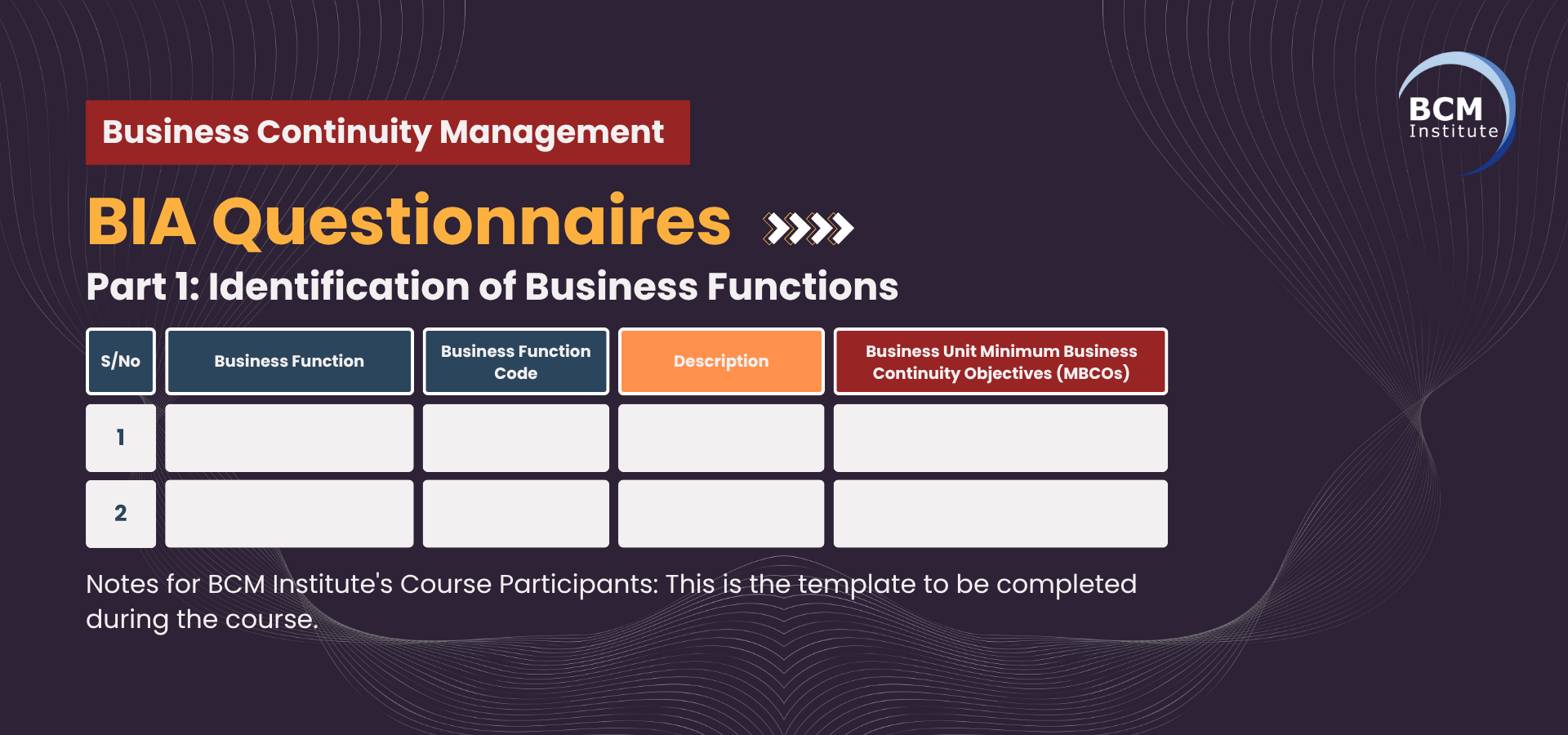
Business Impact Analysis (BIA) begins by identifying the detailed business functions that collectively deliver a Critical Business Function (CBF).
In Pharmaceutical Procurement and Supply Management, this involves decomposing the end-to-end procurement lifecycle into individual operational activities that can be analysed independently for their importance, dependencies, recovery priorities, and operational impacts.
This level of detail enables ALPS Healthcare to understand precisely where disruptions may occur and how they could affect the availability of medicines and pharmaceutical products supporting Singapore's public healthcare system.
An equally important component of the BIA is establishing **Business Unit Minimum Business Continuity Objectives (BU MBCOs)**.
### [![Banner \[BCM\] \[E3\] \[BIA\] \[P1\] Identification of Business Functions](https://no-cache.hubspot.com/cta/default/3893111/206ddd7e-615a-42c8-aa2a-3416a1ad06b3.png)](https://cta-redirect.hubspot.com/cta/redirect/3893111/206ddd7e-615a-42c8-aa2a-3416a1ad06b3)
[Dr Goh Moh Heng](https://blog.bcm-institute.org/ebook/author/dr-goh-moh-heng) Aug 5, 2026
###### Business Continuity Management Certified Planner-Specialist-Expert
### [![\[BCM\] \[ALPS\] Legal Disclaimer Banner](https://no-cache.hubspot.com/cta/default/3893111/eb6856d2-cbb2-4a76-b237-7bd842e84226.png)](https://cta-redirect.hubspot.com/cta/redirect/3893111/eb6856d2-cbb2-4a76-b237-7bd842e84226)
[](https://cta-redirect.hubspot.com/cta/redirect/3893111/7ca79bbb-3795-4d02-8291-f7f6c33552b4)
[![Banner \[BCM\] \[E3\] \[BIA\] \[P1\] Identification of Business Functions](https://no-cache.hubspot.com/cta/default/3893111/206ddd7e-615a-42c8-aa2a-3416a1ad06b3.png)](https://cta-redirect.hubspot.com/cta/redirect/3893111/206ddd7e-615a-42c8-aa2a-3416a1ad06b3)
### CBF-2 Pharmaceutical Procurement and Supply Management
[![\[BCM\] \[ALPS\] \[E3\] \[BIA\] \[T1\] \[CBF\] \[2\] Pharmaceutical Procurement and Supply Management](https://no-cache.hubspot.com/cta/default/3893111/a44633ed-d5cd-446e-be5f-075dbb65247c.png)](https://cta-redirect.hubspot.com/cta/redirect/3893111/a44633ed-d5cd-446e-be5f-075dbb65247c)
Business Impact Analysis (BIA) begins by identifying the detailed business functions that collectively deliver a Critical Business Function (CBF).
In Pharmaceutical Procurement and Supply Management, this involves decomposing the end-to-end procurement lifecycle into individual operational activities that can be analysed independently for their importance, dependencies, recovery priorities, and operational impacts.
This level of detail enables ALPS Healthcare to understand precisely where disruptions may occur and how they could affect the availability of medicines and pharmaceutical products supporting Singapore's public healthcare system.
An equally important component of the BIA is establishing **Business Unit Minimum Business Continuity Objectives (BU MBCOs)**.
A BU MBCO defines the minimum operational capability that each Sub-Critical Business Function must maintain during a disruption to ensure that essential pharmaceutical procurement activities continue.
Rather than restoring full operational capacity immediately, the objective is to sustain critical services at an acceptable level until normal operations can be progressively resumed. These minimum service levels provide measurable operational targets for business units during crises.
The identification of Sub-Critical Business Functions and their corresponding BU MBCOs forms the foundation for subsequent BCM activities. They support the determination of Recovery Time Objectives (RTOs), resource prioritisation, continuity strategy development, recovery procedures, supplier contingency planning, and Business Continuity Plan (BCP) development.
They also strengthen ALPS Healthcare's operational resilience by ensuring that critical pharmaceutical procurement capabilities remain available during disruptive events.
[![Banner \[Table\] \[BCM\] \[E3\] \[BIA\] \[P1\] Identification of Critical Business Functions](https://no-cache.hubspot.com/cta/default/3893111/4fe499c9-0c19-46b4-8b6f-75450dba07d8.png)](https://cta-redirect.hubspot.com/cta/redirect/3893111/4fe499c9-0c19-46b4-8b6f-75450dba07d8)
Table P1: Critical Business Functions for CBF-2
| Sub-CBF Code | Sub-Critical Business Function | Description of Business Function | Business Unit Minimum Business Continuity Objective (BU MBCO) |
| --- | --- | --- | --- |
| CBF-2.1 | Pharmaceutical Demand Forecasting | Forecast demand for medicines using consumption trends, clinical requirements, epidemiological data, and inventory information. | Maintain the ability to produce demand forecasts for all life-saving and essential medicines, with updates at least once every 24 hours during a disruption. |
| CBF-2.2 | Pharmaceutical Requirements Planning | Consolidate demand from healthcare institutions and develop procurement plans. | Continue planning for priority pharmaceuticals supporting critical clinical services while deferring non-essential procurement activities. |
| CBF-2.3 | Approved Drug Catalogue Management | Maintain and update the approved pharmaceutical catalogue used for procurement. | Ensure authorised users can access the latest approved catalogue and update urgent additions or withdrawals within one business day. |
| CBF-2.4 | Supplier Qualification and Evaluation | Assess suppliers against quality, financial, regulatory, and operational criteria. | Maintain qualification assessments for suppliers supporting essential medicines and critical healthcare services while postponing non-urgent supplier evaluations. |
| CBF-2.5 | Pharmaceutical Tender and Sourcing Management | Conduct procurement sourcing exercises and evaluate supplier proposals. | Continue sourcing activities only for pharmaceuticals with immediate supply risks or critical shortages requiring urgent procurement. |
| CBF-2.6 | Contract and Pricing Management | Manage pharmaceutical procurement contracts, pricing agreements, and commercial terms. | Maintain access to active contracts and approve urgent contract amendments required to sustain essential medicine supply. |
| CBF-2.7 | Purchase Order Processing | Generate, approve, issue, and monitor pharmaceutical purchase orders. | Process and approve all purchase orders for priority medicines within agreed emergency procurement timelines while deferring routine orders where appropriate. |
| CBF-2.8 | Regulatory and Product Compliance Verification | Verify compliance with applicable regulatory approvals, licences, and pharmaceutical quality requirements. | Continue regulatory verification for all pharmaceuticals supporting patient treatment before procurement approval is granted. |
| CBF-2.9 | Pharmaceutical Supply Scheduling | Coordinate supplier production, shipment schedules, and delivery planning. | Maintain delivery schedules for essential medicines with daily coordination of suppliers and logistics providers. |
| CBF-2.10 | Pharmaceutical Receipt and Inspection Coordination | Coordinate receipt, documentation verification, and inspection of incoming pharmaceutical shipments. | Continue receiving and verifying all deliveries of critical pharmaceuticals within the same operational day to prevent treatment delays. |
| CBF-2.11 | Cold Chain and Controlled Storage Coordination | Manage temperature-controlled storage and handling of pharmaceutical products. | Maintain continuous temperature monitoring and compliant storage for all cold-chain pharmaceuticals with no interruption to environmental controls. |
| CBF-2.12 | Pharmaceutical Inventory Replenishment | Monitor stock levels and initiate replenishment of pharmaceutical inventory. | Maintain inventory levels above predefined emergency safety stock thresholds for all essential medicines. |
| CBF-2.13 | Drug Shortage Monitoring and Mitigation | Monitor medicine shortages and coordinate alternative sourcing or substitution strategies. | Continue monitoring critical medicine availability and implement alternative sourcing or substitution plans within the same business day when shortages are identified. |
| CBF-2.14 | Supplier Performance Management | Monitor supplier delivery, quality, responsiveness, and contractual performance. | Continue monitoring suppliers supporting essential medicines and escalate any supplier performance issues affecting continuity within four hours of identification. |
| CBF-2.15 | Pharmaceutical Recall Coordination | Coordinate pharmaceutical recalls, product quarantine, and stakeholder communication. | Maintain the capability to identify, isolate, and communicate recalls of affected pharmaceutical products immediately upon notification. |
| CBF-2.16 | Procurement Risk Monitoring | Monitor procurement risks including geopolitical events, supply disruptions, transportation issues, and supplier risks. | Continue daily monitoring of procurement risks affecting essential medicine availability and escalate significant threats to management without delay. |
| CBF-2.17 | Pharmaceutical Procurement Information Management | Maintain procurement documentation, supplier records, contracts, audit trails, and procurement data. | Ensure continuous access to essential procurement records, supplier documentation, and active contracts necessary to support emergency procurement decisions. |
| CBF-2.18 | Pharmaceutical Procurement Reporting and Governance | Produce procurement reports, compliance information, management dashboards, and governance documentation. | Continue producing operational reports on medicine availability, procurement status, supplier risks, and significant disruptions for senior management at least once daily during major incidents. |
[![Banner \[BCM\] \[E3\] \[BIA\] \[Summing Up\] \[P1\] Identification of Critical Business Functions](https://no-cache.hubspot.com/cta/default/3893111/22330ab3-0a0f-4efd-9da7-43032e1e6573.png)](https://cta-redirect.hubspot.com/cta/redirect/3893111/22330ab3-0a0f-4efd-9da7-43032e1e6573)
The identification of detailed **Sub-Critical Business Functions** provides ALPS Healthcare with a structured understanding of the operational activities that collectively enable **Pharmaceutical Procurement and Supply Management**.
By breaking the Critical Business Function into manageable business processes, the Business Impact Analysis can evaluate each activity individually, identify critical dependencies, determine operational impacts, and assess the consequences of disruption across the pharmaceutical supply chain.
The establishment of **Business Unit Minimum Business Continuity Objectives (BU MBCOs)** defines the minimum operational capability that each Sub-Critical Business Function must sustain during a disruption.
These objectives provide measurable service levels that enable business units to prioritise essential pharmaceutical procurement activities, maintain the availability of critical medicines, preserve regulatory compliance, and support uninterrupted healthcare delivery while operating under constrained conditions.
Together, the identified Sub-Critical Business Functions and their BU MBCOs form the foundation for determining **Recovery Time Objectives (RTOs)**, developing continuity and recovery strategies, prioritising critical resources, preparing Business Continuity Plans (BCPs), and strengthening operational resilience.
They enable ALPS Healthcare to make informed recovery decisions, allocate resources effectively, and ensure that essential pharmaceutical procurement capabilities remain available to support Singapore's public healthcare system during disruptive events.
[](https://cta-redirect.hubspot.com/cta/redirect/3893111/3aefb2d2-3110-47c1-ad4f-d3e6e5381066)
[![\[BCM\] \[ALPS\] \[3/4 Banner\] Implementing Business Continuity Management for ALPS Healthcare](https://no-cache.hubspot.com/cta/default/3893111/5bb3d163-ccf4-4942-8e51-90cb0e0de84f.png)](https://cta-redirect.hubspot.com/cta/redirect/3893111/5bb3d163-ccf4-4942-8e51-90cb0e0de84f)
| **eBook 3: Starting Your BCM Implementation** | | | | | | |
| --- | --- | --- | --- | --- | --- | --- |
| **MBCO** | **P&S** | **RAR T1** | **RAR T2** | **RAR T3** | **BCS T1** | **CBF** |
| [![\[BCM\] \[ALPS\] \[E3\] \[BIA\] MBCO Corporate MBCO](https://no-cache.hubspot.com/cta/default/3893111/3e0b35d2-08b6-4caf-b7db-144625ec8145.png)](https://cta-redirect.hubspot.com/cta/redirect/3893111/3e0b35d2-08b6-4caf-b7db-144625ec8145) | [![\[BCM\] \[ALPS\] \[E3\] \[BIA\] \[PS\] Key Product and Services](https://no-cache.hubspot.com/cta/default/3893111/ab611654-bce2-450c-affc-3970de6c8909.png)](https://cta-redirect.hubspot.com/cta/redirect/3893111/ab611654-bce2-450c-affc-3970de6c8909) | [![\[BCM\] \[ALPS\] \[E3\] \[RAR\] \[T1\] List of Threats](https://no-cache.hubspot.com/cta/default/3893111/806c27e6-1db5-42a2-ac84-e0df3624bc49.png)](https://cta-redirect.hubspot.com/cta/redirect/3893111/806c27e6-1db5-42a2-ac84-e0df3624bc49) | [![\[BCM\] \[ALPS\] \[E3\] \[RAR\] \[T2\] Treatment and Control](https://no-cache.hubspot.com/cta/default/3893111/bf6da142-014d-4c47-83cf-f31e0c55b75e.png)](https://cta-redirect.hubspot.com/cta/redirect/3893111/bf6da142-014d-4c47-83cf-f31e0c55b75e) | [![\[BCM\] \[ALPS\] \[E3\] \[RAR\] \[T3\] Risk Impact and Likelihood Assessment](https://no-cache.hubspot.com/cta/default/3893111/4c14572c-2ed4-46aa-82c8-5ead8fd31ced.png)](https://cta-redirect.hubspot.com/cta/redirect/3893111/4c14572c-2ed4-46aa-82c8-5ead8fd31ced) | [![\[BCM\] \[ALPS\] \[E3\] \[BCS\] \[T1\] Mitigation Strategies and Justification](https://no-cache.hubspot.com/cta/default/3893111/25548d11-adb7-4e6e-9a5a-054db2ea377d.png)](https://cta-redirect.hubspot.com/cta/redirect/3893111/25548d11-adb7-4e6e-9a5a-054db2ea377d) | [![\[BCM\] \[ALPS\] \[E1\] \[C10\] Identifying Critical Business Functions](https://no-cache.hubspot.com/cta/default/3893111/94f8b16c-55da-4543-a948-448f2241296e.png)](https://cta-redirect.hubspot.com/cta/redirect/3893111/94f8b16c-55da-4543-a948-448f2241296e) |
| **CBF-2 Pharmaceutical Procurement and Supply Management** | | | | | | |
| **DP** | **BIAQ P1** | **BIAQ P2** | **BIAQ P3** | **BIAQ P4** | **BIAQ P5** | **BIAQ P6** |
| [![\[BCM\] \[ALPS\] \[E3\] \[BIA\] \[DP\] \[CBF\] \[2\] Pharmaceutical Procurement and Supply Management](https://no-cache.hubspot.com/cta/default/3893111/14fb1541-5073-4293-a4b3-76e57b0b5956.png)](https://cta-redirect.hubspot.com/cta/redirect/3893111/14fb1541-5073-4293-a4b3-76e57b0b5956) | [![\[BCM\] \[ALPS\] \[E3\] \[BIA\] \[T1\] \[CBF\] \[2\] Pharmaceutical Procurement and Supply Management](https://no-cache.hubspot.com/cta/default/3893111/a44633ed-d5cd-446e-be5f-075dbb65247c.png)](https://cta-redirect.hubspot.com/cta/redirect/3893111/a44633ed-d5cd-446e-be5f-075dbb65247c) | [![\[BCM\] \[ALPS\] \[E3\] \[BIA\] \[T2\] \[CBF\] \[2\] Pharmaceutical Procurement and Supply Management](https://no-cache.hubspot.com/cta/default/3893111/10661937-edb5-459e-b9fd-07209caac51f.png)](https://cta-redirect.hubspot.com/cta/redirect/3893111/10661937-edb5-459e-b9fd-07209caac51f) | [![\[BCM\] \[ALPS\] \[E3\] \[BIA\] \[T3\] \[CBF\] \[2\] Pharmaceutical Procurement and Supply Management](https://no-cache.hubspot.com/cta/default/3893111/5171d0b5-976b-445f-9e43-a4e588e823f0.png)](https://cta-redirect.hubspot.com/cta/redirect/3893111/5171d0b5-976b-445f-9e43-a4e588e823f0) | [![\[BCM\] \[ALPS\] \[E3\] \[BIA\] \[T4\] \[CBF\] \[2\] Pharmaceutical Procurement and Supply Management](https://no-cache.hubspot.com/cta/default/3893111/34c325a5-f352-4a73-abe3-e665d504d71f.png)](https://cta-redirect.hubspot.com/cta/redirect/3893111/34c325a5-f352-4a73-abe3-e665d504d71f) | [![\[BCM\] \[ALPS\] \[E3\] \[BIA\] \[T5\] \[CBF\] \[2\] Pharmaceutical Procurement and Supply Management](https://no-cache.hubspot.com/cta/default/3893111/0bcf5a3a-4abf-4f74-b32d-fe90a6f667cc.png)](https://cta-redirect.hubspot.com/cta/redirect/3893111/0bcf5a3a-4abf-4f74-b32d-fe90a6f667cc) | [![\[BCM\] \[ALPS\] \[E3\] \[BIA\] \[T6\] \[CBF\] \[2\] Pharmaceutical Procurement and Supply Management](https://no-cache.hubspot.com/cta/default/3893111/b0445693-282e-4078-bb82-d359cdc7f389.png)](https://cta-redirect.hubspot.com/cta/redirect/3893111/b0445693-282e-4078-bb82-d359cdc7f389) |
| | | **BCS T2** | **BCS T3** | **PD** | | |
| | | [![\[BCM\] \[ALPS\] \[E3\] \[BCS\] \[T2\] \[CBF\] \[2\] Pharmaceutical Procurement and Supply Management](https://no-cache.hubspot.com/cta/default/3893111/e0edaf2d-dbbe-4690-a580-2e64966100e7.png)](https://cta-redirect.hubspot.com/cta/redirect/3893111/e0edaf2d-dbbe-4690-a580-2e64966100e7) | [![\[BCM\] \[ALPS\] \[E3\] \[BCS\] \[T3\] \[CBF\] \[2\] Pharmaceutical Procurement and Supply Management](https://no-cache.hubspot.com/cta/default/3893111/39abeb9e-931e-4f0e-a6b4-4d24f339ed63.png)](https://cta-redirect.hubspot.com/cta/redirect/3893111/39abeb9e-931e-4f0e-a6b4-4d24f339ed63) | [![\[BCM\] \[ALPS\] \[E3\] \[PD\] \[CBF\] \[2\] Pharmaceutical Procurement and Supply Management](https://no-cache.hubspot.com/cta/default/3893111/963ac068-f245-4af5-9eed-ba5ecbbff753.png)](https://cta-redirect.hubspot.com/cta/redirect/3893111/963ac068-f245-4af5-9eed-ba5ecbbff753) | | |
| | | | | | | |
#### More Information About Business Continuity Management Courses
To learn more about the course and schedule, click the buttons below for the BCM-300 Business Continuity Management Implementer \[BCM-3\] and the BCM-5000 Business Continuity Management Expert Implementer \[BCM-5\].
| [](https://cta-redirect.hubspot.com/cta/redirect/3893111/f3922b80-e96a-46d6-8993-dc150a5de2d5) | [](https://cta-redirect.hubspot.com/cta/redirect/3893111/9ff8a3dc-e39a-465b-929f-72e232cdd5fb) | [![Register \[BL-B-3\]\*](https://no-cache.hubspot.com/cta/default/3893111/ac6cf073-4cdd-4541-91ed-889f731d5076.png)](https://cta-redirect.hubspot.com/cta/redirect/3893111/ac6cf073-4cdd-4541-91ed-889f731d5076) |
| --- | --- | --- |
| [](https://cta-redirect.hubspot.com/cta/redirect/3893111/21525c10-4003-4934-95fc-fe218174bc5b) | [](https://cta-redirect.hubspot.com/cta/redirect/3893111/46460171-c91a-4936-9bb2-8dc5928a0e02) | [](https://cta-redirect.hubspot.com/cta/redirect/3893111/1cb17ac7-50b2-4f88-bc4b-c7444e4b57b5) |
| [![FAQ \[BL-B-3\]](https://no-cache.hubspot.com/cta/default/3893111/b3824ba1-7aa1-4eb6-bef8-94f57121c5ae.png)](https://cta-redirect.hubspot.com/cta/redirect/3893111/b3824ba1-7aa1-4eb6-bef8-94f57121c5ae) | Please feel free to send us a note if you have any questions. [![Email to Sales Team \[BCM Institute\]](https://no-cache.hubspot.com/cta/default/3893111/3c53daeb-2836-4843-b0e0-645baee2ab9e.png)](https://cta-redirect.hubspot.com/cta/redirect/3893111/3c53daeb-2836-4843-b0e0-645baee2ab9e) | [](https://cta-redirect.hubspot.com/cta/redirect/3893111/9c199ae8-c470-4bb7-9612-73c7a084e94c) |
| [](https://cta-redirect.hubspot.com/cta/redirect/3893111/8999211a-2c51-4be7-bf49-c393f6c67974) | [](https://cta-redirect.hubspot.com/cta/redirect/3893111/5c1aa95d-f6dd-4067-a95c-5cc0c32d7ed8) | [](https://cta-redirect.hubspot.com/cta/redirect/3893111/086ab3b9-4d66-4a95-b2f7-1148e9803a9c) |
#### **Your Comments Here:**
### More Posts
[](https://cta-redirect.hubspot.com/cta/redirect/3893111/839787f4-a4fd-456f-accf-54c947026558)

All rights reserved. Copyright 2026
```json
{
"@context" : "https://schema.org",
"@type" : "BlogPosting",
"author" : {
"@type" : "Person",
"name" : "Dr Goh Moh Heng",
"url" : "https://blog.bcm-institute.org/ebook/author/dr-goh-moh-heng"
},
"dateModified" : "2026-08-06T01:57:27.483Z",
"datePublished" : "2026-08-05T09:57:53.000Z",
"headline" : "[BCM] [ALPS] [E3] [BIA] [P1] [CBF] [2] Pharmaceutical Procurement and Supply Management",
"mainEntityOfPage" : {
"@id" : "https://blog.bcm-institute.org/ebook/bcm-alps-e3-bia-p1-cbf-2-pharmaceutical-procurement-and-supply-management",
"@type" : "WebPage"
},
"publisher" : {
"@type" : "Organization",
"logo" : {
"@type" : "ImageObject",
"url" : "https://blog.bcm-institute.org/hubfs/BCMI%20Logo.png"
},
"name" : "BCMI Pte Ltd"
}
}
```