---
title: [BCM] [ALPS] [E2] [C8] Program Management
description: [BCM] [ALPS] [E2] [C8] Program Management
image: https://blog.bcm-institute.org/hubfs/ALPS%20Graphic%20Folder/ALPS%20Morepost/ALPS%20E2%20Morepost/%5BBCM%5D%20%5BGRA%5D%20%5BE2%5D%20%5BC8%5D%20Program%20Management.jpg
---
.
[](http://www.bcm-institute.org/)
- [Home](https://www.bcm-institute.org/)
- [About Us](https://www.bcm-institute.org/about-us-3/)
- [A President’s Perspective](https://www.bcm-institute.org/about-us/a-presidents-perspective/)
- [Our History](https://www.bcm-institute.org/about-us/our-history/)
- [Our Advisory Council](https://www.bcm-institute.org/about-us/our-advisory-council/)
- [Customers’ Testimonials](https://www.bcm-institute.org/about-us/customers-testimonials/)
- [Credential Verification](https://www.bcm-institute.org/about-us/credential-verification/)
- [Courses](https://blog.bcm-institute.org/blog/course-fees-for-blended-learning-courses-master-catalog)
- [ISO 22301 Business Continuity Management System Audit](https://blog.bcm-institute.org/audit/business-continuity-management-audit-courses)
- [ISO 22301 Business Continuity Management](https://blog.bcm-institute.org/bcm/business-continuity-management-courses)
- [Crisis Communication](https://blog.bcm-institute.org/crisis-communication/crisis-communication-courses)
- [Crisis Management](https://blog.bcm-institute.org/en/crisis-management/courses)
- [IT Disaster Recovery](https://blog.bcm-institute.org/it-disaster-recovery/courses)
- [Operational Resilience](https://blog.bcm-institute.org/operational-resilience/courses)
- [Operational Resilience Audit](https://blog.bcm-institute.org/operational-resilience-audit/courses)
- [Certification](https://blog.bcm-institute.org/certification/types-of-certifications-offered)
- [ISO 22301 BCMS Audit Certification](https://blog.bcm-institute.org/certification/business-continuity-management-audit-certification)
- [ISO22301 Business Continuity Management Certification](https://blog.bcm-institute.org/bcm/business-continuity-management-certification)
- [Crisis Communication Certification](https://blog.bcm-institute.org/crisis-communication/crisis-communication-certification)
- [Crisis Management Certification](https://blog.bcm-institute.org/en/crisis-management/crisis-management-certification)
- [IT Disaster Recovery Planning Certification](https://blog.bcm-institute.org/it-disaster-recovery/it-disaster-recovery-certification)
- [Operational Resilience Certification](https://blog.bcm-institute.org/operational-resilience/operational-resilience-certification)
- [Operational Resilience Audit Certification](https://blog.bcm-institute.org/operational-resilience-audit)
- [Seminars](https://blog.bcm-institute.org/meet-the-expert/mte-webinar-mainpage)
- [Store](https://www.bcm-institute.org/store-2/)
- [Contact Us](http://www.bcm-institute.org/about-us/contact-us/)
-
-
##### **Implementing Business Continuity Management for ALPS Healthcare: An Enterprise Implementation Guide**

# \[BCM\] \[ALPS\] \[E2\] \[C8\] Program Management
[![\[BCM\] \[ALPS\] \[Full Banner\] Implementing Business Continuity Management for ALPS Healthcare](https://no-cache.hubspot.com/cta/default/3893111/a577c05a-ab89-4043-9a89-1dea0d883afc.png)](https://cta-redirect.hubspot.com/cta/redirect/3893111/a577c05a-ab89-4043-9a89-1dea0d883afc)
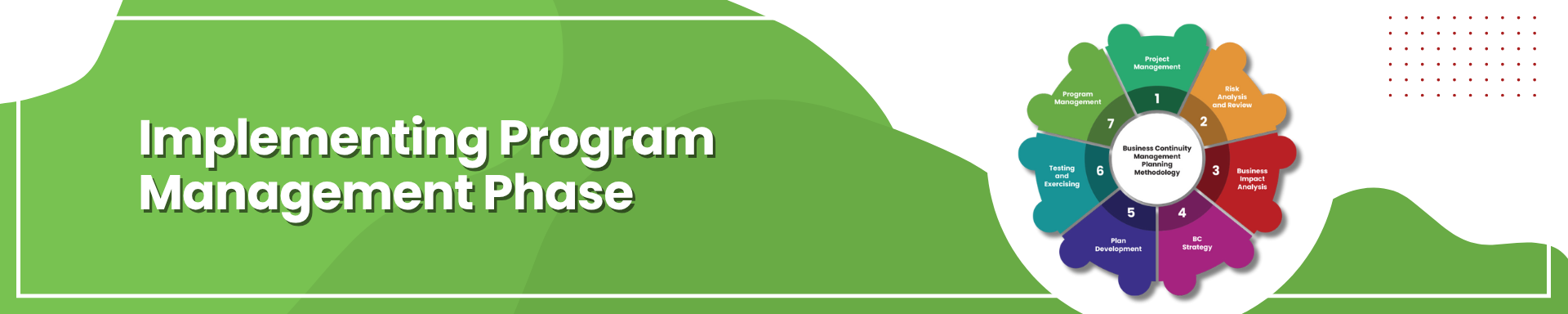
The **Program Management (PgM)** Phase is the seventh and final phase of the Business Continuity Management (BCM) Planning Methodology. While the preceding phases focus on establishing governance, analysing risks, identifying critical business functions, developing continuity strategies, documenting recovery plans, and validating those plans through testing and exercising, the Program Management Phase ensures that the Business Continuity Management System (BCMS) remains effective, relevant, and continuously improved throughout its lifecycle.
For **ALPS Healthcare (ALPS)**, Business Continuity Management cannot be treated as a one-time project. The organisation operates within a dynamic healthcare supply chain environment characterised by changing healthcare demands, evolving technologies, new regulatory requirements, emerging cybersecurity threats, changing supplier networks, and increasing expectations for healthcare resilience. Consequently, the BCM programme must evolve continuously to remain aligned with organisational objectives and Singapore's healthcare priorities.
The purpose of Program Management is to embed Business Continuity Management into ALPS' governance, operational processes, organisational culture, and strategic decision-making. This involves maintaining business continuity documentation, monitoring organisational changes, conducting regular reviews, providing training and awareness programmes, measuring programme performance, managing continual improvement initiatives, and ensuring ongoing compliance with ISO 22301.
For ALPS Healthcare, an effective BCM Programme Management framework strengthens organisational resilience, supports uninterrupted healthcare supply chain operations, and ensures that the organisation remains prepared to respond to future disruptions while continuing to support Singapore's public healthcare institutions.
[](https://cta-redirect.hubspot.com/cta/redirect/3893111/879ee324-2916-4ee7-bd18-19b1be0b7c24)
[Dr Goh Moh Heng](https://blog.bcm-institute.org/ebook/author/dr-goh-moh-heng) Aug 6, 2026
###### Business Continuity Management Certified Planner-Specialist-Expert
###### [![\[BCM\] \[ALPS\] \[Full Banner\] Implementing Business Continuity Management for ALPS Healthcare](https://no-cache.hubspot.com/cta/default/3893111/a577c05a-ab89-4043-9a89-1dea0d883afc.png)](https://cta-redirect.hubspot.com/cta/redirect/3893111/a577c05a-ab89-4043-9a89-1dea0d883afc)
### eBook 2: Chapter 8
### [](https://cta-redirect.hubspot.com/cta/redirect/3893111/879ee324-2916-4ee7-bd18-19b1be0b7c24)
### Program Management Phase for BCM Planning Methodology for
### for ALPS Healthcare
#### Introduction
The **Program Management (PgM)** Phase is the seventh and final phase of the Business[![\[BCM\] \[ALPS\] \[E2\] \[C8\] Program Management](https://no-cache.hubspot.com/cta/default/3893111/52497940-4ed8-4ee5-b5e9-0a1b21e83f29.png)](https://cta-redirect.hubspot.com/cta/redirect/3893111/52497940-4ed8-4ee5-b5e9-0a1b21e83f29) Continuity Management (BCM) Planning Methodology. While the preceding phases focus on establishing governance, analysing risks, identifying critical business functions, developing continuity strategies, documenting recovery plans, and validating those plans through testing and exercising, the Program Management Phase ensures that the Business Continuity Management System (BCMS) remains effective, relevant, and continuously improved throughout its lifecycle.
For **ALPS Healthcare (ALPS)**, Business Continuity Management cannot be treated as a one-time project. The organisation operates within a dynamic healthcare supply chain environment characterised by changing healthcare demands, evolving technologies, new regulatory requirements, emerging cybersecurity threats, changing supplier networks, and increasing expectations for healthcare resilience. Consequently, the BCM programme must evolve continuously to remain aligned with organisational objectives and Singapore's healthcare priorities.
The purpose of Program Management is to embed Business Continuity Management into ALPS' governance, operational processes, organisational culture, and strategic decision-making. This involves maintaining business continuity documentation, monitoring organisational changes, conducting regular reviews, providing training and awareness programmes, measuring programme performance, managing continual improvement initiatives, and ensuring ongoing compliance with ISO 22301.
For ALPS Healthcare, an effective BCM Programme Management framework strengthens organisational resilience, supports uninterrupted healthcare supply chain operations, and ensures that the organisation remains prepared to respond to future disruptions while continuing to support Singapore's public healthcare institutions.
#### **Purpose of Program Management**
The purpose of this chapter is to provide a practical framework for sustaining and continually improving ALPS Healthcare's Business Continuity Management Programme after the initial implementation has been completed.
Unlike the earlier chapters, which focus on developing the Business Continuity Management System, this chapter explains how ALPS should manage the BCMS as a permanent organisational capability rather than as a temporary project.
Specifically, this chapter assists ALPS Healthcare by:
- Establishing long-term BCM governance.
- Integrating BCM into normal business operations.
- Maintaining Business Continuity Plans and supporting documentation.
- Monitoring organisational and environmental changes.
- Ensuring ongoing staff competence through awareness and training.
- Measuring BCM performance using appropriate indicators.
- Supporting compliance with ISO 22301 and organisational governance requirements.
- Promoting continual improvement through audits, exercises, and management reviews.
- Strengthening organisational resilience across the healthcare supply chain.
By implementing the practices described in this chapter, ALPS Healthcare can ensure that its BCM programme remains effective, current, and capable of supporting the continuity of critical healthcare supply chain services despite changing operational conditions.
#### **Objectives of the Program Management Phase**
The objectives of the Program Management Phase are to:
- Sustain the Business Continuity Management System.
- Maintain executive commitment.
- Ensure Business Continuity Plans remain current.
- Monitor organisational changes affecting BCM.
- Coordinate periodic Business Impact Analysis and Risk Analysis reviews.
- Conduct regular testing and exercising.
- Provide BCM awareness and training.
- Monitor programme performance.
- Conduct internal audits and management reviews.
- Promote continual improvement.
- Strengthen organisational resilience.
#### **Program Management Framework**
The Program Management Phase consists of several ongoing activities.
| Programme Activity | Primary Objective | Key Deliverables |
| --- | --- | --- |
| Governance | Maintain executive oversight | BCM Governance Framework |
| Documentation Maintenance | Keep plans current | Updated BCM Documentation |
| Training and Awareness | Maintain organisational readiness | Training Programme |
| Testing and Exercising | Validate preparedness | Annual Exercise Programme |
| Monitoring and Measurement | Assess programme performance | BCM Performance Reports |
| Internal Audit | Verify compliance | Audit Reports |
| Management Review | Evaluate programme effectiveness | Management Review Minutes |
| Continual Improvement | Improve BCM capability | Improvement Action Register |
Unlike previous implementation phases, these activities operate continuously throughout the life of the BCMS.
#### **BCM Governance**
Effective governance ensures that Business Continuity Management remains aligned with ALPS Healthcare's strategic objectives and operational priorities.
Governance responsibilities include:
- Establishing BCM policies.
- Defining organisational responsibilities.
- Approving BCM objectives.
- Allocating resources.
- Monitoring programme performance.
- Reviewing significant risks.
- Approving continual improvement initiatives.
##### **Example – ALPS Healthcare**
The BCM Steering Committee meets quarterly to review programme performance, approve improvements, evaluate emerging risks affecting healthcare supply chain operations, and oversee the implementation of corrective actions arising from exercises and audits.
#### **Documentation Maintenance**
Business Continuity documentation must remain accurate and current.
Documentation requiring regular review includes:
- BCM Policy.
- Business Continuity Plans.
- Crisis Management Plans.
- Department Recovery Plans.
- Contact directories.
- Recovery procedures.
- Supplier information.
- Technology inventories.
- Recovery resource lists.
##### **Review Triggers**
Plans should be reviewed following:
- Organisational restructuring.
- Introduction of new technology.
- New warehouse facilities.
- Supplier changes.
- Regulatory updates.
- Cybersecurity incidents.
- Major exercises.
- Actual disruptions.
##### **Example – ALPS Healthcare**
Following the implementation of a new Warehouse Management System, ALPS updates its Business Continuity Plans to reflect revised recovery procedures, system dependencies, and alternative manual operating processes.
#### **Training and Awareness**
Training ensures that personnel understand their roles during disruptions.
Training should be provided to:
- Executive Management.
- Crisis Management Team.
- BCM Coordinators.
- Department Recovery Teams.
- Warehouse personnel.
- Procurement staff.
- ICT teams.
- Logistics personnel.
- New employees.
Awareness activities may include:
- BCM induction programmes.
- Refresher training.
- E-learning.
- Newsletters.
- Posters.
- Tabletop workshops.
- Awareness campaigns.
##### **Example – ALPS Healthcare**
Annual BCM awareness programmes educate employees on emergency reporting procedures, crisis communications, alternate working arrangements, and their individual responsibilities during disruptions affecting healthcare supply chain operations.
#### **Monitoring Programme Performance**
Performance measurement enables ALPS Healthcare to evaluate the effectiveness of its BCM programme.
Typical Key Performance Indicators (KPIs) include:
- Percentage of plans reviewed.
- Exercise completion rate.
- Training participation.
- Corrective action closure rate.
- Supplier continuity assessment completion.
- Recovery objective achievement.
- Audit findings.
- Management review completion.
##### **Example – ALPS Healthcare**
The BCM dashboard reports quarterly performance indicators, including the percentage of Business Continuity Plans updated, completion of supplier resilience assessments, staff training participation, and corrective actions closed following exercises.
#### **Internal Audit**
Internal audits provide independent assurance that the BCMS remains compliant and effective.
Audit activities include:
- Document reviews.
- Process verification.
- Compliance assessments.
- Plan sampling.
- Exercise evaluations.
- Interviews.
- Evidence collection.
##### **Example – ALPS Healthcare**
Internal auditors verify that Business Continuity Plans have been reviewed annually, exercises have been conducted according to schedule, and corrective actions have been implemented within approved timelines.
#### **Management Review**
Senior management should periodically review the effectiveness of the BCMS.
Typical agenda items include:
- BCM objectives.
- Audit findings.
- Exercise outcomes.
- Emerging risks.
- Regulatory changes.
- Resource requirements.
- Programme performance.
- Improvement recommendations.
##### **Example – ALPS Healthcare**
Executive management reviews BCM performance annually, focusing on resilience improvements, healthcare supply chain risks, supplier resilience, cybersecurity developments, and investment priorities for future capability enhancement.
#### **Continual Improvement**
Continual improvement is a fundamental principle of ISO 22301.
Improvement opportunities arise from:
- Exercises.
- Internal audits.
- Actual incidents.
- Lessons learned.
- Staff feedback.
- Supplier reviews.
- Technology changes.
- Regulatory developments.
Improvement activities may include:
- Updating plans.
- Revising recovery strategies.
- Improving communication procedures.
- Investing in technology resilience.
- Enhancing supplier diversification.
- Strengthening workforce capability.
##### **Example – ALPS Healthcare**
Following a simulation exercise involving a nationwide pharmaceutical shortage, ALPS enhances its supplier diversification strategy, expands strategic inventory levels for selected essential medicines, and revises emergency allocation procedures supporting public healthcare institutions.
#### **ALPS Healthcare-Specific Program Management Requirements**
Because ALPS Healthcare plays a critical role in Singapore's healthcare supply chain, its BCM programme should address several organisation-specific requirements.
##### **Healthcare Supply Chain Resilience**
Continuously monitor the resilience of procurement, warehousing, cold-chain logistics, and healthcare distribution operations to ensure uninterrupted support for public healthcare institutions.
##### **Supplier Resilience Management**
Conduct periodic resilience assessments of critical pharmaceutical manufacturers, medical device suppliers, logistics providers, and outsourced service providers. Verify that key suppliers maintain appropriate Business Continuity and Disaster Recovery capabilities.
##### **Digital Transformation Oversight**
Review the resilience implications of new technologies, including enterprise resource planning systems, warehouse automation, robotics, artificial intelligence, cloud platforms, cybersecurity controls, and digital procurement solutions before implementation.
##### **Cold-Chain Assurance**
Regularly validate temperature-controlled storage, refrigeration systems, backup power arrangements, environmental monitoring devices, and emergency cold-chain transportation capabilities.
##### **Regulatory Compliance**
Monitor changes in Singapore's healthcare regulations, procurement governance requirements, quality management standards, product traceability obligations, and information security expectations that may affect Business Continuity Management.
##### **Healthcare Stakeholder Coordination**
Maintain collaborative BCM arrangements with public healthcare institutions, healthcare clusters, government agencies, logistics providers, and strategic suppliers to support coordinated responses during national healthcare emergencies.
##### **Information Security Integration**
Ensure close integration between the BCM programme, cybersecurity, disaster recovery, enterprise risk management, and operational resilience initiatives to address increasingly sophisticated cyber threats affecting healthcare supply chain operations.
#### **Annual BCM Programme**
A typical annual programme may include:
| Quarter | Activity |
| --- | --- |
| Q1 | Business Continuity Plan review and update |
| Q1 | BCM awareness programme |
| Q2 | Risk Analysis and Business Impact Analysis review |
| Q2 | Tabletop and component exercises |
| Q3 | Integrated or simulation exercises |
| Q3 | Supplier continuity assessments |
| Q4 | Internal BCM audit |
| Q4 | Management review and continual improvement planning |
This annual cycle ensures that BCM activities remain embedded within normal business operations.
#### **BCM Programme Deliverables**
The Program Management Phase should produce:
- BCM Policy Review.
- Annual BCM Programme.
- Updated Business Continuity Plans.
- Exercise Programme.
- Training Records.
- BCM Performance Dashboard.
- Internal Audit Reports.
- Management Review Reports.
- Corrective Action Register.
- Continual Improvement Register.
- Supplier Resilience Assessment Reports.
- Annual BCM Report.
#### **Success Factors**
The long-term success of ALPS Healthcare's BCM programme depends upon:
- Sustained executive leadership.
- Clearly defined governance.
- Adequate funding and resources.
- Regular plan maintenance.
- Ongoing training and awareness.
- Effective testing and exercising.
- Independent audits.
- Timely management reviews.
- Collaboration with healthcare stakeholders.
- Commitment to continual improvement.
#### [![Banner \[Summary\] \[BCM\] \[E2\] \[C8\] Program Management](https://no-cache.hubspot.com/cta/default/3893111/9ab836f6-9d8f-4673-9d57-5729a3c8d644.png)](https://cta-redirect.hubspot.com/cta/redirect/3893111/9ab836f6-9d8f-4673-9d57-5729a3c8d644)
The Program Management Phase transforms Business Continuity Management from a completed implementation project into a sustainable organisational capability that continually protects ALPS Healthcare's critical operations.
Through structured governance, ongoing documentation maintenance, regular training, performance monitoring, testing, auditing, management reviews, and continual improvement, ALPS establishes a mature Business Continuity Management System that evolves alongside organisational growth, technological change, regulatory developments, and the dynamic healthcare environment.
For ALPS Healthcare, effective programme management extends beyond maintaining Business Continuity Plans.
It requires continuous engagement with suppliers, logistics providers, public healthcare institutions, technology partners, and government agencies to ensure that the resilience of the healthcare supply chain is maintained across organisational boundaries.
By embedding Business Continuity Management into everyday governance and decision-making, ALPS strengthens its ability to anticipate disruptions, respond effectively, recover efficiently, and continue delivering essential healthcare supplies to Singapore's public healthcare system.
This chapter completes the seven-phase **Business Continuity Management Planning Methodology** presented throughout this eBook.
Collectively, the phases of **Project Management, Risk Analysis and Review, Business Impact Analysis, Business Continuity Strategy, Plan Development, Testing and Exercising, and Program Management** provide ALPS Healthcare with a comprehensive, ISO 22301-aligned framework for establishing, implementing, maintaining, and continually improving a Business Continuity Management System.
By applying this methodology, ALPS can build a resilient organisation capable of safeguarding critical healthcare supply chain operations, supporting national healthcare resilience, and ensuring the uninterrupted availability of essential medical supplies during both routine operations and major disruptive events.
[![\[BCM\] \[ALPS\] \[3/4 Banner\] Implementing Business Continuity Management for ALPS Healthcare](https://no-cache.hubspot.com/cta/default/3893111/5bb3d163-ccf4-4942-8e51-90cb0e0de84f.png)](https://cta-redirect.hubspot.com/cta/redirect/3893111/5bb3d163-ccf4-4942-8e51-90cb0e0de84f)
| **eBook 2: Implementing Business Continuity Management** | | | | |
| --- | --- | --- | --- | --- |
| **C1** | **C2** | **C3** | **C4** | **C5** |
| [![\[BCM\] \[ALPS\] \[E2\] \[C1\] Business Continuity Management Planning Methodology](https://no-cache.hubspot.com/cta/default/3893111/34a98265-b1ac-4365-8fb1-b89701c81850.png)](https://cta-redirect.hubspot.com/cta/redirect/3893111/34a98265-b1ac-4365-8fb1-b89701c81850) | [![\[BCM\] \[ALPS\] \[E2\] \[C2\] Project Management](https://no-cache.hubspot.com/cta/default/3893111/2a25b902-93e0-4adc-9793-121a2849bfab.png)](https://cta-redirect.hubspot.com/cta/redirect/3893111/2a25b902-93e0-4adc-9793-121a2849bfab) | [![\[BCM\] \[ALPS\] \[E2\] \[C3\] Risk Analysis and Review](https://no-cache.hubspot.com/cta/default/3893111/74b8cdd9-6407-4d41-bfa9-1c382a227c82.png)](https://cta-redirect.hubspot.com/cta/redirect/3893111/74b8cdd9-6407-4d41-bfa9-1c382a227c82) | [![\[BCM\] \[ALPS\] \[E2\] \[C4\] Business Impact Analysis](https://no-cache.hubspot.com/cta/default/3893111/eedd40d9-b511-4e16-96de-58834c1e7d92.png)](https://cta-redirect.hubspot.com/cta/redirect/3893111/eedd40d9-b511-4e16-96de-58834c1e7d92) | [![\[BCM\] \[ALPS\] \[E2\] \[C5\] Business Continuity Strategy](https://no-cache.hubspot.com/cta/default/3893111/404ab765-7f69-49dd-ac4a-b9079f065d1c.png)](https://cta-redirect.hubspot.com/cta/redirect/3893111/404ab765-7f69-49dd-ac4a-b9079f065d1c) |
| **C6** | **C7** | **C8** | **C9** | **C10** |
| [![\[BCM\] \[ALPS\] \[E2\] \[C6\] BCM Plan Development](https://no-cache.hubspot.com/cta/default/3893111/4df32844-f3fe-4e88-b9e0-c33cd4f354f5.png)](https://cta-redirect.hubspot.com/cta/redirect/3893111/4df32844-f3fe-4e88-b9e0-c33cd4f354f5) | [![\[BCM\] \[ALPS\] \[E2\] \[C7\] Testing and Exercising](https://no-cache.hubspot.com/cta/default/3893111/be2eeb3c-4b1a-4d42-bebd-0a30e1047952.png)](https://cta-redirect.hubspot.com/cta/redirect/3893111/be2eeb3c-4b1a-4d42-bebd-0a30e1047952) | [![\[BCM\] \[ALPS\] \[E2\] \[C8\] Program Management](https://no-cache.hubspot.com/cta/default/3893111/52497940-4ed8-4ee5-b5e9-0a1b21e83f29.png)](https://cta-redirect.hubspot.com/cta/redirect/3893111/52497940-4ed8-4ee5-b5e9-0a1b21e83f29) | [![\[BCM\] \[ALPS\] \[E2\] \[C9\] Summary](https://no-cache.hubspot.com/cta/default/3893111/c702d1dd-d76e-4015-8be8-58641496151a.png)](https://cta-redirect.hubspot.com/cta/redirect/3893111/c702d1dd-d76e-4015-8be8-58641496151a) | [![\[BCM\] \[ALPS\] \[E2\] \[C10\] Back Cover of eBook 2](https://no-cache.hubspot.com/cta/default/3893111/7f72c39b-5844-4487-92a5-c9d0f38f0bad.png)](https://cta-redirect.hubspot.com/cta/redirect/3893111/7f72c39b-5844-4487-92a5-c9d0f38f0bad) |
| | | | | |
#### More Information About Business Continuity Management Courses
To learn more about the course and schedule, click the buttons below for BCM-300 Business Continuity Management Implementer \[BCM-3\] and BCM-5000 Business Continuity Management Expert Implementer \[BCM-5\]
| [](https://cta-redirect.hubspot.com/cta/redirect/3893111/f3922b80-e96a-46d6-8993-dc150a5de2d5) | [](https://cta-redirect.hubspot.com/cta/redirect/3893111/9ff8a3dc-e39a-465b-929f-72e232cdd5fb) | [![Register \[BL-B-3\]\*](https://no-cache.hubspot.com/cta/default/3893111/ac6cf073-4cdd-4541-91ed-889f731d5076.png)](https://cta-redirect.hubspot.com/cta/redirect/3893111/ac6cf073-4cdd-4541-91ed-889f731d5076) |
| --- | --- | --- |
| [](https://cta-redirect.hubspot.com/cta/redirect/3893111/21525c10-4003-4934-95fc-fe218174bc5b) | [](https://cta-redirect.hubspot.com/cta/redirect/3893111/46460171-c91a-4936-9bb2-8dc5928a0e02) | [](https://cta-redirect.hubspot.com/cta/redirect/3893111/1cb17ac7-50b2-4f88-bc4b-c7444e4b57b5) |
| [![FAQ \[BL-B-3\]](https://no-cache.hubspot.com/cta/default/3893111/b3824ba1-7aa1-4eb6-bef8-94f57121c5ae.png)](https://cta-redirect.hubspot.com/cta/redirect/3893111/b3824ba1-7aa1-4eb6-bef8-94f57121c5ae) | Please feel free to send us a note if you have any questions. [![Email to Sales Team \[BCM Institute\]](https://no-cache.hubspot.com/cta/default/3893111/3c53daeb-2836-4843-b0e0-645baee2ab9e.png)](https://cta-redirect.hubspot.com/cta/redirect/3893111/3c53daeb-2836-4843-b0e0-645baee2ab9e) | [](https://cta-redirect.hubspot.com/cta/redirect/3893111/9c199ae8-c470-4bb7-9612-73c7a084e94c) |
| [](https://cta-redirect.hubspot.com/cta/redirect/3893111/8999211a-2c51-4be7-bf49-c393f6c67974) | [](https://cta-redirect.hubspot.com/cta/redirect/3893111/5c1aa95d-f6dd-4067-a95c-5cc0c32d7ed8) | [](https://cta-redirect.hubspot.com/cta/redirect/3893111/086ab3b9-4d66-4a95-b2f7-1148e9803a9c) |
**Comments**
### More Posts
[](https://cta-redirect.hubspot.com/cta/redirect/3893111/839787f4-a4fd-456f-accf-54c947026558)

All rights reserved. Copyright 2026
```json
{
"@context" : "https://schema.org",
"@type" : "BlogPosting",
"author" : {
"@type" : "Person",
"name" : "Dr Goh Moh Heng",
"url" : "https://blog.bcm-institute.org/ebook/author/dr-goh-moh-heng"
},
"dateModified" : "2026-08-06T01:03:50.657Z",
"datePublished" : "2026-08-06T00:50:00.000Z",
"headline" : "[BCM] [ALPS] [E2] [C8] Program Management",
"mainEntityOfPage" : {
"@id" : "https://blog.bcm-institute.org/ebook/bcm-alps-e2-c8-program-management",
"@type" : "WebPage"
},
"publisher" : {
"@type" : "Organization",
"logo" : {
"@type" : "ImageObject",
"url" : "https://blog.bcm-institute.org/hubfs/BCMI%20Logo.png"
},
"name" : "BCMI Pte Ltd"
}
}
```