---
title: [BCM] [ALPS] [E2] [C6] BCM Plan Development
description: [BCM] [ALPS] [E2] [C6] BCM Plan Development
image: https://blog.bcm-institute.org/hubfs/ALPS%20Graphic%20Folder/ALPS%20Morepost/ALPS%20E2%20Morepost/%5BBCM%5D%20%5BGRA%5D%20%5BE2%5D%20%5BC6%5D%20BCM%20Plan%20Development.jpg
---
.
[](http://www.bcm-institute.org/)
- [Home](https://www.bcm-institute.org/)
- [About Us](https://www.bcm-institute.org/about-us-3/)
- [A President’s Perspective](https://www.bcm-institute.org/about-us/a-presidents-perspective/)
- [Our History](https://www.bcm-institute.org/about-us/our-history/)
- [Our Advisory Council](https://www.bcm-institute.org/about-us/our-advisory-council/)
- [Customers’ Testimonials](https://www.bcm-institute.org/about-us/customers-testimonials/)
- [Credential Verification](https://www.bcm-institute.org/about-us/credential-verification/)
- [Courses](https://blog.bcm-institute.org/blog/course-fees-for-blended-learning-courses-master-catalog)
- [ISO 22301 Business Continuity Management System Audit](https://blog.bcm-institute.org/audit/business-continuity-management-audit-courses)
- [ISO 22301 Business Continuity Management](https://blog.bcm-institute.org/bcm/business-continuity-management-courses)
- [Crisis Communication](https://blog.bcm-institute.org/crisis-communication/crisis-communication-courses)
- [Crisis Management](https://blog.bcm-institute.org/en/crisis-management/courses)
- [IT Disaster Recovery](https://blog.bcm-institute.org/it-disaster-recovery/courses)
- [Operational Resilience](https://blog.bcm-institute.org/operational-resilience/courses)
- [Operational Resilience Audit](https://blog.bcm-institute.org/operational-resilience-audit/courses)
- [Certification](https://blog.bcm-institute.org/certification/types-of-certifications-offered)
- [ISO 22301 BCMS Audit Certification](https://blog.bcm-institute.org/certification/business-continuity-management-audit-certification)
- [ISO22301 Business Continuity Management Certification](https://blog.bcm-institute.org/bcm/business-continuity-management-certification)
- [Crisis Communication Certification](https://blog.bcm-institute.org/crisis-communication/crisis-communication-certification)
- [Crisis Management Certification](https://blog.bcm-institute.org/en/crisis-management/crisis-management-certification)
- [IT Disaster Recovery Planning Certification](https://blog.bcm-institute.org/it-disaster-recovery/it-disaster-recovery-certification)
- [Operational Resilience Certification](https://blog.bcm-institute.org/operational-resilience/operational-resilience-certification)
- [Operational Resilience Audit Certification](https://blog.bcm-institute.org/operational-resilience-audit)
- [Seminars](https://blog.bcm-institute.org/meet-the-expert/mte-webinar-mainpage)
- [Store](https://www.bcm-institute.org/store-2/)
- [Contact Us](http://www.bcm-institute.org/about-us/contact-us/)
-
-
##### **Implementing Business Continuity Management for ALPS Healthcare: An Enterprise Implementation Guide**

# \[BCM\] \[ALPS\] \[E2\] \[C6\] BCM Plan Development
[![\[BCM\] \[ALPS\] \[Full Banner\] Implementing Business Continuity Management for ALPS Healthcare](https://no-cache.hubspot.com/cta/default/3893111/a577c05a-ab89-4043-9a89-1dea0d883afc.png)](https://cta-redirect.hubspot.com/cta/redirect/3893111/a577c05a-ab89-4043-9a89-1dea0d883afc)
The **Business Continuity Plan Development (PD)** Phase is the fifth phase of the Business Continuity Management (BCM) Planning Methodology and represents the transition from planning to operational readiness. The previous phases—Project Management, Risk Analysis and Review, Business Impact Analysis, and Business Continuity Strategy—establish the governance, identify organisational risks, prioritise critical business functions, and define recovery strategies. The Plan Development Phase converts these decisions into practical, documented procedures that personnel can execute during an actual disruption.
For **ALPS Healthcare (ALPS)**, Business Continuity Plans (BCPs) are essential because the organisation is responsible for ensuring the continuous procurement, warehousing, inventory management, and distribution of pharmaceuticals, medical devices, medical consumables, and other essential healthcare supplies supporting Singapore's public healthcare system. During a disruptive event, personnel must be able to respond quickly using clearly documented procedures rather than relying on individual knowledge or improvised decisions.
A Business Continuity Plan is more than a document; it is an operational guide that defines responsibilities, recovery priorities, communication procedures, resource requirements, and step-by-step actions required to maintain or restore critical business functions. Well-designed plans enable ALPS to respond consistently to disruptions affecting suppliers, warehouses, logistics operations, information systems, cold-chain facilities, transportation networks, or critical personnel.
This chapter explains the activities involved in developing Business Continuity Plans and presents a structured approach suitable for ALPS Healthcare. The methodology aligns with ISO 22301 and ensures that business continuity plans are comprehensive, practical, consistent, and capable of supporting the continuity of Singapore's healthcare supply chain.
### [](https://cta-redirect.hubspot.com/cta/redirect/3893111/a8d5e9c1-7cf9-4dc1-b2b5-d07c5b8544f3)
[Dr Goh Moh Heng](https://blog.bcm-institute.org/ebook/author/dr-goh-moh-heng) Aug 6, 2026
###### Business Continuity Management Certified Planner-Specialist-Expert
###### [![\[BCM\] \[ALPS\] \[Full Banner\] Implementing Business Continuity Management for ALPS Healthcare](https://no-cache.hubspot.com/cta/default/3893111/a577c05a-ab89-4043-9a89-1dea0d883afc.png)](https://cta-redirect.hubspot.com/cta/redirect/3893111/a577c05a-ab89-4043-9a89-1dea0d883afc)
### eBook 2: Chapter 6
### [](https://cta-redirect.hubspot.com/cta/redirect/3893111/a8d5e9c1-7cf9-4dc1-b2b5-d07c5b8544f3)
### BC Plan Development Phase as part of the ALPS Healthcare
#### Introduction
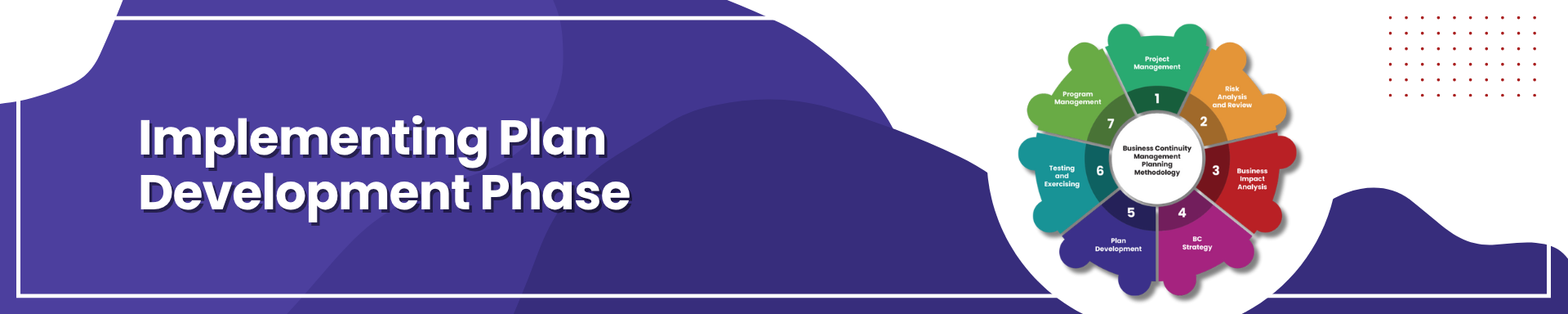
The **Business Continuity Plan Development (PD)** Phase is the fifth phase of the [![\[BCM\] \[ALPS\] \[E2\] \[C6\] BCM Plan Development](https://no-cache.hubspot.com/cta/default/3893111/4df32844-f3fe-4e88-b9e0-c33cd4f354f5.png)](https://cta-redirect.hubspot.com/cta/redirect/3893111/4df32844-f3fe-4e88-b9e0-c33cd4f354f5)Business Continuity Management (BCM) Planning Methodology and represents the transition from planning to operational readiness. The previous phases—Project Management, Risk Analysis and Review, Business Impact Analysis, and Business Continuity Strategy—establish the governance, identify organisational risks, prioritise critical business functions, and define recovery strategies. The Plan Development Phase converts these decisions into practical, documented procedures that personnel can execute during an actual disruption.
For **ALPS Healthcare (ALPS)**, Business Continuity Plans (BCPs) are essential because the organisation is responsible for ensuring the continuous procurement, warehousing, inventory management, and distribution of pharmaceuticals, medical devices, medical consumables, and other essential healthcare supplies supporting Singapore's public healthcare system. During a disruptive event, personnel must be able to respond quickly using clearly documented procedures rather than relying on individual knowledge or improvised decisions.
A Business Continuity Plan is more than a document; it is an operational guide that defines responsibilities, recovery priorities, communication procedures, resource requirements, and step-by-step actions required to maintain or restore critical business functions. Well-designed plans enable ALPS to respond consistently to disruptions affecting suppliers, warehouses, logistics operations, information systems, cold-chain facilities, transportation networks, or critical personnel.
This chapter explains the activities involved in developing Business Continuity Plans and presents a structured approach suitable for ALPS Healthcare. The methodology aligns with ISO 22301 and ensures that business continuity plans are comprehensive, practical, consistent, and capable of supporting the continuity of Singapore's healthcare supply chain.
#### **Objectives of the Plan Development Phase**
The objectives of the Business Continuity Plan Development Phase are to:
- Translate approved continuity strategies into documented operational procedures.
- Develop standardised Business Continuity Plan templates.
- Define recovery roles and responsibilities.
- Establish recovery organisation structures.
- Provide clear response and recovery procedures.
- Standardise documentation across all business units.
- Ensure plans are complete, accurate, and approved.
- Prepare plans for testing and continual maintenance.
#### **What Does Plan Development Entail?**
The Plan Development Phase consists of three major stages:
| Stage | Objective | Primary Deliverables |
| --- | --- | --- |
| Stage 1 | Determine the structure and organisation of Business Continuity Plans | BC Plan Framework and Templates |
| Stage 2 | Conduct Business Continuity Plan writing workshops | Draft Business Continuity Plans |
| Stage 3 | Finalise and approve Business Continuity Plans | Approved Business Continuity Plans |
Each stage builds progressively upon the previous one to ensure that the completed plans are accurate, practical, and aligned with ALPS Healthcare's operational requirements.
#### **Stage 1 – Determining the Organisation of the Business Continuity Plan Document**
The first stage establishes the overall structure of the Business Continuity Plan documentation before individual plans are written.
Rather than allowing each business unit to develop plans independently, ALPS should adopt a standardised framework to ensure consistency, simplify maintenance, and facilitate coordinated responses during disruptive events.
#### **Designing and Developing the Business Continuity Plan Template**
A standard template ensures that every Business Continuity Plan follows a common structure and includes all information required during an emergency.
A typical Business Continuity Plan template should include:
- Document control and version history.
- Purpose and scope.
- Critical Business Function.
- Recovery objectives (MAO, MBCO, RTO, RPO).
- Activation criteria.
- Incident notification procedures.
- Roles and responsibilities.
- Recovery organisation structure.
- Contact information.
- Resource requirements.
- Alternate operating procedures.
- Recovery activities.
- Internal and external communication procedures.
- Escalation procedures.
- Vendor and stakeholder contacts.
- Recovery checklists.
- Appendices and supporting documents.
##### **Example – ALPS Healthcare**
ALPS develops a standard Business Continuity Plan template that is used across Procurement, Warehouse Operations, Cold-Chain Logistics, Distribution Operations, Information Technology, Supplier Management, and Corporate Services. This standardisation ensures that every department documents recovery information in a consistent format, enabling personnel to navigate plans quickly during an emergency.
#### **Determining the Recovery Organisation**
Each Business Continuity Plan should define the organisational structure responsible for managing recovery activities.
Typical recovery roles include:
- Business Unit Recovery Manager.
- Business Continuity Coordinator.
- Recovery Team Leaders.
- Operations Recovery Team.
- Information Technology Recovery Team.
- Logistics Recovery Team.
- Communications Coordinator.
- Administrative Support Team.
The recovery organisation should clearly identify reporting relationships, delegated authorities, and decision-making responsibilities.
##### **Example – ALPS Healthcare**
For the **Healthcare Distribution and Delivery Operations** function, the recovery organisation includes representatives from Logistics Operations, Warehouse Management, Fleet Coordination, ICT Support, Supplier Management, and Corporate Communications to ensure coordinated restoration of delivery services to public healthcare institutions.
#### **Stage 2 – Conducting a Business Continuity Plan Writing Workshop**
Once the plan structure has been established, ALPS should conduct structured workshops to guide Business Unit (BU) BCM Coordinators and plan owners through the plan development process.
The objective is to ensure that all plans are developed using consistent methodologies and reflect actual operational practices.
##### **Workshop Objectives**
The workshops should:
- Explain the Business Continuity Plan template.
- Review Business Impact Analysis findings.
- Review approved recovery strategies.
- Clarify recovery objectives.
- Explain documentation standards.
- Define responsibilities for plan completion.
- Establish submission timelines.
##### **Participants**
Typical participants include:
- BCM Manager.
- BCM Coordinators.
- Business Unit Heads.
- Department Managers.
- ICT Representatives.
- Human Resources.
- Procurement Representatives.
- Warehouse Managers.
- Logistics Managers.
- Quality Assurance personnel.
##### **Completion of the Plan Template**
Following the workshops, individual Business Unit BCM Coordinators complete the Business Continuity Plan template for their respective business functions.
Plans should include:
- Department-specific recovery procedures.
- Resource requirements.
- Manual workarounds.
- Critical contacts.
- Recovery priorities.
- Supplier information.
- Escalation procedures.
- Communication protocols.
##### **Example – ALPS Healthcare**
The BCM Coordinator for **Cold-Chain and Controlled-Environment Logistics** develops detailed procedures covering refrigeration failures, emergency transfer of temperature-sensitive products, generator activation, alternative cold storage facilities, temperature monitoring, and communication with healthcare institutions receiving critical pharmaceuticals and vaccines.
#### **Stage 3 – Finalisation of the Business Continuity Plan Production**
After draft plans have been completed, they should undergo formal review and validation before approval.
Validation ensures that the plans are operationally accurate, complete, and capable of supporting recovery objectives.
##### **Validation Activities**
Validation should include:
- Technical review.
- Operational review.
- Cross-functional review.
- Management review.
- Regulatory compliance review.
- Document quality review.
- Consistency review.
##### **Validation by Business Unit BCM Coordinators**
Business Unit BCM Coordinators should verify:
- Accuracy of operational procedures.
- Completeness of recovery activities.
- Currency of contact information.
- Resource availability.
- Consistency with approved strategies.
- Alignment with Recovery Time Objectives.
##### **Validation by Heads of Business Units**
Business Unit Heads should confirm:
- Recovery priorities.
- Operational feasibility.
- Resource commitments.
- Staffing arrangements.
- Management approval.
- Organisational accountability.
##### **Example – ALPS Healthcare**
The Head of Warehouse Operations reviews the Business Continuity Plan for Warehouse and Storage Operations to ensure that recovery procedures accurately reflect warehouse layouts, automated storage systems, forklift availability, inventory handling processes, and emergency operating procedures before formally approving the plan.
#### **ALPS Healthcare-Specific Plan Development Requirements**
To support its role within Singapore's healthcare ecosystem, ALPS should incorporate the following organisation-specific requirements into all Business Continuity Plans.
##### **Healthcare Supply Continuity**
Plans should prioritise the uninterrupted supply of pharmaceuticals, medical devices, laboratory consumables, surgical supplies, vaccines, and emergency medical products.
##### **Supplier Continuity**
Each plan should identify:
- Critical suppliers.
- Alternate suppliers.
- Emergency procurement procedures.
- Supplier escalation contacts.
- Contractual continuity arrangements.
##### **Cold-Chain Operations**
Plans should document:
- Temperature monitoring procedures.
- Backup refrigeration arrangements.
- Emergency transportation.
- Product integrity verification.
- Cold-chain incident escalation.
##### **Warehouse Operations**
Plans should address:
- Manual inventory procedures.
- Alternative warehouse facilities.
- Automated system failures.
- Stock relocation.
- Emergency receiving and dispatch processes.
##### **Information Technology**
Plans should include:
- ICT disaster recovery procedures.
- Manual procurement processes.
- Alternative communication methods.
- Data backup arrangements.
- Cyber incident response integration.
##### **Healthcare Stakeholder Communications**
Plans should contain communication procedures for:
- Public healthcare institutions.
- Suppliers.
- Logistics providers.
- Government agencies.
- Regulatory authorities.
- Internal management.
#### **Recommended Business Continuity Plan Structure**
ALPS Healthcare should adopt a consistent structure for all Business Continuity Plans.
| Section | Content |
| --- | --- |
| Document Control | Version history and approvals |
| Purpose | Plan objectives |
| Scope | Business function covered |
| Recovery Objectives | MAO, MBCO, RTO, RPO |
| Recovery Organisation | Team structure and responsibilities |
| Activation Procedures | Plan activation criteria |
| Incident Notification | Escalation and communications |
| Resource Requirements | People, facilities, ICT, suppliers |
| Recovery Procedures | Step-by-step recovery activities |
| Alternate Operating Arrangements | Manual workarounds and alternate facilities |
| Stakeholder Contacts | Internal and external contacts |
| Appendices | Supporting information and forms |
##### **Plan Development Deliverables**
The Business Continuity Plan Development Phase should produce:
- Business Continuity Plan templates.
- Department Business Continuity Plans.
- Crisis Management Plans.
- Recovery Team Structure.
- Contact Directories.
- Recovery Checklists.
- Communication Procedures.
- Resource Inventories.
- Plan Approval Records.
- Document Control Register.
#### **Relationship with the Testing and Exercising Phase**
Completed Business Continuity Plans should not be considered operational until they have been tested.
The next phase of the BCM Planning Methodology will validate:
- Plan completeness.
- Recovery procedures.
- Team readiness.
- Communication effectiveness.
- Recovery timing.
- Decision-making processes.
- Resource availability.
Testing provides assurance that documented plans can be successfully executed during actual disruptive events.
#### **Success Factors**
Successful plan development depends upon:
- Standardised documentation.
- Strong executive support.
- Business unit participation.
- Experienced BCM Coordinators.
- Accurate Business Impact Analysis.
- Practical recovery strategies.
- Effective workshops.
- Thorough validation.
- Management approval.
- Commitment to continual updates.
#### [![Banner \[Summary\] \[BCM\] \[E2\] \[C6\] BCM Plan Development](https://no-cache.hubspot.com/cta/default/3893111/a8cffab8-99ea-4a3b-8755-e4196a5d5b95.png)](https://cta-redirect.hubspot.com/cta/redirect/3893111/a8cffab8-99ea-4a3b-8755-e4196a5d5b95)
The Business Continuity Plan Development Phase transforms ALPS Healthcare's continuity strategies into structured, actionable plans that enable personnel to respond effectively to disruptive events. By following a disciplined three-stage approach—**determining the Business Continuity Plan structure, conducting structured plan writing workshops, and validating and finalising the completed plans**—ALPS ensures that every business unit develops consistent, comprehensive, and operationally practical documentation.
Given ALPS' responsibility for supporting Singapore's public healthcare supply chain, Business Continuity Plans must extend beyond internal recovery procedures to include supplier continuity, cold-chain preservation, warehouse resilience, information technology recovery, logistics coordination, and communication with healthcare institutions and government agencies. Standardised templates, clearly defined recovery organisations, and rigorous validation processes ensure that all plans are aligned with the recovery objectives established during the Business Impact Analysis and the strategies developed in the preceding chapter.
The outputs of this phase—including approved Business Continuity Plans, Crisis Management Plans, Recovery Team Structures, Contact Directories, Recovery Checklists, and Communication Procedures—provide the operational foundation for responding to real incidents. In the next chapter, **Testing and Exercising**, ALPS Healthcare will validate these plans through structured exercises, simulations, and recovery testing to confirm that personnel, processes, and resources are capable of supporting the uninterrupted continuity of Singapore's healthcare supply chain under a wide range of disruptive scenarios.
[![\[BCM\] \[ALPS\] \[3/4 Banner\] Implementing Business Continuity Management for ALPS Healthcare](https://no-cache.hubspot.com/cta/default/3893111/5bb3d163-ccf4-4942-8e51-90cb0e0de84f.png)](https://cta-redirect.hubspot.com/cta/redirect/3893111/5bb3d163-ccf4-4942-8e51-90cb0e0de84f)
| **eBook 2: Implementing Business Continuity Management** | | | | |
| --- | --- | --- | --- | --- |
| **C1** | **C2** | **C3** | **C4** | **C5** |
| [![\[BCM\] \[ALPS\] \[E2\] \[C1\] Business Continuity Management Planning Methodology](https://no-cache.hubspot.com/cta/default/3893111/34a98265-b1ac-4365-8fb1-b89701c81850.png)](https://cta-redirect.hubspot.com/cta/redirect/3893111/34a98265-b1ac-4365-8fb1-b89701c81850) | [![\[BCM\] \[ALPS\] \[E2\] \[C2\] Project Management](https://no-cache.hubspot.com/cta/default/3893111/2a25b902-93e0-4adc-9793-121a2849bfab.png)](https://cta-redirect.hubspot.com/cta/redirect/3893111/2a25b902-93e0-4adc-9793-121a2849bfab) | [![\[BCM\] \[ALPS\] \[E2\] \[C3\] Risk Analysis and Review](https://no-cache.hubspot.com/cta/default/3893111/74b8cdd9-6407-4d41-bfa9-1c382a227c82.png)](https://cta-redirect.hubspot.com/cta/redirect/3893111/74b8cdd9-6407-4d41-bfa9-1c382a227c82) | [![\[BCM\] \[ALPS\] \[E2\] \[C4\] Business Impact Analysis](https://no-cache.hubspot.com/cta/default/3893111/eedd40d9-b511-4e16-96de-58834c1e7d92.png)](https://cta-redirect.hubspot.com/cta/redirect/3893111/eedd40d9-b511-4e16-96de-58834c1e7d92) | [![\[BCM\] \[ALPS\] \[E2\] \[C5\] Business Continuity Strategy](https://no-cache.hubspot.com/cta/default/3893111/404ab765-7f69-49dd-ac4a-b9079f065d1c.png)](https://cta-redirect.hubspot.com/cta/redirect/3893111/404ab765-7f69-49dd-ac4a-b9079f065d1c) |
| **C6** | **C7** | **C8** | **C9** | **C10** |
| [![\[BCM\] \[ALPS\] \[E2\] \[C6\] BCM Plan Development](https://no-cache.hubspot.com/cta/default/3893111/4df32844-f3fe-4e88-b9e0-c33cd4f354f5.png)](https://cta-redirect.hubspot.com/cta/redirect/3893111/4df32844-f3fe-4e88-b9e0-c33cd4f354f5) | [![\[BCM\] \[ALPS\] \[E2\] \[C7\] Testing and Exercising](https://no-cache.hubspot.com/cta/default/3893111/be2eeb3c-4b1a-4d42-bebd-0a30e1047952.png)](https://cta-redirect.hubspot.com/cta/redirect/3893111/be2eeb3c-4b1a-4d42-bebd-0a30e1047952) | [![\[BCM\] \[ALPS\] \[E2\] \[C8\] Program Management](https://no-cache.hubspot.com/cta/default/3893111/52497940-4ed8-4ee5-b5e9-0a1b21e83f29.png)](https://cta-redirect.hubspot.com/cta/redirect/3893111/52497940-4ed8-4ee5-b5e9-0a1b21e83f29) | [![\[BCM\] \[ALPS\] \[E2\] \[C9\] Summary](https://no-cache.hubspot.com/cta/default/3893111/c702d1dd-d76e-4015-8be8-58641496151a.png)](https://cta-redirect.hubspot.com/cta/redirect/3893111/c702d1dd-d76e-4015-8be8-58641496151a) | [![\[BCM\] \[ALPS\] \[E2\] \[C10\] Back Cover of eBook 2](https://no-cache.hubspot.com/cta/default/3893111/7f72c39b-5844-4487-92a5-c9d0f38f0bad.png)](https://cta-redirect.hubspot.com/cta/redirect/3893111/7f72c39b-5844-4487-92a5-c9d0f38f0bad) |
| | | | | |
#### ore Information About Business Continuity Management Courses
To learn more about the course and schedule, click the buttons below for BCM-300 Business Continuity Management Implementer \[BCM-3\] and BCM-5000 Business Continuity Management Expert Implementer \[BCM-5\]
| [](https://cta-redirect.hubspot.com/cta/redirect/3893111/f3922b80-e96a-46d6-8993-dc150a5de2d5) | [](https://cta-redirect.hubspot.com/cta/redirect/3893111/9ff8a3dc-e39a-465b-929f-72e232cdd5fb) | [![Register \[BL-B-3\]\*](https://no-cache.hubspot.com/cta/default/3893111/ac6cf073-4cdd-4541-91ed-889f731d5076.png)](https://cta-redirect.hubspot.com/cta/redirect/3893111/ac6cf073-4cdd-4541-91ed-889f731d5076) |
| --- | --- | --- |
| [](https://cta-redirect.hubspot.com/cta/redirect/3893111/21525c10-4003-4934-95fc-fe218174bc5b) | [](https://cta-redirect.hubspot.com/cta/redirect/3893111/46460171-c91a-4936-9bb2-8dc5928a0e02) | [](https://cta-redirect.hubspot.com/cta/redirect/3893111/1cb17ac7-50b2-4f88-bc4b-c7444e4b57b5) |
| [![FAQ \[BL-B-3\]](https://no-cache.hubspot.com/cta/default/3893111/b3824ba1-7aa1-4eb6-bef8-94f57121c5ae.png)](https://cta-redirect.hubspot.com/cta/redirect/3893111/b3824ba1-7aa1-4eb6-bef8-94f57121c5ae) | Please feel free to send us a note if you have any questions. [![Email to Sales Team \[BCM Institute\]](https://no-cache.hubspot.com/cta/default/3893111/3c53daeb-2836-4843-b0e0-645baee2ab9e.png)](https://cta-redirect.hubspot.com/cta/redirect/3893111/3c53daeb-2836-4843-b0e0-645baee2ab9e) | [](https://cta-redirect.hubspot.com/cta/redirect/3893111/9c199ae8-c470-4bb7-9612-73c7a084e94c) |
| [](https://cta-redirect.hubspot.com/cta/redirect/3893111/8999211a-2c51-4be7-bf49-c393f6c67974) | [](https://cta-redirect.hubspot.com/cta/redirect/3893111/5c1aa95d-f6dd-4067-a95c-5cc0c32d7ed8) | [](https://cta-redirect.hubspot.com/cta/redirect/3893111/086ab3b9-4d66-4a95-b2f7-1148e9803a9c) |
**Comments**
### More Posts
[](https://cta-redirect.hubspot.com/cta/redirect/3893111/839787f4-a4fd-456f-accf-54c947026558)

All rights reserved. Copyright 2026
```json
{
"@context" : "https://schema.org",
"@type" : "BlogPosting",
"author" : {
"@type" : "Person",
"name" : "Dr Goh Moh Heng",
"url" : "https://blog.bcm-institute.org/ebook/author/dr-goh-moh-heng"
},
"dateModified" : "2026-08-06T01:03:08.408Z",
"datePublished" : "2026-08-06T00:50:03.000Z",
"headline" : "[BCM] [ALPS] [E2] [C6] BCM Plan Development",
"mainEntityOfPage" : {
"@id" : "https://blog.bcm-institute.org/ebook/bcm-alps-e2-c6-bcm-plan-development",
"@type" : "WebPage"
},
"publisher" : {
"@type" : "Organization",
"logo" : {
"@type" : "ImageObject",
"url" : "https://blog.bcm-institute.org/hubfs/BCMI%20Logo.png"
},
"name" : "BCMI Pte Ltd"
}
}
```