---
title: [BCM] [ALPS] [E2] [C4] Business Impact Analysis
description: [BCM] [ALPS] [E2] [C4] Business Impact Analysis
image: https://blog.bcm-institute.org/hubfs/ALPS%20Graphic%20Folder/ALPS%20Morepost/ALPS%20E2%20Morepost/%5BBCM%5D%20%5BGRA%5D%20%5BE2%5D%20%5BC4%5D%20Business%20Impact%20Analysis.jpg
---
.
[](http://www.bcm-institute.org/)
- [Home](https://www.bcm-institute.org/)
- [About Us](https://www.bcm-institute.org/about-us-3/)
- [A President’s Perspective](https://www.bcm-institute.org/about-us/a-presidents-perspective/)
- [Our History](https://www.bcm-institute.org/about-us/our-history/)
- [Our Advisory Council](https://www.bcm-institute.org/about-us/our-advisory-council/)
- [Customers’ Testimonials](https://www.bcm-institute.org/about-us/customers-testimonials/)
- [Credential Verification](https://www.bcm-institute.org/about-us/credential-verification/)
- [Courses](https://blog.bcm-institute.org/blog/course-fees-for-blended-learning-courses-master-catalog)
- [ISO 22301 Business Continuity Management System Audit](https://blog.bcm-institute.org/audit/business-continuity-management-audit-courses)
- [ISO 22301 Business Continuity Management](https://blog.bcm-institute.org/bcm/business-continuity-management-courses)
- [Crisis Communication](https://blog.bcm-institute.org/crisis-communication/crisis-communication-courses)
- [Crisis Management](https://blog.bcm-institute.org/en/crisis-management/courses)
- [IT Disaster Recovery](https://blog.bcm-institute.org/it-disaster-recovery/courses)
- [Operational Resilience](https://blog.bcm-institute.org/operational-resilience/courses)
- [Operational Resilience Audit](https://blog.bcm-institute.org/operational-resilience-audit/courses)
- [Certification](https://blog.bcm-institute.org/certification/types-of-certifications-offered)
- [ISO 22301 BCMS Audit Certification](https://blog.bcm-institute.org/certification/business-continuity-management-audit-certification)
- [ISO22301 Business Continuity Management Certification](https://blog.bcm-institute.org/bcm/business-continuity-management-certification)
- [Crisis Communication Certification](https://blog.bcm-institute.org/crisis-communication/crisis-communication-certification)
- [Crisis Management Certification](https://blog.bcm-institute.org/en/crisis-management/crisis-management-certification)
- [IT Disaster Recovery Planning Certification](https://blog.bcm-institute.org/it-disaster-recovery/it-disaster-recovery-certification)
- [Operational Resilience Certification](https://blog.bcm-institute.org/operational-resilience/operational-resilience-certification)
- [Operational Resilience Audit Certification](https://blog.bcm-institute.org/operational-resilience-audit)
- [Seminars](https://blog.bcm-institute.org/meet-the-expert/mte-webinar-mainpage)
- [Store](https://www.bcm-institute.org/store-2/)
- [Contact Us](http://www.bcm-institute.org/about-us/contact-us/)
-
-
##### **Implementing Business Continuity Management for ALPS Healthcare: An Enterprise Implementation Guide**

# \[BCM\] \[ALPS\] \[E2\] \[C4\] Business Impact Analysis
[![\[BCM\] \[ALPS\] \[Full Banner\] Implementing Business Continuity Management for ALPS Healthcare](https://no-cache.hubspot.com/cta/default/3893111/a577c05a-ab89-4043-9a89-1dea0d883afc.png)](https://cta-redirect.hubspot.com/cta/redirect/3893111/a577c05a-ab89-4043-9a89-1dea0d883afc)
The **Business Impact Analysis (BIA)** is the third phase of the Business Continuity Management (BCM) Planning Methodology and represents one of the most important activities in developing an effective Business Continuity Management System (BCMS).
While the previous chapter focused on identifying and assessing risks, the Business Impact Analysis determines **what must be recovered, how quickly it must be recovered, and what resources are required to support recovery**.
For **ALPS Healthcare (ALPS)**, the BIA is particularly significant because the organisation is responsible for ensuring the uninterrupted procurement, storage, inventory management, and distribution of pharmaceuticals, medical devices, medical consumables, and other healthcare supplies across Singapore's public healthcare system.
Any prolonged disruption to these critical business functions can directly affect hospitals, polyclinics, community healthcare providers, and ultimately patient care.
Unlike a traditional risk assessment, which evaluates the likelihood and consequences of disruptive events, the Business Impact Analysis examines the **business consequences of operational disruptions, regardless of their cause**.
Whether the interruption results from a cyberattack, warehouse fire, pandemic, supplier failure, transportation disruption, or utility outage, the BIA determines the operational impacts, financial implications, regulatory consequences, healthcare service impacts, reputational effects, and recovery priorities.
The Business Impact Analysis enables ALPS to establish recovery objectives, identify resource dependencies, prioritise recovery activities, and support the development of practical business continuity strategies that align with ISO 22301 requirements and Singapore's healthcare resilience objectives.
This chapter presents a structured Business Impact Analysis methodology tailored specifically to ALPS Healthcare's healthcare supply chain operations.
[](https://cta-redirect.hubspot.com/cta/redirect/3893111/6b386b1f-455a-4825-b4ba-4200e0c5fd7e)
[Dr Goh Moh Heng](https://blog.bcm-institute.org/ebook/author/dr-goh-moh-heng) Aug 6, 2026
###### Business Continuity Management Certified Planner-Specialist-Expert
###### [![\[BCM\] \[ALPS\] Legal Disclaimer Banner](https://no-cache.hubspot.com/cta/default/3893111/eb6856d2-cbb2-4a76-b237-7bd842e84226.png)](https://cta-redirect.hubspot.com/cta/redirect/3893111/eb6856d2-cbb2-4a76-b237-7bd842e84226)
### eBook 2: Chapter 4
### [](https://cta-redirect.hubspot.com/cta/redirect/3893111/6b386b1f-455a-4825-b4ba-4200e0c5fd7e)
### Implementing the Business Impact Analysis Phase for ALPS Healthcare
#### **Introduction**
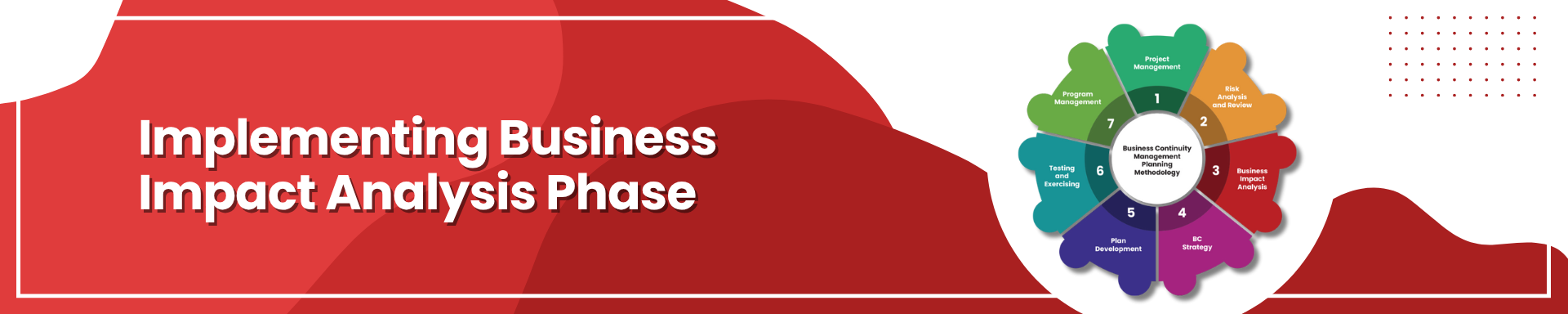
[![\[BCM\] \[ALPS\] \[E2\] \[C4\] Business Impact Analysis](https://no-cache.hubspot.com/cta/default/3893111/eedd40d9-b511-4e16-96de-58834c1e7d92.png)](https://cta-redirect.hubspot.com/cta/redirect/3893111/eedd40d9-b511-4e16-96de-58834c1e7d92)The **Business Impact Analysis (BIA)** is the third phase of the Business Continuity Management (BCM) Planning Methodology and represents one of the most important activities in developing an effective Business Continuity Management System (BCMS).
While the previous chapter focused on identifying and assessing risks, the Business Impact Analysis determines **what must be recovered, how quickly it must be recovered, and what resources are required to support recovery**.
For **ALPS Healthcare (ALPS)**, the BIA is particularly significant because the organisation is responsible for ensuring the uninterrupted procurement, storage, inventory management, and distribution of pharmaceuticals, medical devices, medical consumables, and other healthcare supplies across Singapore's public healthcare system.
Any prolonged disruption to these critical business functions can directly affect hospitals, polyclinics, community healthcare providers, and ultimately patient care.
Unlike a traditional risk assessment, which evaluates the likelihood and consequences of disruptive events, the Business Impact Analysis examines the **business consequences of operational disruptions, regardless of their cause**.
Whether the interruption results from a cyberattack, warehouse fire, pandemic, supplier failure, transportation disruption, or utility outage, the BIA determines the operational impacts, financial implications, regulatory consequences, healthcare service impacts, reputational effects, and recovery priorities.
The Business Impact Analysis enables ALPS to establish recovery objectives, identify resource dependencies, prioritise recovery activities, and support the development of practical business continuity strategies that align with ISO 22301 requirements and Singapore's healthcare resilience objectives.
This chapter presents a structured Business Impact Analysis methodology tailored specifically to ALPS Healthcare's healthcare supply chain operations.
#### **Objectives of the Business Impact Analysis**
The Business Impact Analysis aims to:
- Identify ALPS Healthcare's Critical Business Functions (CBFs).
- Evaluate the consequences of operational disruptions.
- Determine recovery priorities.
- Establish Maximum Acceptable Outage (MAO).
- Define Minimum Business Continuity Objectives (MBCO).
- Determine Recovery Time Objectives (RTO).
- Determine Recovery Point Objectives (RPO).
- Identify resource dependencies.
- Support Business Continuity Strategy development.
- Ensure continuity of healthcare supply services supporting Singapore's public healthcare institutions.
#### **Business Impact Analysis Methodology**
The Business Impact Analysis consists of the following activities:
| Step | Activity | Primary Deliverables |
| --- | --- | --- |
| 1 | Identify Critical Business Functions | CBF Catalogue |
| 2 | Assess Business Impacts | Business Impact Assessment |
| 3 | Determine Recovery Objectives | MAO, MBCO, RTO, RPO |
| 4 | Identify Resource Dependencies | Dependency Register |
| 5 | Prioritise Recovery | Recovery Priority Matrix |
| 6 | Validate Results | Approved BIA Report |
#### **Identifying Critical Business Functions**
A Critical Business Function (CBF) is a business activity that must continue or be recovered within a defined period to prevent unacceptable consequences.
For ALPS Healthcare, the following Critical Business Functions have been identified.
##### **Table 4-1. ALPS Healthcare Critical Business Functions**
| CBF Code | Critical Business Function |
| --- | --- |
| CBF-1 | Strategic Procurement and Sourcing |
| CBF-2 | Pharmaceutical Procurement and Supply Management |
| CBF-3 | Medical Supplies and Equipment Procurement |
| CBF-4 | Supplier and Vendor Management |
| CBF-5 | Contract and Purchase Order Management |
| CBF-6 | Demand Planning and Supply Planning |
| CBF-7 | Inventory Management and Replenishment |
| CBF-8 | Warehouse and Storage Operations |
| CBF-9 | Cold-Chain and Controlled-Environment Logistics |
| CBF-10 | Healthcare Distribution and Delivery Operations |
| CBF-11 | Supply Shortage and Supply Disruption Management |
| CBF-12 | Procurement and Supply Chain Information Systems |
| CBF-13 | Supply Chain Data, Analytics and Reporting |
| CBF-14 | Quality Assurance and Product Traceability |
| CBF-15 | Financial Operations and Supplier Payments |
| CBF-16 | Regulatory, Governance and Compliance Management |
| CBF-17 | Information Security and Cyber Resilience |
| CBF-18 | Business Continuity and Crisis Management |
| CBF-19 | Public Healthcare Institution Coordination and Stakeholder Management |
| CBF-20 | Corporate Management and Decision Support |
#### **Assessing Business Impacts**
Each Critical Business Function should be evaluated against multiple impact dimensions.
##### **Impact Categories**
- Patient care impact
- Healthcare service continuity
- Operational impact
- Financial impact
- Regulatory impact
- Legal impact
- Reputational impact
- Information security impact
- Supply chain impact
- Public confidence
##### **Example – ALPS Healthcare**
If **CBF-10 Healthcare Distribution and Delivery Operations** is disrupted for 48 hours:
- Delayed delivery of essential medicines to hospitals.
- Reduced availability of emergency medical supplies.
- Increased inventory shortages at healthcare institutions.
- Activation of emergency procurement arrangements.
- Potential delays in patient treatment.
- Increased logistics costs.
- Reputational damage.
- Heightened regulatory scrutiny.
### **Determining Recovery Objectives**
The Business Impact Analysis establishes measurable recovery objectives.
#### **Maximum Acceptable Outage (MAO)**
The maximum period that a Critical Business Function can remain unavailable before unacceptable consequences occur.
##### **Example**
The maximum acceptable outage for emergency pharmaceutical distribution may be measured in hours rather than days.
#### **Minimum Business Continuity Objective (MBCO)**
The minimum acceptable level of service to be maintained during a disruption.
##### **Example**
During a major disruption, ALPS may prioritise:
- Emergency medicines.
- Intensive Care Unit supplies.
- Emergency Department supplies.
- Blood products.
- Vaccines.
- Critical surgical consumables.
Routine or non-urgent deliveries may be temporarily deferred to ensure that life-critical healthcare needs continue to be met.
#### **Recovery Time Objective (RTO)**
The targeted time to restore a disrupted function.
Example:
| Business Function | Example RTO |
| --- | --- |
| Healthcare Distribution | 4 Hours |
| Cold-Chain Monitoring | Immediate |
| Warehouse Management System | 8 Hours |
| Procurement Platform | 12 Hours |
| Financial Payments | 48 Hours |
#### **Recovery Point Objective (RPO)**
The maximum acceptable amount of data loss.
##### **Example**
Examples include:
- Purchase Orders
- Inventory Records
- Warehouse Transactions
- Supplier Contracts
- Delivery Schedules
Mission-critical systems supporting procurement and inventory management should have minimal RPOs to maintain inventory accuracy and supply chain integrity.
### **Resource Dependency Analysis**
Each Critical Business Function depends upon multiple resources.
#### **Categories of Dependencies**
##### **People**
- Procurement specialists
- Pharmacists
- Warehouse personnel
- Drivers
- ICT support
- Quality Assurance staff
##### **Facilities**
- Warehouses
- Distribution centres
- Cold rooms
- Office facilities
- Loading bays
##### **Technology**
- ERP
- Warehouse Management System
- Transportation Management System
- Procurement Platform
- Supplier Portal
- Inventory Management System
- Network Infrastructure
##### **Information**
- Supplier contracts
- Purchase orders
- Inventory records
- Distribution schedules
- Product traceability data
##### **Third Parties**
- Pharmaceutical manufacturers
- Medical suppliers
- Logistics providers
- Cloud service providers
- Equipment maintenance vendors
##### **Utilities**
- Electricity
- Water
- Internet
- Telecommunications
- Fuel
##### **Example – CBF-8 Warehouse and Storage Operations**
Dependencies include:
- Warehouse staff
- Warehouse Management System
- Forklifts
- Automated storage systems
- Barcode scanners
- Electricity
- Fire suppression systems
- Security systems
- Inventory database
- Transport operators
#### **Recovery Prioritisation**
Recovery priorities should reflect the importance of each Critical Business Function.
##### **Example Recovery Priority**
| Priority | Critical Business Function |
| --- | --- |
| 1 | Pharmaceutical Procurement and Supply Management |
| 1 | Healthcare Distribution and Delivery Operations |
| 1 | Cold-Chain Logistics |
| 1 | Inventory Management and Replenishment |
| 2 | Warehouse Operations |
| 2 | Supply Disruption Management |
| 2 | Information Systems |
| 3 | Financial Operations |
| 3 | Corporate Support Services |
The recovery sequence should always prioritise functions that have the greatest impact on patient safety and continuity of healthcare services.
#### **ALPS Healthcare-Specific Business Impact Analysis Requirements**
To reflect ALPS Healthcare's role within Singapore's public healthcare ecosystem, the Business Impact Analysis should address the following organisation-specific requirements:
##### **National Healthcare Supply Continuity**
Assess the impact of disruptions on the continuous availability of pharmaceuticals, vaccines, medical devices, laboratory consumables, surgical supplies, and other essential healthcare products across all supported healthcare institutions.
##### **Critical Supplier Dependency**
Identify single-source suppliers, overseas manufacturers, and strategic vendors whose failure could significantly affect procurement and distribution activities.
##### **Cold-Chain Integrity**
Evaluate the operational consequences of failures affecting refrigerated warehouses, temperature-controlled transport, environmental monitoring systems, and cold-chain logistics supporting temperature-sensitive healthcare products.
##### **Digital Supply Chain Systems**
Assess the impact of disruptions affecting enterprise resource planning (ERP), Warehouse Management Systems (WMS), Transportation Management Systems (TMS), procurement platforms, inventory management systems, supplier portals, and product traceability systems.
##### **Public Healthcare Institution Support**
Determine the minimum service levels required to maintain supply continuity for public hospitals, national speciality centres, polyclinics, and community healthcare providers during prolonged disruptions.
##### **Emergency Stockpile Management**
Evaluate the operational impact associated with accessing, replenishing, and distributing strategic emergency inventories during national emergencies, disease outbreaks, or large-scale healthcare incidents.
##### **Regulatory Compliance**
Assess disruptions that may affect compliance with healthcare regulations, product traceability requirements, procurement governance, quality assurance standards, and reporting obligations to Singapore regulatory authorities.
##### **Cyber Resilience**
Consider the impact of cyber incidents affecting procurement, inventory management, warehouse automation, supplier communications, and distribution scheduling, ensuring that recovery objectives support both operational continuity and information security.
#### **Business Impact Analysis Deliverables**
The BIA should produce the following deliverables:
- Critical Business Function Catalogue
- Business Impact Assessment Report
- Recovery Priority Matrix
- Resource Dependency Register
- MAO Register
- MBCO Register
- RTO Register
- RPO Register
- Critical Resource Register
- Executive Summary
- Management Approval Report
#### **Relationship with the Business Continuity Strategy Phase**
The outputs from the Business Impact Analysis provide the foundation for the next phase of the BCM Planning Methodology.
The Business Continuity Strategy (BCS) Phase uses the BIA outputs to:
- Design recovery strategies.
- Determine alternate facilities.
- Develop technology recovery solutions.
- Identify alternate suppliers.
- Establish workforce continuity arrangements.
- Develop logistics recovery strategies.
- Allocate recovery resources.
Without an accurate Business Impact Analysis, recovery strategies may fail to address the organisation's most critical operational priorities.
#### **Success Factors**
The success of the Business Impact Analysis depends on:
- Active participation by business units.
- Strong executive sponsorship.
- Accurate identification of critical business functions.
- Comprehensive dependency mapping.
- Realistic recovery objectives.
- Reliable operational data.
- Collaboration with suppliers and healthcare institutions.
- Alignment with enterprise risk management.
- Regular reviews and updates following organisational changes.
[![Banner \[Summary\] \[BCM\] \[E2\] \[C4\] Business Impact Analysis](https://no-cache.hubspot.com/cta/default/3893111/3d259877-5780-4502-9473-1129f6d08a8c.png)](https://cta-redirect.hubspot.com/cta/redirect/3893111/3d259877-5780-4502-9473-1129f6d08a8c)
The Business Impact Analysis Phase enables ALPS Healthcare to identify the business functions essential to maintaining Singapore's healthcare supply chain and understand the operational consequences of their disruption.
By systematically evaluating business impacts, defining recovery priorities, establishing Maximum Acceptable Outages (MAO), Minimum Business Continuity Objectives (MBCO), Recovery Time Objectives (RTO), and Recovery Point Objectives (RPO), ALPS gains the information required to make informed decisions about resilience investments and recovery planning.
Because ALPS supports the procurement, storage, and distribution of critical healthcare products, its Business Impact Analysis must extend beyond internal operational considerations to include dependencies on suppliers, logistics providers, information systems, healthcare institutions, and regulatory obligations.
The identification of resource dependencies and recovery priorities ensures that continuity planning focuses first on functions essential to safeguarding patient care and sustaining healthcare service delivery across Singapore.
The deliverables produced during this phase—including the Critical Business Function Catalogue, Business Impact Assessment Report, Recovery Objectives Register, Dependency Register, and Recovery Priority Matrix—form the basis for the **Business Continuity Strategy (BCS) Phase**.
In the next chapter, ALPS Healthcare will use these outputs to develop practical recovery strategies, identify alternate operating arrangements, strengthen supplier resilience, and establish the capabilities required to continue delivering critical healthcare supply chain services during disruptive events.
[![\[BCM\] \[ALPS\] \[3/4 Banner\] Implementing Business Continuity Management for ALPS Healthcare](https://no-cache.hubspot.com/cta/default/3893111/5bb3d163-ccf4-4942-8e51-90cb0e0de84f.png)](https://cta-redirect.hubspot.com/cta/redirect/3893111/5bb3d163-ccf4-4942-8e51-90cb0e0de84f)
| **eBook 2: Implementing Business Continuity Management** | | | | |
| --- | --- | --- | --- | --- |
| **C1** | **C2** | **C3** | **C4** | **C5** |
| [![\[BCM\] \[ALPS\] \[E2\] \[C1\] Business Continuity Management Planning Methodology](https://no-cache.hubspot.com/cta/default/3893111/34a98265-b1ac-4365-8fb1-b89701c81850.png)](https://cta-redirect.hubspot.com/cta/redirect/3893111/34a98265-b1ac-4365-8fb1-b89701c81850) | [![\[BCM\] \[ALPS\] \[E2\] \[C2\] Project Management](https://no-cache.hubspot.com/cta/default/3893111/2a25b902-93e0-4adc-9793-121a2849bfab.png)](https://cta-redirect.hubspot.com/cta/redirect/3893111/2a25b902-93e0-4adc-9793-121a2849bfab) | [![\[BCM\] \[ALPS\] \[E2\] \[C3\] Risk Analysis and Review](https://no-cache.hubspot.com/cta/default/3893111/74b8cdd9-6407-4d41-bfa9-1c382a227c82.png)](https://cta-redirect.hubspot.com/cta/redirect/3893111/74b8cdd9-6407-4d41-bfa9-1c382a227c82) | [![\[BCM\] \[ALPS\] \[E2\] \[C4\] Business Impact Analysis](https://no-cache.hubspot.com/cta/default/3893111/eedd40d9-b511-4e16-96de-58834c1e7d92.png)](https://cta-redirect.hubspot.com/cta/redirect/3893111/eedd40d9-b511-4e16-96de-58834c1e7d92) | [![\[BCM\] \[ALPS\] \[E2\] \[C5\] Business Continuity Strategy](https://no-cache.hubspot.com/cta/default/3893111/404ab765-7f69-49dd-ac4a-b9079f065d1c.png)](https://cta-redirect.hubspot.com/cta/redirect/3893111/404ab765-7f69-49dd-ac4a-b9079f065d1c) |
| **C6** | **C7** | **C8** | **C9** | **C10** |
| [![\[BCM\] \[ALPS\] \[E2\] \[C6\] BCM Plan Development](https://no-cache.hubspot.com/cta/default/3893111/4df32844-f3fe-4e88-b9e0-c33cd4f354f5.png)](https://cta-redirect.hubspot.com/cta/redirect/3893111/4df32844-f3fe-4e88-b9e0-c33cd4f354f5) | [![\[BCM\] \[ALPS\] \[E2\] \[C7\] Testing and Exercising](https://no-cache.hubspot.com/cta/default/3893111/be2eeb3c-4b1a-4d42-bebd-0a30e1047952.png)](https://cta-redirect.hubspot.com/cta/redirect/3893111/be2eeb3c-4b1a-4d42-bebd-0a30e1047952) | [![\[BCM\] \[ALPS\] \[E2\] \[C8\] Program Management](https://no-cache.hubspot.com/cta/default/3893111/52497940-4ed8-4ee5-b5e9-0a1b21e83f29.png)](https://cta-redirect.hubspot.com/cta/redirect/3893111/52497940-4ed8-4ee5-b5e9-0a1b21e83f29) | [![\[BCM\] \[ALPS\] \[E2\] \[C9\] Summary](https://no-cache.hubspot.com/cta/default/3893111/c702d1dd-d76e-4015-8be8-58641496151a.png)](https://cta-redirect.hubspot.com/cta/redirect/3893111/c702d1dd-d76e-4015-8be8-58641496151a) | [![\[BCM\] \[ALPS\] \[E2\] \[C10\] Back Cover of eBook 2](https://no-cache.hubspot.com/cta/default/3893111/7f72c39b-5844-4487-92a5-c9d0f38f0bad.png)](https://cta-redirect.hubspot.com/cta/redirect/3893111/7f72c39b-5844-4487-92a5-c9d0f38f0bad) |
| | | | | |
#### More Information About Business Continuity Management Courses
To learn more about the course and schedule, click the buttons below for BCM-300 Business Continuity Management Implementer \[BCM-3\] and BCM-5000 Business Continuity Management Expert Implementer \[BCM-5\]
| [](https://cta-redirect.hubspot.com/cta/redirect/3893111/f3922b80-e96a-46d6-8993-dc150a5de2d5) | [](https://cta-redirect.hubspot.com/cta/redirect/3893111/9ff8a3dc-e39a-465b-929f-72e232cdd5fb) | [![Register \[BL-B-3\]\*](https://no-cache.hubspot.com/cta/default/3893111/ac6cf073-4cdd-4541-91ed-889f731d5076.png)](https://cta-redirect.hubspot.com/cta/redirect/3893111/ac6cf073-4cdd-4541-91ed-889f731d5076) |
| --- | --- | --- |
| [](https://cta-redirect.hubspot.com/cta/redirect/3893111/21525c10-4003-4934-95fc-fe218174bc5b) | [](https://cta-redirect.hubspot.com/cta/redirect/3893111/46460171-c91a-4936-9bb2-8dc5928a0e02) | [](https://cta-redirect.hubspot.com/cta/redirect/3893111/1cb17ac7-50b2-4f88-bc4b-c7444e4b57b5) |
| [![FAQ \[BL-B-3\]](https://no-cache.hubspot.com/cta/default/3893111/b3824ba1-7aa1-4eb6-bef8-94f57121c5ae.png)](https://cta-redirect.hubspot.com/cta/redirect/3893111/b3824ba1-7aa1-4eb6-bef8-94f57121c5ae) | Please feel free to send us a note if you have any questions. [![Email to Sales Team \[BCM Institute\]](https://no-cache.hubspot.com/cta/default/3893111/3c53daeb-2836-4843-b0e0-645baee2ab9e.png)](https://cta-redirect.hubspot.com/cta/redirect/3893111/3c53daeb-2836-4843-b0e0-645baee2ab9e) | [](https://cta-redirect.hubspot.com/cta/redirect/3893111/9c199ae8-c470-4bb7-9612-73c7a084e94c) |
| [](https://cta-redirect.hubspot.com/cta/redirect/3893111/8999211a-2c51-4be7-bf49-c393f6c67974) | [](https://cta-redirect.hubspot.com/cta/redirect/3893111/5c1aa95d-f6dd-4067-a95c-5cc0c32d7ed8) | [](https://cta-redirect.hubspot.com/cta/redirect/3893111/086ab3b9-4d66-4a95-b2f7-1148e9803a9c) |
#### **Comments**
### More Posts
[](https://cta-redirect.hubspot.com/cta/redirect/3893111/839787f4-a4fd-456f-accf-54c947026558)

All rights reserved. Copyright 2026
```json
{
"@context" : "https://schema.org",
"@type" : "BlogPosting",
"author" : {
"@type" : "Person",
"name" : "Dr Goh Moh Heng",
"url" : "https://blog.bcm-institute.org/ebook/author/dr-goh-moh-heng"
},
"dateModified" : "2026-08-06T01:02:36.774Z",
"datePublished" : "2026-08-06T00:50:06.000Z",
"headline" : "[BCM] [ALPS] [E2] [C4] Business Impact Analysis",
"mainEntityOfPage" : {
"@id" : "https://blog.bcm-institute.org/ebook/bcm-alps-e2-c4-business-impact-analysis",
"@type" : "WebPage"
},
"publisher" : {
"@type" : "Organization",
"logo" : {
"@type" : "ImageObject",
"url" : "https://blog.bcm-institute.org/hubfs/BCMI%20Logo.png"
},
"name" : "BCMI Pte Ltd"
}
}
```