---
title: [BCM] [ACF] [E1] [C1] Overview of BCM Case Study
description: [BCM] [SPD] [E1] [C1] Overview of BCM Case Study
image: https://blog.bcm-institute.org/hubfs/SPD%20Graphic%20Folder/SPD%20E1%20Morepost/%5BBCM%5D%20%5BSPD%5D%20%5BE1%5D%20%5BC1%5D%20Overview%20of%20BCM%20Case%20Study.jpg
---
.
[](http://www.bcm-institute.org/)
- [Home](https://www.bcm-institute.org/)
- [About Us](https://www.bcm-institute.org/about-us-3/)
- [A President’s Perspective](https://www.bcm-institute.org/about-us/a-presidents-perspective/)
- [Our History](https://www.bcm-institute.org/about-us/our-history/)
- [Our Advisory Council](https://www.bcm-institute.org/about-us/our-advisory-council/)
- [Customers’ Testimonials](https://www.bcm-institute.org/about-us/customers-testimonials/)
- [Credential Verification](https://www.bcm-institute.org/about-us/credential-verification/)
- [Courses](https://blog.bcm-institute.org/blog/course-fees-for-blended-learning-courses-master-catalog)
- [ISO 22301 Business Continuity Management System Audit](https://blog.bcm-institute.org/audit/business-continuity-management-audit-courses)
- [ISO 22301 Business Continuity Management](https://blog.bcm-institute.org/bcm/business-continuity-management-courses)
- [Crisis Communication](https://blog.bcm-institute.org/crisis-communication/crisis-communication-courses)
- [Crisis Management](https://blog.bcm-institute.org/en/crisis-management/courses)
- [IT Disaster Recovery](https://blog.bcm-institute.org/it-disaster-recovery/courses)
- [Operational Resilience](https://blog.bcm-institute.org/operational-resilience/courses)
- [Operational Resilience Audit](https://blog.bcm-institute.org/operational-resilience-audit/courses)
- [Certification](https://blog.bcm-institute.org/certification/types-of-certifications-offered)
- [ISO 22301 BCMS Audit Certification](https://blog.bcm-institute.org/certification/business-continuity-management-audit-certification)
- [ISO22301 Business Continuity Management Certification](https://blog.bcm-institute.org/bcm/business-continuity-management-certification)
- [Crisis Communication Certification](https://blog.bcm-institute.org/crisis-communication/crisis-communication-certification)
- [Crisis Management Certification](https://blog.bcm-institute.org/en/crisis-management/crisis-management-certification)
- [IT Disaster Recovery Planning Certification](https://blog.bcm-institute.org/it-disaster-recovery/it-disaster-recovery-certification)
- [Operational Resilience Certification](https://blog.bcm-institute.org/operational-resilience/operational-resilience-certification)
- [Operational Resilience Audit Certification](https://blog.bcm-institute.org/operational-resilience-audit)
- [Seminars](https://blog.bcm-institute.org/meet-the-expert/mte-webinar-mainpage)
- [Store](https://www.bcm-institute.org/store-2/)
- [Contact Us](http://www.bcm-institute.org/about-us/contact-us/)
-
-
##### Resilient Support: Implementing Business Continuity Management at ACF
# \[BCM\] \[ACF\] \[E1\] \[C1\] Overview of BCM Case Study
[](https://cta-redirect.hubspot.com/cta/redirect/3893111/4458e6b5-c212-45ab-899e-445b65b8f22d)
[![x eBook Cover \[BCM\] \[ACF\] \[E1\] \[2D\]](https://no-cache.hubspot.com/cta/default/3893111/e7b27de5-704a-4e75-b7d8-c6a47f81c2dd.png)](https://cta-redirect.hubspot.com/cta/redirect/3893111/e7b27de5-704a-4e75-b7d8-c6a47f81c2dd)Asia Community Foundation (ACF) operates in an environment where trust, responsible stewardship, timely grantmaking, sound governance, and reliable access to information are fundamental to achieving its philanthropic purpose.
A disruption to ACF may therefore have consequences extending beyond the organisation itself.
It may affect donors seeking to execute philanthropic intentions, nonprofit and social-impact organisations awaiting grants, partners supporting programmes across Asia, and ultimately communities that depend upon funded initiatives.
Business Continuity Management (BCM) gives ACF a structured approach to preparing for such disruptions.
BCM is not limited to recovering information technology after a system failure.
It considers the organisation as a whole and seeks to ensure that its most important activities can continue at an acceptable level when normal operating arrangements are disrupted.
### [](https://cta-redirect.hubspot.com/cta/redirect/3893111/26552c6a-ef41-48d4-b53d-d0b00b62e57f)
[Moh Heng Goh](https://blog.bcm-institute.org/ebook/author/moh-heng-goh) Sep 25, 2026
###### Business Continuity Management Certified Planner-Specialist-Expert
### **[](https://cta-redirect.hubspot.com/cta/redirect/3893111/bac56002-b686-44ff-9216-12ae95bda0f0)**
### eBook 1: Chapter 1
### [](https://cta-redirect.hubspot.com/cta/redirect/3893111/26552c6a-ef41-48d4-b53d-d0b00b62e57f)
### Building Business Continuity Resilience for ACF
#### Introduction
Asia Community Foundation (ACF) operates in an environment where trust, [![\[BCM\] \[ACF\] \[E1\] \[C1\] Overview of BCM Case Study](https://no-cache.hubspot.com/cta/default/3893111/28cb6883-2857-48df-8601-20b15ced2a72.png)](https://cta-redirect.hubspot.com/cta/redirect/3893111/28cb6883-2857-48df-8601-20b15ced2a72)responsible stewardship, timely grantmaking, sound governance, and reliable access to information are fundamental to achieving its philanthropic purpose.
A disruption to ACF may therefore have consequences extending beyond the organisation itself.
It may affect donors seeking to execute philanthropic intentions, nonprofit and social-impact organisations awaiting grants, partners supporting programmes across Asia, and ultimately communities that depend upon funded initiatives.
Business Continuity Management (BCM) gives ACF a structured approach to preparing for such disruptions.
BCM is not limited to recovering information technology after a system failure. It considers the organisation as a whole and seeks to ensure that its most important activities can continue at an acceptable level when normal operating arrangements are disrupted.
For ACF, this means understanding:
- what services and activities are most important;
- who depends upon those services;
- how quickly disrupted activities must be restored;
- what people, information, technology, facilities and third parties are required;
- what threats could interrupt operations;
- what alternative arrangements are required;
- who has authority to make decisions during disruption; and
- how continuity capabilities should be exercised, maintained and improved.
This chapter provides an overview of the BCM foundations that will be developed throughout *Understanding Your Organisation for Asia Community Foundation*.
It introduces ACF's operations, BCM goals and objectives, planning assumptions, BCM organisation, operating environment, planning methodology, risk environment and Critical Business Functions.
#### **Introducing BCM for Asia Community Foundation**
Business Continuity Management is a management process through which an organisation develops the capability to continue priority activities and recover from disruptive incidents.
ISO 22301 provides the international management-system framework for establishing, implementing, operating, monitoring, reviewing, maintaining and continually improving a Business Continuity Management System (BCMS).
For ACF, BCM aims to protect the organisation's ability to fulfil its philanthropic responsibilities despite disruption.
A practical BCM capability should enable ACF to:
- protect people;
- maintain essential grantmaking activities;
- safeguard donor and grantee information;
- preserve financial and governance controls;
- continue essential donor and partner communications;
- meet important legal, regulatory and contractual obligations;
- maintain access to critical information and technology;
- manage dependencies on banks, technology providers and other third parties; and
- recover disrupted operations in a controlled manner.
##### **Example**
Consider a cyberattack that makes ACF's primary grant-management and document systems unavailable shortly before several approved grants are scheduled for payment.
BCM would not simply aim to restore the affected server or application.
ACF would need to determine whether urgent grants can continue safely using verified alternative information, appropriate due-diligence records, authorised approval arrangements, alternative financial processes and secure communication channels.
BCM therefore protects the **business outcome**, not merely the technology supporting it.
#### **[](https://cta-redirect.hubspot.com/cta/redirect/3893111/acdcec83-5ab9-4360-b668-cf37354bde84)**
#### **Understanding ACF's Operations**
Effective BCM begins with understanding the organisation.
ACF facilitates philanthropy through activities including grantmaking and advisory services, donor-advised funds, impact funds and other giving arrangements.
Its activities connect donors with nonprofit and social-impact organisations and involve a network of partners across Singapore and the wider Asian region.
From a continuity perspective, ACF should understand the complete philanthropic service lifecycle rather than examine individual departments independently.
##### **Philanthropic Service Lifecycle**
The end-to-end service involves several interconnected stages:
1. donor engagement and philanthropic intent;
2. fund establishment or receipt;
3. donor and grantee due diligence;
4. grant recommendation and assessment;
5. authorised approval;
6. financial disbursement;
7. engagement with funded organisations;
8. grant monitoring and reporting; and
9. assessment of outcomes and impact.
Each stage may depend upon different combinations of people, information, technology, financial institutions and external organisations.
For example, processing a grant may require:
- donor records;
- grantee records;
- due-diligence documentation;
- grant agreements;
- authorised personnel;
- approval authorities;
- finance systems;
- banking services;
- digital communications; and
- third-party services.
BCM planning should identify these dependencies before a disruption occurs.
#### **Why BCM Matters to ACF**
The importance of BCM becomes clear when you examine the consequences of prolonged disruption.
##### **Impact on Donors**
Donors expect philanthropic resources to be administered responsibly and according to agreed arrangements.
A significant disruption could affect grant recommendations, fund information, reporting or scheduled disbursements.
##### **Impact on Grantees**
Some nonprofit organisations may depend upon scheduled grants to fund programmes, personnel or community services.
Delayed funding could therefore create downstream consequences beyond ACF.
##### **Financial Impact**
Disruption to financial systems, banking arrangements or approval processes could delay transactions or increase the risk of processing errors.
##### **Governance and Compliance Impact**
ACF must continue to preserve appropriate governance, financial controls, due diligence and accountability even during disruptive conditions.
Business continuity arrangements must not circumvent these controls simply to restore operations more quickly.
##### **Information Impact**
ACF processes important information about donors, nonprofit organisations, grants, financial transactions, and governance.
Loss, corruption, unauthorised disclosure or prolonged unavailability of such information could significantly affect operations.
##### **Reputational Impact**
Philanthropic organisations depend heavily upon stakeholder confidence.
An inability to manage a major disruption effectively could affect confidence among donors, partners and other stakeholders.
#### **[](https://cta-redirect.hubspot.com/cta/redirect/3893111/bf448584-ed62-43bf-830d-e8e73f606fa4)**
#### **Identifying BCM Goals for ACF**
BCM goals define what ACF intends its continuity programme to achieve at the organisational level.
Appropriate goals include:
##### **Goal 1 — Protect People**
Protect employees, contractors, visitors and other relevant stakeholders during disruptive incidents.
##### **Goal 2 — Maintain Critical Philanthropic Services**
Ensure that priority grantmaking, fund administration and stakeholder activities can continue at an acceptable level.
##### **Goal 3 — Protect Philanthropic Resources**
Maintain financial controls and safeguard funds during normal operations, disruption and recovery.
##### **Goal 4 — Protect Critical Information**
Maintain appropriate availability, integrity, confidentiality and recoverability of donor, grantee, financial and governance information.
##### **Goal 5 — Maintain Stakeholder Confidence**
Provide timely, reliable communications to donors, nonprofit partners, Board members, and other affected stakeholders.
##### **Goal 6 — Meet Governance and Compliance Responsibilities**
Maintain applicable governance, statutory, regulatory, contractual and policy obligations during disruption.
##### **Goal 7 — Build Organisational Resilience**
Develop repeatable capabilities that allow ACF to anticipate, respond to, recover from and learn from disruptions.
[](https://cta-redirect.hubspot.com/cta/redirect/3893111/7f0f119d-fad1-42d6-9d33-a8190502e6c0)
#### **Establishing Business Continuity Objectives for ACF**
Goals provide overall direction. Business continuity objectives translate that direction into measurable outcomes.
ACF could establish objectives such as:
| BCM Area | Illustrative ACF Objective |
| --- | --- |
| People | Maintain reliable emergency communication and staff accountability arrangements |
| Critical Functions | Establish approved recovery requirements for every Critical Business Function |
| Grantmaking | Maintain controlled arrangements for processing genuinely urgent grants during major disruption |
| Information | Ensure critical donor, grant and grantee records can be recovered within approved recovery requirements |
| Technology | Align technology recovery capabilities with business-defined recovery priorities |
| Finance | Maintain alternative arrangements for essential authorised financial transactions |
| Third Parties | Identify critical external dependencies and assess continuity arrangements |
| Crisis Management | Maintain defined escalation, command and decision-making arrangements |
| Exercises | Exercise priority continuity arrangements according to an approved programme |
| Improvement | Record exercise and incident findings and track corrective actions to completion |
Objectives should be measurable where practical and periodically reviewed by management.
#### **[](https://cta-redirect.hubspot.com/cta/redirect/3893111/c338a09a-7f6f-47e5-a008-c9d4d3aa9653)**
#### **Determining Business Continuity Assumptions**
Business continuity plans cannot anticipate every possible incident. Planning assumptions provide a common basis for developing practical response and recovery arrangements.
ACF should establish assumptions appropriate to its operating environment.
Examples include:
**Assumption 1 — Office Access May Be Unavailable**
Employees may temporarily be unable to access normal workplaces because of building incidents, infrastructure failures or external events.
**Assumption 2 — Technology May Be Unavailable**
Critical cloud platforms, communications services or business applications may become inaccessible.
**Assumption 3 — Key Personnel May Be Unavailable**
An incident may occur when executives, function owners or specialist personnel cannot be contacted.
Therefore, establish delegated authority and alternates.
**Assumption 4 — Third Parties May Fail**
Banks, cloud providers, telecommunications providers, professional advisers or other partners may experience their own disruptions.
**Assumption 5 — Information May Be Unavailable or Untrusted**
During a cyber incident, data may exist, but you cannot automatically assume its integrity.
**Assumption 6 — Disruption May Affect Multiple Functions**
A severe event may simultaneously affect people, systems, facilities and external partners.
**Assumption 7 — Normal Controls Must Continue**
Financial, due diligence, security and governance controls should continue during recovery unless an explicitly approved alternative control has been established.
**Assumption 8 — Regional Events May Affect Cross-Border Activities**
Because ACF supports giving across Asia, disruption outside Singapore may affect nonprofit partners, payment routes, communications or programme delivery.
Validate these assumptions during exercises and revise them as ACF's operating environment changes.
[](https://cta-redirect.hubspot.com/cta/redirect/3893111/7d3edc55-29ae-4482-b5f0-90d2063aa09e)
#### **Developing the BCM Team Composition for ACF**
BCM requires clearly defined ownership.
A practical governance structure for ACF could include the following roles.
##### **Board / Senior Management**
Responsibilities should include:
- approving BCM policy;
- providing strategic oversight;
- reviewing significant continuity risks;
- approving organisational recovery priorities; and
- ensuring appropriate resources are available.
##### **BCM Steering or Management Oversight**
Responsibilities may include:
- coordinating BCM implementation;
- reviewing Business Impact Analysis results;
- resolving cross-functional continuity issues;
- monitoring exercise and remediation programmes; and
- reporting BCM status to senior management.
##### **BCM Coordinator**
The coordinator manages the day-to-day BCM programme, including:
- maintaining the BCM framework;
- coordinating BIAs;
- facilitating risk assessments;
- supporting continuity plan development;
- coordinating exercises;
- maintaining documentation; and
- tracking improvement actions.
##### **Critical Business Function Owners**
CBF Owners should:
- validate critical activities;
- define business impacts;
- establish recovery requirements;
- identify dependencies;
- approve continuity strategies; and
- maintain recovery procedures.
##### **Supporting Functions**
Relevant supporting capabilities may include:
- finance;
- information technology;
- cybersecurity;
- human resources;
- communications;
- governance and compliance;
- facilities; and
- third-party management.
##### **Crisis Management Team**
For severe disruptions, a Crisis Management Team should provide strategic command, decision-making, prioritisation and stakeholder coordination.
#### **[](https://cta-redirect.hubspot.com/cta/redirect/3893111/26315a0c-e417-4811-9a9a-4083209ce9b9)**
#### **Analysing ACF's Operating Environment**
ISO 22301 requires organisations to understand the context within which their BCMS operates.
For ACF, this includes internal and external factors.
##### **Internal Environment**
Relevant considerations include:
- organisational structure;
- governance arrangements;
- workforce size and specialist roles;
- grantmaking processes;
- financial controls;
- donor-advised fund administration;
- information architecture;
- technology platforms;
- internal policies;
- organisational culture; and
- available continuity resources.
##### **External Environment**
Relevant considerations include:
- Singapore's charity governance environment;
- donors and philanthropic partners;
- nonprofit and social-impact organisations;
- banking and payment providers;
- technology and cloud providers;
- professional advisers;
- cybersecurity threats;
- regional political and economic developments;
- natural hazards;
- public-health events;
- climate-related disruption; and
- cross-border operational dependencies.
ACF should monitor changes in this environment because changes can alter its continuity risks.
For example, greater use of cloud platforms may reduce dependency on physical offices while simultaneously increasing dependency on internet connectivity, identity-management services and cloud providers.
#### **[](https://cta-redirect.hubspot.com/cta/redirect/3893111/087d509d-3aea-4a9d-b16b-25b27f8e4623) Implementing the BCM Planning Methodology**
For this implementation guide, the BCM planning methodology consists of **seven phases**:
- **[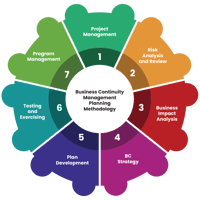](https://cta-redirect.hubspot.com/cta/redirect/3893111/2200ad8c-7d99-4dd5-b92b-249b8d708b20)**Project Management (PM)
- Risk Analysis and Review (RAR)
- Business Impact Analysis (BIA)
- Business Continuity Strategy (BCS)
- Plan Development (PD)
- Testing and Exercising (TE)
- Programme Management (PgM)
ACF should implement BCM as a structured lifecycle, not a collection of standalone emergency plans.
A practical methodology contains seven major phases.
**Phase 1 — Programme Management**
Establish governance, policy, roles, responsibilities, scope and programme management arrangements.
**Phase 2 — Risk Assessment**
Identify threats, vulnerabilities, existing controls and potential disruption scenarios.
**Phase 3 — Business Impact Analysis**
Determine critical activities, understand disruption consequences, and establish recovery priorities.
**Phase 4 — Business Continuity Strategy**
Identify practical solutions for meeting approved recovery requirements.
**Phase 5 — Plan Development**
Document activation, response, continuity and recovery procedures.
**Phase 6 — Testing and Exercising**
Validate whether the arrangements work under realistic disruptive conditions.
**Phase 7 — Programme Management and Continual Improvement**
Review incidents, exercises, organisational changes and performance to continually improve the BCMS.
The methodology should operate as a continuous management cycle rather than a one-time project.
#### **[](https://cta-redirect.hubspot.com/cta/redirect/3893111/a4fa9f02-e184-43b1-8a52-230bf302dd76)**
#### **Assessing Risks and Threats for ACF**
Risk assessment examines what could disrupt ACF's priority activities.
The objective is not to predict every incident. Instead, ACF should understand credible threats, vulnerabilities, dependencies, and existing controls well enough to develop appropriate continuity strategies.
Illustrative threat categories include:
| Threat Category | Examples Relevant to ACF |
| --- | --- |
| Cyber | Ransomware, account compromise, data breach, malicious access |
| Technology | Cloud outage, application failure, telecommunications failure |
| Information | Data corruption, accidental deletion, inaccessible records |
| People | Loss of key personnel, widespread illness, workforce disruption |
| Facilities | Fire, building outage, utility interruption, inaccessible workplace |
| Financial | Banking outage, payment disruption, transaction-processing failure |
| Third Party | Failure of cloud, banking, professional or other service providers |
| Regional | Natural disaster, civil disruption or infrastructure failure affecting partners |
| Compliance | Failure of required due diligence, reporting or governance processes |
| Supply/Service Chain | Dependency failure affecting a critical philanthropic activity |
Risk assessment and BIA perform different but complementary roles.
**Risk assessment asks what could cause disruption.**
**Business Impact Analysis asks what happens if an activity is disrupted and how quickly it must be recovered.**
Both are necessary.
#### **[](https://cta-redirect.hubspot.com/cta/redirect/3893111/fbb42012-8f64-401c-a56c-d84bdcfeee14)**
#### **Identifying Critical Business Functions for ACF**
Not every ACF activity requires the same recovery priority.
A Critical Business Function is an activity or function whose prolonged disruption would create unacceptable consequences for ACF, its stakeholders or its ability to achieve its purpose.
An initial enterprise catalogue may include:
| Code | Proposed Critical Business Function |
| --- | --- |
| CBF-1 | Donor-Advised Fund Administration |
| CBF-2 | Grantmaking and Grant Disbursement |
| CBF-3 | Donor Engagement and Philanthropic Advisory |
| CBF-4 | Grantee Due Diligence and Compliance Screening |
| CBF-5 | Donor Due Diligence and Onboarding |
| CBF-6 | Impact and Collaborative Fund Administration |
| CBF-7 | Cross-Border Giving and Grant Administration |
| CBF-8 | Financial Management, Payment and Fund Reconciliation |
| CBF-9 | Governance, Regulatory Compliance and Critical Reporting |
| CBF-10 | Critical Donor, Grantee and Grant Information Management |
| CBF-11 | Critical Digital Platforms and ICT Services |
| CBF-12 | Crisis and Critical Stakeholder Communications |
The catalogue should subsequently be validated through ACF's formal BIA process.
The important principle is that **criticality is determined by the consequences of disruption over time**, not simply by whether an activity is important during normal operations.
#### **Example — Ransomware Affecting Grantmaking**
Consider a ransomware incident affecting ACF's grant-management environment, shared document repositories and selected finance systems.
Several grants are scheduled for disbursement during the affected period.
ACF's BCM arrangements should enable management to determine:
**What Has Been Affected?**
Identify systems, information, people, processes and third parties affected by the incident.
**Which Critical Functions Are at Risk?**
Determine whether grantmaking, fund administration, finance, donor servicing or other CBFs are affected.
**Which Commitments Are Time-Sensitive?**
Identify approved grants and other obligations that cannot reasonably be deferred.
**Can Information Be Trusted?**
Verify the integrity of alternative or restored information before processing transactions.
**Can Alternative Procedures Be Activated?**
Determine whether approved manual or alternate processes can safely support urgent activities.
**Who Can Authorise Decisions?**
Use predefined delegated authority and escalation arrangements.
**Who Must Be Informed?**
Identify employees, Board members, donors, grantees, financial institutions and other affected stakeholders.
**How Will Normal Operations Be Restored?**
Coordinate technology recovery with business recovery priorities.
**How Will Transactions Be Reconciled?**
Ensure activities performed under continuity arrangements are captured and reconciled when normal systems return.
**What Must Be Improved?**
Conduct a post-incident review and incorporate lessons into BCM arrangements.
This example illustrates why BCM must integrate crisis management, cybersecurity, technology recovery, financial controls, business operations and stakeholder communications.
#### **Relationship Between BCM and Related Disciplines**
BCM should integrate with ACF's wider management framework.
##### **Risk Management**
Identifies and evaluates uncertainty and threats.
##### **Crisis Management**
Provides strategic leadership and decision-making during major incidents.
##### **Incident Management**
Coordinates operational response to specific incidents.
##### **IT Disaster Recovery**
Restores technology services and infrastructure.
##### **Cybersecurity**
Protects information and systems and responds to cyber threats.
##### **Emergency Management**
Protects life, safety and physical assets.
##### **Third-Party Risk Management**
Addresses dependencies on external organisations.
##### **Business Continuity**
Coordinates these capabilities to maintain and recover priority business activities.
Effective resilience depends upon these disciplines working together rather than operating independently.
#### **ISO 22301 Alignment**
ACF's BCMS should reflect the principal management-system elements of ISO 22301.
These include:
| **ISO 22301 Management Area** | **Application to ACF** |
| --- | --- |
| **Context** | Understand ACF, stakeholders, obligations and BCMS scope |
| **Leadership** | Establish policy, governance, accountability and management commitment |
| **Planning** | Address BCMS risks, opportunities and objectives |
| **Support** | Provide people, competencies, communications, resources and documented information |
| **Operation** | Conduct BIA and risk assessment and establish continuity strategies and procedures |
| **Performance Evaluation** | Monitor, measure, audit and review BCM performance |
| **Improvement** | Correct weaknesses and continually improve the BCMS |
ISO 22301:2019 remains the published international BCMS requirements standard as this chapter is prepared, together with its 2024 climate-action amendment.
A new edition is under development, so ACF should periodically review the applicable standard when maintaining the BCMS.
#### **BCM Documentation Structure**
ACF's BCM documentation should be structured so that different documents serve different purposes.
A practical hierarchy may include:
**Level 1 — BCM Policy**
Defines management intent, scope, principles and accountability.
**Level 2 — BCM Framework**
Defines methodology, governance, standards and programme requirements.
**Level 3 — Assessments**
Includes Business Impact Analyses and risk assessments.
**Level 4 — Strategies**
Documents approved continuity and recovery solutions.
**Level 5 — Plans and Procedures**
Provides actionable incident, continuity and recovery instructions.
**Level 6 — Exercise and Review Records**
Provides evidence that arrangements have been tested, reviewed and improved.
Documentation should remain proportionate to ACF's size and complexity. A smaller organisation does not necessarily require more documents; it requires clear, usable and controlled information.
#### **Building BCM into ACF's Organisational Culture**
BCM will be effective only when it becomes part of normal organisational management.
Employees should understand:
- their responsibilities during disruption;
- how incidents are reported;
- how they receive emergency instructions;
- which activities receive priority;
- where continuity procedures are located;
- what alternative arrangements are available; and
- when issues must be escalated.
Management should reinforce BCM through:
- induction;
- awareness activities;
- role-specific training;
- exercises;
- management reviews;
- lessons learned from incidents; and
- periodic updates.
BCM should therefore be regarded as an organisational capability rather than a document maintained by one coordinator.
#### **Relationship to the Three-eBook Series**
This three-eBook series takes ACF through a progressive BCM implementation journey.
**[![\[BCM\] \[E1\] \[C1\] eBook 1 to eBook 3 One Implementation Journey](https://no-cache.hubspot.com/cta/default/3893111/c8ff4234-63bc-493b-9945-c28a3c55b3f0.png)](https://cta-redirect.hubspot.com/cta/redirect/3893111/c8ff4234-63bc-493b-9945-c28a3c55b3f0)**
##### **eBook 1 — Understanding Your Organisation for Asia Community Foundation**
Establishes organisational context, goals, objectives, assumptions, governance, operating environment, risks and Critical Business Functions.
##### **eBook 2 — Implementing Business Continuity Management for Asia Community Foundation**
Translates the understanding established in eBook 1 into detailed BCM assessments, strategies, plans and implementation activities.
##### **eBook 3 — Starting Your BCM Implementation for Asia Community Foundation**
Provides practical guidance for commencing, organising and sustaining implementation across ACF.
Together, the three books move from **understanding to implementation** to **sustained organisational capability**.
#### **Chapter Roadmap**
This introductory chapter establishes the foundation for the remaining chapters of eBook 1.
The subsequent chapters examine in greater depth:
1. introducing BCM within ACF;
2. understanding ACF's operations;
3. establishing BCM goals;
4. defining business continuity objectives;
5. documenting planning assumptions;
6. developing BCM team composition and governance;
7. analysing the operating environment;
8. applying the BCM planning methodology;
9. assessing risks and threats; and
10. identifying Critical Business Functions.
Each element contributes to a common objective: understanding ACF well enough to design continuity arrangements based on its actual mission, operations, stakeholders, dependencies, and risks.
### [![Banner \[Summary\] \[BCM\] \[E1\] \[C2\] Understanding Your Organisation](https://no-cache.hubspot.com/cta/default/3893111/f008eb8e-2d77-4964-abfa-a4ef718b1284.png)](https://cta-redirect.hubspot.com/cta/redirect/3893111/f008eb8e-2d77-4964-abfa-a4ef718b1284)
Business Continuity Management provides Asia Community Foundation with a systematic way to prepare for disruption while protecting the philanthropic services and stakeholder relationships that support its mission.
For ACF, effective BCM requires more than emergency response or technology recovery.
It requires an organisation-wide understanding of critical grantmaking activities, donor and grantee obligations, financial controls, information requirements, governance arrangements, external dependencies and recovery priorities.
ISO 22301 provides the management-system foundation for developing this capability.
Applied proportionately, it enables ACF to establish governance, understand its operating context, analyse business impacts and risks, develop recovery strategies, document actionable plans, exercise those arrangements and continually improve them.
The starting point is understanding the organisation itself.
By defining ACF's BCM goals, objectives, assumptions, governance structure, operating environment, threats and Critical Business Functions, eBook 1 establishes the foundation upon which the remaining BCM implementation activities can be built.
The desired outcome is not simply an organisation that possesses business continuity plans.
It is an organisation that understands **what must continue, why it matters, what it depends upon, how quickly it must recover, who is responsible and how continuity will be maintained when normal operations are no longer available**.
That understanding provides the foundation for a practical and sustainable Business Continuity Management System for Asia Community Foundation.
[](https://cta-redirect.hubspot.com/cta/redirect/3893111/3aefb2d2-3110-47c1-ad4f-d3e6e5381066)
Blogs marked \[x\] are under construction
[](https://cta-redirect.hubspot.com/cta/redirect/3893111/42759885-71e0-4d0d-a239-459f50f0d300)
| **eBook 1: Understanding Your Organisation** | | | | | |
| --- | --- | --- | --- | --- | --- |
| **C1** | **C2 \[x\]** | **C3 \[x\]** | **C4 \[x\]** | **C5 \[x\]** | **C6 \[x\]** |
| [![\[BCM\] \[ACF\] \[E1\] \[C1\] Overview of BCM Case Study](https://no-cache.hubspot.com/cta/default/3893111/28cb6883-2857-48df-8601-20b15ced2a72.png)](https://cta-redirect.hubspot.com/cta/redirect/3893111/28cb6883-2857-48df-8601-20b15ced2a72) | [](https://cta-redirect.hubspot.com/cta/redirect/3893111/9521ac04-796b-4b8e-a17d-92441226b9a3) | [](https://cta-redirect.hubspot.com/cta/redirect/3893111/1ecd461e-a1e1-4c0b-ab5c-1b87b101749e) | [](https://cta-redirect.hubspot.com/cta/redirect/3893111/f1194d59-a6a6-4d50-b449-955eb4c26b5c) | [](https://cta-redirect.hubspot.com/cta/redirect/3893111/2cdb04ed-52f3-4f6d-8ae9-fdc438c5b45e) | [](https://cta-redirect.hubspot.com/cta/redirect/3893111/30f67573-8dc6-4e11-b59d-bdd8ec56fd01) |
| **C7 \[x\]** | **C8 \[x\]** | **C9 \[x\]** | **C10** | **C11 \[x\]** | **C12 \[x\]** |
| [](https://cta-redirect.hubspot.com/cta/redirect/3893111/3e8749b5-59e4-4733-ad5c-7d89539dbbfb) | [](https://cta-redirect.hubspot.com/cta/redirect/3893111/ba1e4b44-8eb4-43c4-8b2d-540188430924) | [](https://cta-redirect.hubspot.com/cta/redirect/3893111/7a14d0d1-50dc-4005-abe7-4ff617ec1551) | [![\[BCM\] \[ACF\] \[E1\] \[C10\] Identifying Critical Business Functions](https://no-cache.hubspot.com/cta/default/3893111/a5ea9cb8-0f14-4831-88e5-de8d8fc0fbb6.png)](https://cta-redirect.hubspot.com/cta/redirect/3893111/a5ea9cb8-0f14-4831-88e5-de8d8fc0fbb6) | [](https://cta-redirect.hubspot.com/cta/redirect/3893111/b2a7e938-55d2-4628-aa95-62293e47c0cd) | [](https://cta-redirect.hubspot.com/cta/redirect/3893111/9939495c-db9d-4d8f-a358-286733d9a1c0) |
| | | | | | |
#### More Information About Business Continuity Management Courses
To learn more about the course and schedule, click the buttons below for BCM-300 Business Continuity Management Implementer \[BCM-3\] and BCM-5000 Business Continuity Management Expert Implementer \[BCM-5\].
| [](https://cta-redirect.hubspot.com/cta/redirect/3893111/f3922b80-e96a-46d6-8993-dc150a5de2d5) | [](https://cta-redirect.hubspot.com/cta/redirect/3893111/9ff8a3dc-e39a-465b-929f-72e232cdd5fb) | [![Register \[BL-B-3\]\*](https://no-cache.hubspot.com/cta/default/3893111/ac6cf073-4cdd-4541-91ed-889f731d5076.png)](https://cta-redirect.hubspot.com/cta/redirect/3893111/ac6cf073-4cdd-4541-91ed-889f731d5076) |
| --- | --- | --- |
| [](https://cta-redirect.hubspot.com/cta/redirect/3893111/21525c10-4003-4934-95fc-fe218174bc5b) | [](https://cta-redirect.hubspot.com/cta/redirect/3893111/46460171-c91a-4936-9bb2-8dc5928a0e02) | [](https://cta-redirect.hubspot.com/cta/redirect/3893111/1cb17ac7-50b2-4f88-bc4b-c7444e4b57b5) |
| [![FAQ \[BL-B-3\]](https://no-cache.hubspot.com/cta/default/3893111/b3824ba1-7aa1-4eb6-bef8-94f57121c5ae.png)](https://cta-redirect.hubspot.com/cta/redirect/3893111/b3824ba1-7aa1-4eb6-bef8-94f57121c5ae) | Please feel free to send us a note if you have any questions. [![Email to Sales Team \[BCM Institute\]](https://no-cache.hubspot.com/cta/default/3893111/3c53daeb-2836-4843-b0e0-645baee2ab9e.png)](https://cta-redirect.hubspot.com/cta/redirect/3893111/3c53daeb-2836-4843-b0e0-645baee2ab9e) | [](https://cta-redirect.hubspot.com/cta/redirect/3893111/9c199ae8-c470-4bb7-9612-73c7a084e94c) |
| [](https://cta-redirect.hubspot.com/cta/redirect/3893111/8999211a-2c51-4be7-bf49-c393f6c67974) | [](https://cta-redirect.hubspot.com/cta/redirect/3893111/5c1aa95d-f6dd-4067-a95c-5cc0c32d7ed8) | [](https://cta-redirect.hubspot.com/cta/redirect/3893111/086ab3b9-4d66-4a95-b2f7-1148e9803a9c) |
### Your Comments Here :
### More Posts
[](https://cta-redirect.hubspot.com/cta/redirect/3893111/839787f4-a4fd-456f-accf-54c947026558)

All rights reserved. Copyright 2026
```json
{
"@context" : "https://schema.org",
"@type" : "BlogPosting",
"author" : {
"@type" : "Person",
"name" : "Moh Heng Goh",
"url" : "https://blog.bcm-institute.org/ebook/author/moh-heng-goh"
},
"dateModified" : "2026-09-25T12:39:59.370Z",
"datePublished" : "2026-09-25T12:22:40.000Z",
"headline" : "[BCM] [ACF] [E1] [C1] Overview of BCM Case Study",
"mainEntityOfPage" : {
"@id" : "https://blog.bcm-institute.org/ebook/bcm-acf-e1-c1-overview-of-bcm-case-study",
"@type" : "WebPage"
},
"publisher" : {
"@type" : "Organization",
"logo" : {
"@type" : "ImageObject",
"url" : "https://blog.bcm-institute.org/hubfs/BCMI%20Logo.png"
},
"name" : "BCMI Pte Ltd"
}
}
```