---
title: [OR] [P2] [S5] [LL] [C7] Linking Lessons Learned to Critical Business Services (CBS)
description: [OR] [P2] [S5] [LL] [C7] Linking Lessons Learned to Critical Business Services (CBS)
image: https://blog.bcm-institute.org/hubfs/OR%20Implement%20Mapping%20Graphic/OR%20Implement%20Series%20Lesson%20Learned%20Morepost/%5BOR%5D%20%5BP2%5D%20%5BS5%5D%20%5BLL%5D%20%5BC7%5D%20Linking%20Lessons%20Learned%20to%20CBS.jpg
---
. .
[](http://www.bcm-institute.org/)
- [Home](https://www.bcm-institute.org/)
- [About Us](https://www.bcm-institute.org/about-us-3/)
- [A President’s Perspective](https://www.bcm-institute.org/about-us/a-presidents-perspective/)
- [Our History](https://www.bcm-institute.org/about-us/our-history/)
- [Our Advisory Council](https://www.bcm-institute.org/about-us/our-advisory-council/)
- [Customers’ Testimonials](https://www.bcm-institute.org/about-us/customers-testimonials/)
- [Credential Verification](https://www.bcm-institute.org/about-us/credential-verification/)
- [Courses](https://blog.bcm-institute.org/blog/course-fees-for-blended-learning-courses-master-catalog)
- [ISO 22301 Business Continuity Management System Audit](https://blog.bcm-institute.org/audit/business-continuity-management-audit-courses)
- [ISO 22301 Business Continuity Management](https://blog.bcm-institute.org/bcm/business-continuity-management-courses)
- [Crisis Communication](https://blog.bcm-institute.org/crisis-communication/crisis-communication-courses)
- [Crisis Management](https://blog.bcm-institute.org/en/crisis-management/courses)
- [IT Disaster Recovery](https://blog.bcm-institute.org/it-disaster-recovery/courses)
- [Operational Resilience](https://blog.bcm-institute.org/operational-resilience/courses)
- [Operational Resilience Audit](https://blog.bcm-institute.org/operational-resilience-audit/courses)
- [Certification](https://blog.bcm-institute.org/certification/types-of-certifications-offered)
- [ISO 22301 BCMS Audit Certification](https://blog.bcm-institute.org/certification/business-continuity-management-audit-certification)
- [ISO22301 Business Continuity Management Certification](https://blog.bcm-institute.org/bcm/business-continuity-management-certification)
- [Crisis Communication Certification](https://blog.bcm-institute.org/crisis-communication/crisis-communication-certification)
- [Crisis Management Certification](https://blog.bcm-institute.org/en/crisis-management/crisis-management-certification)
- [IT Disaster Recovery Planning Certification](https://blog.bcm-institute.org/it-disaster-recovery/it-disaster-recovery-certification)
- [Operational Resilience Certification](https://blog.bcm-institute.org/operational-resilience/operational-resilience-certification)
- [Operational Resilience Audit Certification](https://blog.bcm-institute.org/operational-resilience-audit)
- [Seminars](https://blog.bcm-institute.org/meet-the-expert/mte-webinar-mainpage)
- [Store](https://www.bcm-institute.org/store-2/)
- [Contact Us](http://www.bcm-institute.org/about-us/contact-us/)
-
-
###### Improving Lessons Learned: Strengthening Operational Resilience Through Continuous Improvement
# \[OR\] \[P2\] \[S5\] \[LL\] \[C7\] Linking Lessons Learned to Critical Business Services (CBS)
[](https://cta-redirect.hubspot.com/cta/redirect/3893111/4b69ddd1-f01e-4fa9-a2e1-ffa60ba221fc)
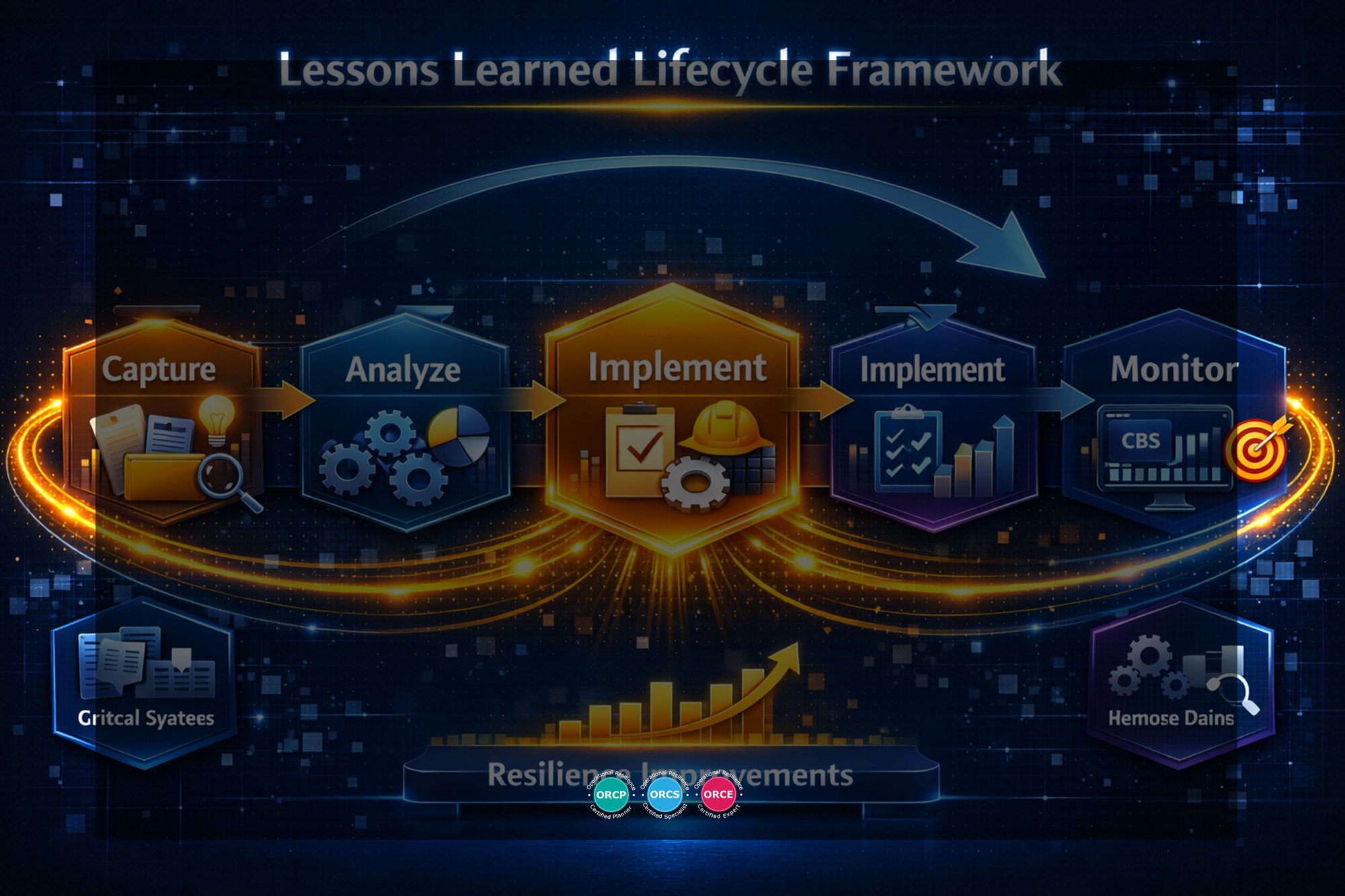
A key principle of operational resilience is that organisations must focus on **services delivered to external customers**, rather than isolated processes or systems. While incidents and failures often occur at the process or system level, their true significance lies in their **impact on Critical Business Services (CBS)**.
Many organisations fail to realise the full value of lessons learned because they:
- Analyse issues at a **component level (e.g., IT systems, processes)**
- Do not connect these issues to **service outcomes**
- Implement improvements that do not strengthen overall service resilience
This chapter emphasises the need to **link lessons learned directly to CBS**, ensuring that all improvements are aligned with:
- Service continuity
- Customer impact
- Regulatory expectations
[](https://cta-redirect.hubspot.com/cta/redirect/3893111/2545ed73-a288-4ae5-9525-acc4b7887e4c)
[Moh Heng Goh](https://blog.bcm-institute.org/ebook-or/author/moh-heng-goh) May 14, 2026
###### Operational Resilience Certified Planner-Specialist-Expert
### [](https://cta-redirect.hubspot.com/cta/redirect/3893111/3c164f95-e606-4b33-8624-b491c3f0fa1a)
### \[P2\] \[S5\] Chapter 7
### [](https://cta-redirect.hubspot.com/cta/redirect/3893111/4b69ddd1-f01e-4fa9-a2e1-ffa60ba221fc)Linking Lessons Learned to Critical Business Services (CBS)
#### **Introduction**
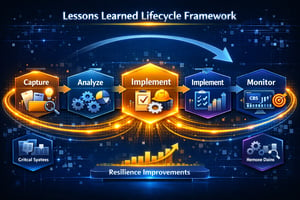
A key principle of operational resilience is that organisations must focus on **services delivered to external customers**, rather than isolated processes or systems. While incidents and failures often occur at the process or system level, their true significance lies in their **impact on Critical Business Services (CBS)**.[![\[OR\] \[P2\] \[S5\] \[LL\] \[C7\] Linking Lessons Learned to CBS](https://no-cache.hubspot.com/cta/default/3893111/f484c1bf-992a-4298-8752-6fec87c33912.png)](https://cta-redirect.hubspot.com/cta/redirect/3893111/f484c1bf-992a-4298-8752-6fec87c33912)
Many organisations fail to realise the full value of lessons learned because they:
- Analyse issues at a **component level (e.g., IT systems, processes)**
- Do not connect these issues to **service outcomes**
- Implement improvements that do not strengthen overall service resilience
This chapter emphasises the need to **link lessons learned directly to CBS**, ensuring that all improvements are aligned with:
- Service continuity
- Customer impact
- Regulatory expectations
#### **Purpose of the Chapter**
To establish a **service-centric approach** for applying Lessons Learned by linking them directly to **Critical Business Services (CBS)**, ensuring that improvements strengthen end-to-end service resilience, protect customers, and support compliance with operational resilience requirements.
#### **Understanding Critical Business Services (CBS)**
##### **Definition**
A **Critical Business Service (CBS)** is a service delivered to an external end user where disruption would result in:
- Intolerable harm to customers
- Threats to market integrity
- Financial or reputational damage
- Regulatory consequences
##### **Key Characteristics**
- Service-oriented (not process or system-based)
- Customer-facing
- Outcome-driven
- Defined by impact tolerance
##### **CBS vs Processes and Systems**
| Element | Description |
| --- | --- |
| CBS | End-to-end service delivered to customers |
| Process | Activities that support the service |
| Technology | Systems enabling processes |
| Resources | People and third parties supporting delivery |
Lessons learned must ultimately focus on **strengthening CBS**, not just fixing individual components.
#### **Why Linking Lessons Learned to CBS is Critical**
##### **Ensuring Service-Centric Improvements**
- Align improvements with customer impact
- Avoid siloed fixes
##### **Supporting Impact Tolerance Compliance**
- Ensure services remain within defined tolerance levels
- Identify conditions leading to breaches
##### **Enhancing End-to-End Resilience**
- Address interdependencies across:
##### ** Meeting Regulatory Expectations**
Regulators expect organisations to:
- Focus on service continuity
- Demonstrate resilience at the service level
#### **Mapping Lessons Learned to CBS**
##### **Step-by-Step Approach**
**Step 1: Identify Impacted CBS**
- Determine which CBS was affected by the incident or test
- Consider both direct and indirect impacts
**Step 2: Map to Sub-CBS**
- Break down CBS into **sub-components**
- Identify specific service elements affected
**Step 3: Link to Dependencies**
- Map issues to:
**Step 4: Assess Service Impact**
- Evaluate:
##### **Sample Mapping Table**
| Sub-CBS Code | Sub-CBS | Issue Identified | Dependency Type | Root Cause | Impact |
| --- | --- | --- | --- | --- | --- |
| 2.1 | Payment Processing | Transaction delays | Technology | System overload | Customer delays |
| 2.2 | Settlement Processing | Failed transactions | Process | Manual intervention errors | Financial impact |
#### **Understanding End-to-End Service Impact**
##### **Service Chain Perspective**
CBS must be viewed as **end-to-end service chains**, involving:
- Upstream processes
- Core processing systems
- Downstream services
- External dependencies
##### **7.5.2 Cascading Failures**
A failure in one component can:
- Trigger failures in other components
- Amplify service disruption
- Lead to widespread impact
##### **7.5.3 Example**
A failure in a payment gateway may:
- Delay transaction processing
- Impact customer access
- Affect downstream settlement systems
Lessons learned must address **entire service chains**, not isolated failures.
#### **Linking Lessons to Customer Impact**
##### **Customer-Centric Analysis**
Lessons learned should consider:
- Number of customers affected
- Nature of service disruption
- Duration of impact
##### **Types of Customer Impact**
- Service unavailability
- Delayed transactions
- Data inaccuracies
- Poor customer experience
##### **Enhancing Customer Outcomes**
Improvements should aim to:
- Reduce disruption duration
- Improve service reliability
- Enhance communication with customers
#### **Integration with Impact Tolerance**
##### **Assessing Tolerance Breaches**
- Determine whether CBS exceeded defined tolerances
- Identify triggers of breach
##### **Refining Impact Tolerance**
- Adjust thresholds based on real-world data
- Improve monitoring mechanisms
##### **Strengthening Controls**
- Implement controls to:
#### **Strengthening Interdependencies Through Lessons Learned**
##### **Identifying Weak Dependencies**
Lessons learned often reveal weaknesses in:
- Internal processes
- Technology systems
- Third-party relationships
##### **Improving Interconnections**
- Enhance communication between systems
- Strengthen integration points
##### **Third-Party Dependencies**
- Assess vendor performance
- Improve oversight and contingency planning
#### **Embedding Service-Centric Thinking**
##### **Shift from Component to Service Perspective**
- Focus on outcomes, not activities
- Align improvements with CBS
##### **Breaking Down Silos**
- Integrate insights across:
##### **Cross-Functional Collaboration**
- Ensure all stakeholders understand their role in service delivery
#### **Practical Case Example: Payments CBS**
##### **Scenario**
A bank experiences a disruption in its **Payments and Funds Transfer Service**.
##### **Lessons Learned Mapping**
| Component | Issue | Impact on CBS |
| --- | --- | --- |
| IT System | System outage | Transactions halted |
| Process | Manual recovery delays | Extended downtime |
| Third-Party | Vendor latency | Slower processing |
##### **Insights**
- Service disruption was caused by **multiple interdependent failures**
- Improvements required across:
##### **Outcome**
- Enhanced system redundancy
- Improved recovery procedures
- Strengthened vendor SLAs
#### **Common Pitfalls**
Organisations often face the following challenges:
##### **Component-Level Focus**
- Fixing systems without considering service impact
##### **Incomplete Mapping**
- Failure to identify all dependencies
##### **Lack of Customer Perspective**
- Ignoring customer impact
##### **Siloed Improvements**
- Lack of coordination across functions
#### **Best Practices**
##### **Adopt a Service-Centric Framework**
- Align all lessons with CBS
##### **Maintain Updated Mapping**
- Regularly update interdependency maps
##### **Use Data and Metrics**
- Measure service performance
- Monitor impact tolerance
##### **Integrate Across Functions**
- Collaborate across departments
[![\[Banner\] \[Summing\] \[OR\] \[E2\] \[C13\] Improving Lessons Learned](https://no-cache.hubspot.com/cta/default/3893111/71190ffb-94e6-4ae9-b40a-8f29585ab4ec.png)](https://cta-redirect.hubspot.com/cta/redirect/3893111/71190ffb-94e6-4ae9-b40a-8f29585ab4ec)
Linking lessons learned to Critical Business Services is essential for achieving **true operational resilience**. By focusing on service outcomes rather than individual components, organisations can:
- Strengthen end-to-end service delivery
- Improve customer experience
- Enhance compliance with regulatory expectations
- Reduce the likelihood and impact of disruptions
This service-centric approach ensures that lessons learned translate into **meaningful, organisation-wide improvements**.
##### **Transition to Next Chapter**
Having established the importance of linking lessons learned to Critical Business Services, the next chapter will explore **how lessons learned integrate with scenario testing and impact tolerance**, ensuring continuous refinement of testing strategies and resilience thresholds.
[](https://cta-redirect.hubspot.com/cta/redirect/3893111/49818a85-5555-4d5b-a3ca-28d5300db18b)
| **C1** | **C2** | **C3** | **C4** | **C5** | **C6** |
| --- | --- | --- | --- | --- | --- |
| [![\[OR\] \[P2\] \[S5\] \[LL\] \[C1\] Introduction to Lessons Learned in OR](https://no-cache.hubspot.com/cta/default/3893111/b76a622a-f295-4503-87fa-4c58f5f087a8.png)](https://cta-redirect.hubspot.com/cta/redirect/3893111/b76a622a-f295-4503-87fa-4c58f5f087a8) | [![\[OR\] \[P2\] \[S5\] \[LL\] \[C2\] The Role of Lessons Learned in the OR Lifecycle](https://no-cache.hubspot.com/cta/default/3893111/b9f0d952-dfd0-400d-b37f-24d9c59f2baa.png)](https://cta-redirect.hubspot.com/cta/redirect/3893111/b9f0d952-dfd0-400d-b37f-24d9c59f2baa) | [![\[OR\] \[P2\] \[S5\] \[LL\] \[C3\] Governance and Ownership of Lessons Learned](https://no-cache.hubspot.com/cta/default/3893111/8e352c01-ff6a-4ff6-b81b-90ad0ad15f46.png)](https://cta-redirect.hubspot.com/cta/redirect/3893111/8e352c01-ff6a-4ff6-b81b-90ad0ad15f46) | [![\[OR\] \[P2\] \[S5\] \[LL\] \[C4\] Sources and Triggers for Capturing Lessons Learned](https://no-cache.hubspot.com/cta/default/3893111/856c1acb-96c5-49ed-afa3-ffbb8e61d9e6.png)](https://cta-redirect.hubspot.com/cta/redirect/3893111/856c1acb-96c5-49ed-afa3-ffbb8e61d9e6) | [![\[OR\] \[P2\] \[S5\] \[LL\] \[C5\] Lessons Learned Framework and Methodology](https://no-cache.hubspot.com/cta/default/3893111/c86a2b1e-05a8-44b9-a74f-730d85b6d046.png)](https://cta-redirect.hubspot.com/cta/redirect/3893111/c86a2b1e-05a8-44b9-a74f-730d85b6d046) | [![\[OR\] \[P2\] \[S5\] \[LL\] \[C6\] Root Cause Analysis (RCA) Techniques](https://no-cache.hubspot.com/cta/default/3893111/b3d2f707-1f82-4f0a-8d51-f3451c78c337.png)](https://cta-redirect.hubspot.com/cta/redirect/3893111/b3d2f707-1f82-4f0a-8d51-f3451c78c337) |
| **C7** | **C8** | **C9** | **C10** | **C11** | **C12 ** |
| [![\[OR\] \[P2\] \[S5\] \[LL\] \[C7\] Linking Lessons Learned to CBS](https://no-cache.hubspot.com/cta/default/3893111/f484c1bf-992a-4298-8752-6fec87c33912.png)](https://cta-redirect.hubspot.com/cta/redirect/3893111/f484c1bf-992a-4298-8752-6fec87c33912) | [![\[OR\] \[P2\] \[S5\] \[LL\] \[C8\] Integration with Scenario Testing and Impact Tolerance](https://no-cache.hubspot.com/cta/default/3893111/5eaa1a40-8d88-414b-8f38-9db2edd6ca0b.png)](https://cta-redirect.hubspot.com/cta/redirect/3893111/5eaa1a40-8d88-414b-8f38-9db2edd6ca0b) | [![\[OR\] \[P2\] \[S5\] \[LL\] \[C9\] Developing and Prioritising Improvement Actions](https://no-cache.hubspot.com/cta/default/3893111/af3c93f2-7736-4431-84d3-664e4bc9e425.png)](https://cta-redirect.hubspot.com/cta/redirect/3893111/af3c93f2-7736-4431-84d3-664e4bc9e425) | [![\[OR\] \[P2\] \[S5\] \[LL\] \[C10\] Embedding Continuous Improvement](https://no-cache.hubspot.com/cta/default/3893111/505103ad-4012-41a7-9fb9-afda3baeb58d.png)](https://cta-redirect.hubspot.com/cta/redirect/3893111/505103ad-4012-41a7-9fb9-afda3baeb58d) | [![\[OR\] \[P2\] \[S5\] \[LL\] \[C11\] Communication of Lessons Learned](https://no-cache.hubspot.com/cta/default/3893111/fba3d8cc-8854-4f13-9408-37d1ebc49091.png)](https://cta-redirect.hubspot.com/cta/redirect/3893111/fba3d8cc-8854-4f13-9408-37d1ebc49091) | [![\[OR\] \[P2\] \[S5\] \[LL\] \[C12\] Technology and Tools for Lessons Learned Management](https://no-cache.hubspot.com/cta/default/3893111/2b75ccca-cdc3-4327-84ff-e06677302878.png)](https://cta-redirect.hubspot.com/cta/redirect/3893111/2b75ccca-cdc3-4327-84ff-e06677302878) |
| **C13** | **C14** | **C15** | **C16** | **C17** | |
| [![\[OR\] \[P2\] \[S5\] \[LL\] \[C13\] Regulatory Expectations and Compliance](https://no-cache.hubspot.com/cta/default/3893111/516c631b-bb38-4b5f-9446-afcedbe2751c.png)](https://cta-redirect.hubspot.com/cta/redirect/3893111/516c631b-bb38-4b5f-9446-afcedbe2751c) | [![\[OR\] \[P2\] \[S5\] \[LL\] \[C14\] Common Challenges and Pitfalls](https://no-cache.hubspot.com/cta/default/3893111/afb5b7fb-efcb-4832-a6bd-44f3f36c97ee.png)](https://cta-redirect.hubspot.com/cta/redirect/3893111/afb5b7fb-efcb-4832-a6bd-44f3f36c97ee) | [![\[OR\] \[P2\] \[S5\] \[LL\] \[C15\] Practical Case Study (Banking Sector Example)](https://no-cache.hubspot.com/cta/default/3893111/9769f9fc-a994-4962-b5cf-7b2aa9ad5875.png)](https://cta-redirect.hubspot.com/cta/redirect/3893111/9769f9fc-a994-4962-b5cf-7b2aa9ad5875) | [![\[OR\] \[P2\] \[S5\] \[LL\] \[C16\] Future Trends in Lessons Learned](https://no-cache.hubspot.com/cta/default/3893111/b0a94161-20fe-4a63-a164-12d2be9c007c.png)](https://cta-redirect.hubspot.com/cta/redirect/3893111/b0a94161-20fe-4a63-a164-12d2be9c007c) | [![\[OR\] \[P2\] \[S5\] \[LL\] \[C17\] Key Takeaways and Call to Action](https://no-cache.hubspot.com/cta/default/3893111/edcf7673-1c76-45e7-9b70-12cda97ceac6.png)](https://cta-redirect.hubspot.com/cta/redirect/3893111/edcf7673-1c76-45e7-9b70-12cda97ceac6) | |
#### More Information About OR-5000 \[OR-5\] or OR-300 \[OR-3\]
To learn more about the course and schedule, click the buttons below for the OR-300 Operational Resilience Implementer course and the OR-5000 Operational Resilience Expert Implementer course.
| [](https://cta-redirect.hubspot.com/cta/redirect/3893111/3530eccb-515d-401e-afc2-3469e26d7fbf) | [](https://cta-redirect.hubspot.com/cta/redirect/3893111/fdd4fa9c-ed69-40c1-925f-4eb6a1c5c255) | [](https://cta-redirect.hubspot.com/cta/redirect/3893111/77a34b84-0a6d-44f8-b8d6-6ab04cdf5edd) |
| --- | --- | --- |
| [](https://cta-redirect.hubspot.com/cta/redirect/3893111/6e5c0cda-39b9-4bbd-b3d4-4cf46a790b14) | [](https://cta-redirect.hubspot.com/cta/redirect/3893111/a68a08aa-36d3-4216-9551-202c9fde06ea) | [![ \[BL-OR\] \[3-4-5\] View Schedule](https://no-cache.hubspot.com/cta/default/3893111/d0d733a1-16c0-4b68-a26d-adbfd4fc6069.png)](https://cta-redirect.hubspot.com/cta/redirect/3893111/d0d733a1-16c0-4b68-a26d-adbfd4fc6069) |
| [![\[BL-OR\] \[3\] FAQ OR-300](https://no-cache.hubspot.com/cta/default/3893111/f20c71b4-f5e8-4aa5-8056-c374ca33a091.png)](https://cta-redirect.hubspot.com/cta/redirect/3893111/f20c71b4-f5e8-4aa5-8056-c374ca33a091) | If you have any questions, click to contact us.[![Email to Sales Team \[BCM Institute\]](https://no-cache.hubspot.com/cta/default/3893111/3c53daeb-2836-4843-b0e0-645baee2ab9e.png)](https://cta-redirect.hubspot.com/cta/redirect/3893111/3c53daeb-2836-4843-b0e0-645baee2ab9e) | [](https://cta-redirect.hubspot.com/cta/redirect/3893111/7f2718a4-ea80-4f84-a319-dc2d4df37a46) |
| [](https://cta-redirect.hubspot.com/cta/redirect/3893111/74b1e556-8cd2-4a74-8821-db1804534955) | [](https://cta-redirect.hubspot.com/cta/redirect/3893111/f2bd8eb1-32d2-4732-9267-ea53223cf58f) | [](https://cta-redirect.hubspot.com/cta/redirect/3893111/084e620a-46c5-419a-82ed-6a681d15c0b6) |
#### **Comments:**
---

---

---
---


All rights reserved. Copyright 2026
```json
{
"@context" : "https://schema.org",
"@type" : "BlogPosting",
"author" : {
"@type" : "Person",
"name" : "Moh Heng Goh",
"url" : "https://blog.bcm-institute.org/ebook-or/author/moh-heng-goh"
},
"dateModified" : "2026-05-14T15:21:56.845Z",
"datePublished" : "2026-05-14T14:24:35.000Z",
"headline" : "[OR] [P2] [S5] [LL] [C7] Linking Lessons Learned to Critical Business Services (CBS)",
"mainEntityOfPage" : {
"@id" : "https://blog.bcm-institute.org/ebook-or/or-p2-s5-ll-c7-linking-lessons-learned-to-critical-business-services-cbs",
"@type" : "WebPage"
},
"publisher" : {
"@type" : "Organization",
"logo" : {
"@type" : "ImageObject",
"url" : "https://blog.bcm-institute.org/hubfs/BCMI%20Logo.png"
},
"name" : "BCMI Pte Ltd"
}
}
```