---
title: [OR] [P2] [S3] [ITo] [C18] [Back Cover] eBook 1
description: [OR] [P2] [S3] [ITo] [C18] [Back Cover] eBook 1
image: https://blog.bcm-institute.org/hubfs/OR%20Implement%20Series/OR%20BB%20P2S1_CBS_01.jpg
---
. .
[](http://www.bcm-institute.org/)
- [Home](https://www.bcm-institute.org/)
- [About Us](https://www.bcm-institute.org/about-us-3/)
- [A President’s Perspective](https://www.bcm-institute.org/about-us/a-presidents-perspective/)
- [Our History](https://www.bcm-institute.org/about-us/our-history/)
- [Our Advisory Council](https://www.bcm-institute.org/about-us/our-advisory-council/)
- [Customers’ Testimonials](https://www.bcm-institute.org/about-us/customers-testimonials/)
- [Credential Verification](https://www.bcm-institute.org/about-us/credential-verification/)
- [Courses](https://blog.bcm-institute.org/blog/course-fees-for-blended-learning-courses-master-catalog)
- [ISO 22301 Business Continuity Management System Audit](https://blog.bcm-institute.org/audit/business-continuity-management-audit-courses)
- [ISO 22301 Business Continuity Management](https://blog.bcm-institute.org/bcm/business-continuity-management-courses)
- [Crisis Communication](https://blog.bcm-institute.org/crisis-communication/crisis-communication-courses)
- [Crisis Management](https://blog.bcm-institute.org/en/crisis-management/courses)
- [IT Disaster Recovery](https://blog.bcm-institute.org/it-disaster-recovery/courses)
- [Operational Resilience](https://blog.bcm-institute.org/operational-resilience/courses)
- [Operational Resilience Audit](https://blog.bcm-institute.org/operational-resilience-audit/courses)
- [Certification](https://blog.bcm-institute.org/certification/types-of-certifications-offered)
- [ISO 22301 BCMS Audit Certification](https://blog.bcm-institute.org/certification/business-continuity-management-audit-certification)
- [ISO22301 Business Continuity Management Certification](https://blog.bcm-institute.org/bcm/business-continuity-management-certification)
- [Crisis Communication Certification](https://blog.bcm-institute.org/crisis-communication/crisis-communication-certification)
- [Crisis Management Certification](https://blog.bcm-institute.org/en/crisis-management/crisis-management-certification)
- [IT Disaster Recovery Planning Certification](https://blog.bcm-institute.org/it-disaster-recovery/it-disaster-recovery-certification)
- [Operational Resilience Certification](https://blog.bcm-institute.org/operational-resilience/operational-resilience-certification)
- [Operational Resilience Audit Certification](https://blog.bcm-institute.org/operational-resilience-audit)
- [Seminars](https://blog.bcm-institute.org/meet-the-expert/mte-webinar-mainpage)
- [Store](https://www.bcm-institute.org/store-2/)
- [Contact Us](http://www.bcm-institute.org/about-us/contact-us/)
-
-
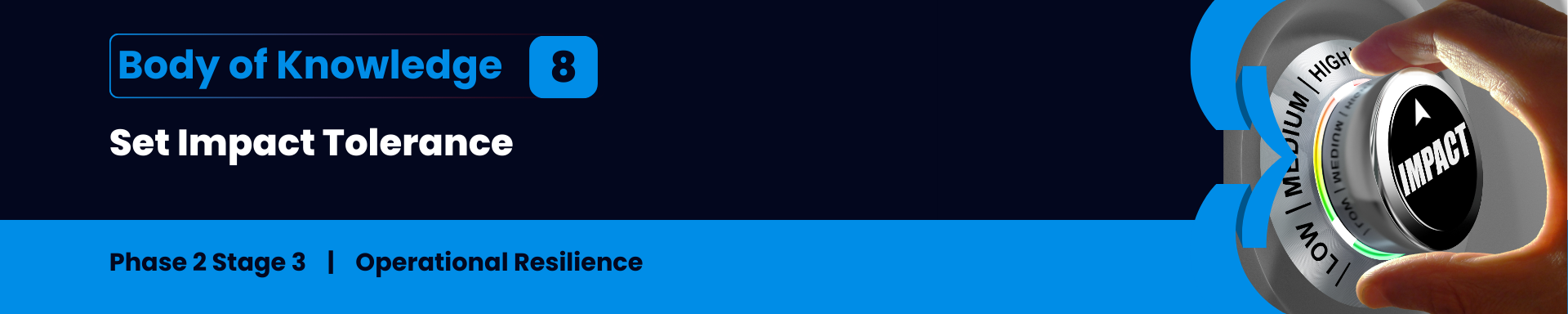
###### Setting Impact Tolerances: A Practical Guide for Operational Resilience Implementation

# \[OR\] \[P2\] \[S3\] \[ITo\] \[C18\] \[Back Cover\] eBook 1
[](https://cta-redirect.hubspot.com/cta/redirect/3893111/b130e2d2-651f-4fd6-af68-9a5a85e124da)
[![Book Cover \[OR\] \[P2\] \[S3\] Setting Impact Tolerances](https://no-cache.hubspot.com/cta/default/3893111/18403c9d-7fbb-42fa-ba2c-0596e61af3f7.png)](https://cta-redirect.hubspot.com/cta/redirect/3893111/18403c9d-7fbb-42fa-ba2c-0596e61af3f7)In today’s increasingly complex and interconnected environment, organisations are no longer measured by how quickly they recover—but by how well they can **withstand disruption without causing intolerable harm**.
Setting Impact Tolerances provides a practical, implementation-focused guide for Operational Resilience leaders to define, calibrate, and operationalise impact tolerance as a core resilience capability.
Developed by BCM Institute, this eBook translates the **OR Planning Methodology (Plan Phase – Stage 3: Set Impact Tolerance)** into actionable steps, tools, and real-world applications.
Designed for appointed Operational Resilience team leads, coordinators, and risk professionals, this guide bridges regulatory expectations with hands-on execution—helping organisations move from compliance to true resilience maturity.
[](https://cta-redirect.hubspot.com/cta/redirect/3893111/e5fad794-08a2-4f8b-ba94-5d32e15ba9bc)
[Moh Heng Goh](https://blog.bcm-institute.org/ebook-or/author/moh-heng-goh) May 8, 2026
###### Operational Resilience Certified Planner-Specialist-Expert
#### [](https://cta-redirect.hubspot.com/cta/redirect/3893111/00e8044a-8a62-4f8f-be7c-9c267d8b3dfc)
### \[P2\] \[S3\] Chapter 18
### [](https://cta-redirect.hubspot.com/cta/redirect/3893111/b130e2d2-651f-4fd6-af68-9a5a85e124da)
### **Back Cover Content – “Setting Impact Tolerances: A Practical Guide for Operational Resilience Implementation”**
[![\[OR\] \[P2\] \[S3\] \[ITo\] \[C18\] Back Cover](https://no-cache.hubspot.com/cta/default/3893111/3623335d-0b26-4ee7-afbf-0d431358b390.png)](https://cta-redirect.hubspot.com/cta/redirect/3893111/3623335d-0b26-4ee7-afbf-0d431358b390)In today’s increasingly complex and interconnected environment, organisations are no longer measured by how quickly they recover—but by how well they can **withstand disruption without causing intolerable harm**.
Setting Impact Tolerances provides a practical, implementation-focused guide for Operational Resilience leaders to define, calibrate, and operationalise impact tolerance as a core resilience capability.
Developed by BCM Institute, this eBook translates the **OR Planning Methodology (Plan Phase – Stage 3: Set Impact Tolerance)** into actionable steps, tools, and real-world applications.
Designed for appointed Operational Resilience team leads, coordinators, and risk professionals, this guide bridges regulatory expectations with hands-on execution—helping organisations move from compliance to true resilience maturity.
**[![Book Cover \[OR\] \[P2\] \[S3\] Setting Impact Tolerances](https://no-cache.hubspot.com/cta/default/3893111/18403c9d-7fbb-42fa-ba2c-0596e61af3f7.png)](https://cta-redirect.hubspot.com/cta/redirect/3893111/18403c9d-7fbb-42fa-ba2c-0596e61af3f7)Inside this eBook, you will:**
- Gain a clear understanding of **impact tolerance** and its role in operational resilience
- Align tolerance thresholds with **Critical Business Services (CBS)** and customer outcomes
- Apply a **step-by-step methodology** to define Maximum Tolerable Downtime (MTD) and impact thresholds
- Use **structured assessment frameworks and templates** to document and justify tolerances
- Calibrate tolerances through **severe but plausible scenario testing**
- Integrate **dependency mapping (people, process, technology, third parties)** into tolerance setting
- Establish **governance, ownership, and accountability** for resilience decisions
- Validate tolerances through testing, monitoring, and continuous improvement
- Learn from a **practical banking sector case study** with real-world application
- Understand **future trends**, including AI-driven resilience and real-time tolerance monitoring
**Take your expertise further:**
This eBook is part of the learning pathway for the **OR-5000 Operational Resilience Expert Implementer Programme**, an advanced certification by BCM Institute. Participants will:
- Develop end-to-end capability to implement **impact tolerance within their organisation**
- Gain hands-on experience through **training-led implementation**
- Earn a **globally recognised certification** upon successful completion of the qualifying examination
- Join a network of certified professionals leading operational resilience initiatives across industries
**Move beyond recovery. Define your limits. Build resilience that holds under pressure.**
[](https://cta-redirect.hubspot.com/cta/redirect/3893111/05996af2-38e1-4f05-96c6-6f5d6469c9de)
| **C1** | **C2** | **C3** | **C4** | **C5** | **C6** |
| --- | --- | --- | --- | --- | --- |
| [![\[OR\] \[P2\] \[S3\] \[ITo\] \[C1\] Introduction to Impact Tolerance](https://no-cache.hubspot.com/cta/default/3893111/a2d06a13-c2ac-4e0a-b8ea-c5afcab91844.png)](https://cta-redirect.hubspot.com/cta/redirect/3893111/a2d06a13-c2ac-4e0a-b8ea-c5afcab91844) | [![\[OR\] \[P2\] \[S3\] \[ITo\] \[C2\] Regulatory and Standards Landscape](https://no-cache.hubspot.com/cta/default/3893111/04df8f17-629c-458f-af01-67e3da528b63.png)](https://cta-redirect.hubspot.com/cta/redirect/3893111/04df8f17-629c-458f-af01-67e3da528b63) | [![\[OR\] \[P2\] \[S3\] \[ITo\] \[C3\] Understanding Impact Tolerance in Context](https://no-cache.hubspot.com/cta/default/3893111/ea66bac0-7b34-4d56-9c93-c33c8f7964bc.png)](https://cta-redirect.hubspot.com/cta/redirect/3893111/ea66bac0-7b34-4d56-9c93-c33c8f7964bc) | [![\[OR\] \[P2\] \[S3\] \[ITo\] \[C4\] Linking Impact Tolerance to Critical Business Services (CBS)](https://no-cache.hubspot.com/cta/default/3893111/24ceb290-50c2-4af4-be00-41894f00c7cb.png)](https://cta-redirect.hubspot.com/cta/redirect/3893111/24ceb290-50c2-4af4-be00-41894f00c7cb) | [![\[OR\] \[P2\] \[S3\] \[ITo\] \[C5\] Key Components of Impact Tolerance](https://no-cache.hubspot.com/cta/default/3893111/6e9d8a15-c0a3-4e28-b9a4-c2dcc3e2081e.png)](https://cta-redirect.hubspot.com/cta/redirect/3893111/6e9d8a15-c0a3-4e28-b9a4-c2dcc3e2081e) | [![\[OR\] \[P2\] \[S3\] \[ITo\] \[C6\] Methodology for Setting Impact Tolerance](https://no-cache.hubspot.com/cta/default/3893111/77526e47-fc15-4c7b-bf03-cadd672b40db.png)](https://cta-redirect.hubspot.com/cta/redirect/3893111/77526e47-fc15-4c7b-bf03-cadd672b40db) |
| **C7** | **C8** | **C9** | **C10** | **C11** | **C12 ** |
| [![\[OR\] \[P2\] \[S3\] \[ITo\] \[C7\] Impact Tolerance Assessment Framework](https://no-cache.hubspot.com/cta/default/3893111/abf28462-aba4-4970-81be-55cf66dc6147.png)](https://cta-redirect.hubspot.com/cta/redirect/3893111/abf28462-aba4-4970-81be-55cf66dc6147) | [![\[OR\] \[P2\] \[S3\] \[ITo\] \[C8\] Scenario-Based Calibration of Impact Tolerance](https://no-cache.hubspot.com/cta/default/3893111/23b3a54d-37ce-494b-acb1-33b3cc5e1655.png)](https://cta-redirect.hubspot.com/cta/redirect/3893111/23b3a54d-37ce-494b-acb1-33b3cc5e1655) | [![\[OR\] \[P2\] \[S3\] \[ITo\] \[C9\] Role of Dependency Mapping in Impact Tolerance](https://no-cache.hubspot.com/cta/default/3893111/d35fd8b0-e936-4ab3-9706-4366bfcb8cbe.png)](https://cta-redirect.hubspot.com/cta/redirect/3893111/d35fd8b0-e936-4ab3-9706-4366bfcb8cbe) | [![\[OR\] \[P2\] \[S3\] \[ITo\] \[C10\] Governance, Ownership, and Accountability](https://no-cache.hubspot.com/cta/default/3893111/de12fefd-b6c6-4156-83a9-5d19ca5bc508.png)](https://cta-redirect.hubspot.com/cta/redirect/3893111/de12fefd-b6c6-4156-83a9-5d19ca5bc508) | [![\[OR\] \[P2\] \[S3\] \[ITo\] \[C11\] Integration with Operational Resilience Framework](https://no-cache.hubspot.com/cta/default/3893111/84d3d3c4-0647-4ffd-99b4-a20a12526019.png)](https://cta-redirect.hubspot.com/cta/redirect/3893111/84d3d3c4-0647-4ffd-99b4-a20a12526019) | [![\[OR\] \[P2\] \[S3\] \[ITo\] \[C12\] Testing and Validation of Impact Tolerances](https://no-cache.hubspot.com/cta/default/3893111/9a9cb7eb-1ca3-4790-b39e-f6b0035a1eae.png)](https://cta-redirect.hubspot.com/cta/redirect/3893111/9a9cb7eb-1ca3-4790-b39e-f6b0035a1eae) |
| **C13** | **C14** | **C15** | **C16** | **C17** | **C18** |
| [![\[OR\] \[P2\] \[S3\] \[ITo\] \[C13\] Monitoring, Metrics, and Continuous Improvement](https://no-cache.hubspot.com/cta/default/3893111/1a32f981-3a16-427a-a63f-5a40ab93ea21.png)](https://cta-redirect.hubspot.com/cta/redirect/3893111/1a32f981-3a16-427a-a63f-5a40ab93ea21) | [![\[OR\] \[P2\] \[S3\] \[ITo\] \[C14\] Common Challenges and Pitfalls](https://no-cache.hubspot.com/cta/default/3893111/8831463d-a357-4203-806b-fb31ef71d615.png)](https://cta-redirect.hubspot.com/cta/redirect/3893111/8831463d-a357-4203-806b-fb31ef71d615) | [![\[OR\] \[P2\] \[S3\] \[ITo\] \[C15\] Practical Case Study (Banking Sector Example)](https://no-cache.hubspot.com/cta/default/3893111/fef15761-14c6-4e2b-b157-554cceb33d14.png)](https://cta-redirect.hubspot.com/cta/redirect/3893111/fef15761-14c6-4e2b-b157-554cceb33d14) | [![\[OR\] \[P2\] \[S3\] \[ITo\] \[C16\] Future Trends in Impact Tolerance](https://no-cache.hubspot.com/cta/default/3893111/b6a701db-167e-4630-88ad-de0d43deb322.png)](https://cta-redirect.hubspot.com/cta/redirect/3893111/b6a701db-167e-4630-88ad-de0d43deb322) | [![\[OR\] \[P2\] \[S3\] \[ITo\] \[C17\] Key Takeaways and Call to Action](https://no-cache.hubspot.com/cta/default/3893111/bf49e0c2-33a3-48bc-97d2-eb939aed77bd.png)](https://cta-redirect.hubspot.com/cta/redirect/3893111/bf49e0c2-33a3-48bc-97d2-eb939aed77bd) | [![\[OR\] \[P2\] \[S3\] \[ITo\] \[C18\] Back Cover](https://no-cache.hubspot.com/cta/default/3893111/3623335d-0b26-4ee7-afbf-0d431358b390.png)](https://cta-redirect.hubspot.com/cta/redirect/3893111/3623335d-0b26-4ee7-afbf-0d431358b390) |
#### More Information About OR-5000 \[OR-5\] or OR-300 \[OR-3\]
To learn more about the course and schedule, click the buttons below for the OR-300 Operational Resilience Implementer course and the OR-5000 Operational Resilience Expert Implementer course.
| [](https://cta-redirect.hubspot.com/cta/redirect/3893111/3530eccb-515d-401e-afc2-3469e26d7fbf) | [](https://cta-redirect.hubspot.com/cta/redirect/3893111/fdd4fa9c-ed69-40c1-925f-4eb6a1c5c255) | [](https://cta-redirect.hubspot.com/cta/redirect/3893111/77a34b84-0a6d-44f8-b8d6-6ab04cdf5edd) |
| --- | --- | --- |
| [](https://cta-redirect.hubspot.com/cta/redirect/3893111/6e5c0cda-39b9-4bbd-b3d4-4cf46a790b14) | [](https://cta-redirect.hubspot.com/cta/redirect/3893111/a68a08aa-36d3-4216-9551-202c9fde06ea) | [![ \[BL-OR\] \[3-4-5\] View Schedule](https://no-cache.hubspot.com/cta/default/3893111/d0d733a1-16c0-4b68-a26d-adbfd4fc6069.png)](https://cta-redirect.hubspot.com/cta/redirect/3893111/d0d733a1-16c0-4b68-a26d-adbfd4fc6069) |
| [![\[BL-OR\] \[3\] FAQ OR-300](https://no-cache.hubspot.com/cta/default/3893111/f20c71b4-f5e8-4aa5-8056-c374ca33a091.png)](https://cta-redirect.hubspot.com/cta/redirect/3893111/f20c71b4-f5e8-4aa5-8056-c374ca33a091) | If you have any questions, click to contact us.[![Email to Sales Team \[BCM Institute\]](https://no-cache.hubspot.com/cta/default/3893111/3c53daeb-2836-4843-b0e0-645baee2ab9e.png)](https://cta-redirect.hubspot.com/cta/redirect/3893111/3c53daeb-2836-4843-b0e0-645baee2ab9e) | [](https://cta-redirect.hubspot.com/cta/redirect/3893111/7f2718a4-ea80-4f84-a319-dc2d4df37a46) |
| [](https://cta-redirect.hubspot.com/cta/redirect/3893111/74b1e556-8cd2-4a74-8821-db1804534955) | [](https://cta-redirect.hubspot.com/cta/redirect/3893111/f2bd8eb1-32d2-4732-9267-ea53223cf58f) | [](https://cta-redirect.hubspot.com/cta/redirect/3893111/084e620a-46c5-419a-82ed-6a681d15c0b6) |
#### **Comments:**
---

---

---
---


All rights reserved. Copyright 2026
```json
{
"@context" : "https://schema.org",
"@type" : "BlogPosting",
"author" : {
"@type" : "Person",
"name" : "Moh Heng Goh",
"url" : "https://blog.bcm-institute.org/ebook-or/author/moh-heng-goh"
},
"dateModified" : "2026-05-11T07:43:46.967Z",
"datePublished" : "2026-05-08T10:05:31.000Z",
"headline" : "[OR] [P2] [S3] [ITo] [C18] [Back Cover] eBook 1",
"mainEntityOfPage" : {
"@id" : "https://blog.bcm-institute.org/ebook-or/or-p2-s3-ito-c18-back-cover-ebook-1",
"@type" : "WebPage"
},
"publisher" : {
"@type" : "Organization",
"logo" : {
"@type" : "ImageObject",
"url" : "https://blog.bcm-institute.org/hubfs/BCMI%20Logo.png"
},
"name" : "BCMI Pte Ltd"
}
}
```