---
title: [OR] [P2] [S2] [MII] [C2] Why Mapping is Critical for Operational Resilience
description: [OR] [P2] [S2] [MII] [C1] Introduction to Interconnections and Interdependencies
image: https://blog.bcm-institute.org/hubfs/OR%20Critical%20Business%20Services%20P2%20Morepost/%5BOR%5D%20%5BP2%5D%20%5BS1%5D%20%5BCBS%5D%20%5BC1%5D%20Purpose%20and%20Importance.png
---
. .
[](http://www.bcm-institute.org/)
- [Home](https://www.bcm-institute.org/)
- [About Us](https://www.bcm-institute.org/about-us-3/)
- [A President’s Perspective](https://www.bcm-institute.org/about-us/a-presidents-perspective/)
- [Our History](https://www.bcm-institute.org/about-us/our-history/)
- [Our Advisory Council](https://www.bcm-institute.org/about-us/our-advisory-council/)
- [Customers’ Testimonials](https://www.bcm-institute.org/about-us/customers-testimonials/)
- [Credential Verification](https://www.bcm-institute.org/about-us/credential-verification/)
- [Courses](https://blog.bcm-institute.org/blog/course-fees-for-blended-learning-courses-master-catalog)
- [ISO 22301 Business Continuity Management System Audit](https://blog.bcm-institute.org/audit/business-continuity-management-audit-courses)
- [ISO 22301 Business Continuity Management](https://blog.bcm-institute.org/bcm/business-continuity-management-courses)
- [Crisis Communication](https://blog.bcm-institute.org/crisis-communication/crisis-communication-courses)
- [Crisis Management](https://blog.bcm-institute.org/en/crisis-management/courses)
- [IT Disaster Recovery](https://blog.bcm-institute.org/it-disaster-recovery/courses)
- [Operational Resilience](https://blog.bcm-institute.org/operational-resilience/courses)
- [Operational Resilience Audit](https://blog.bcm-institute.org/operational-resilience-audit/courses)
- [Certification](https://blog.bcm-institute.org/certification/types-of-certifications-offered)
- [ISO 22301 BCMS Audit Certification](https://blog.bcm-institute.org/certification/business-continuity-management-audit-certification)
- [ISO22301 Business Continuity Management Certification](https://blog.bcm-institute.org/bcm/business-continuity-management-certification)
- [Crisis Communication Certification](https://blog.bcm-institute.org/crisis-communication/crisis-communication-certification)
- [Crisis Management Certification](https://blog.bcm-institute.org/en/crisis-management/crisis-management-certification)
- [IT Disaster Recovery Planning Certification](https://blog.bcm-institute.org/it-disaster-recovery/it-disaster-recovery-certification)
- [Operational Resilience Certification](https://blog.bcm-institute.org/operational-resilience/operational-resilience-certification)
- [Operational Resilience Audit Certification](https://blog.bcm-institute.org/operational-resilience-audit)
- [Seminars](https://blog.bcm-institute.org/meet-the-expert/mte-webinar-mainpage)
- [Store](https://www.bcm-institute.org/store-2/)
- [Contact Us](http://www.bcm-institute.org/about-us/contact-us/)
-
-
###### From Complexity to Clarity: Mapping Interconnections and Interdependencies for Operational Resilience
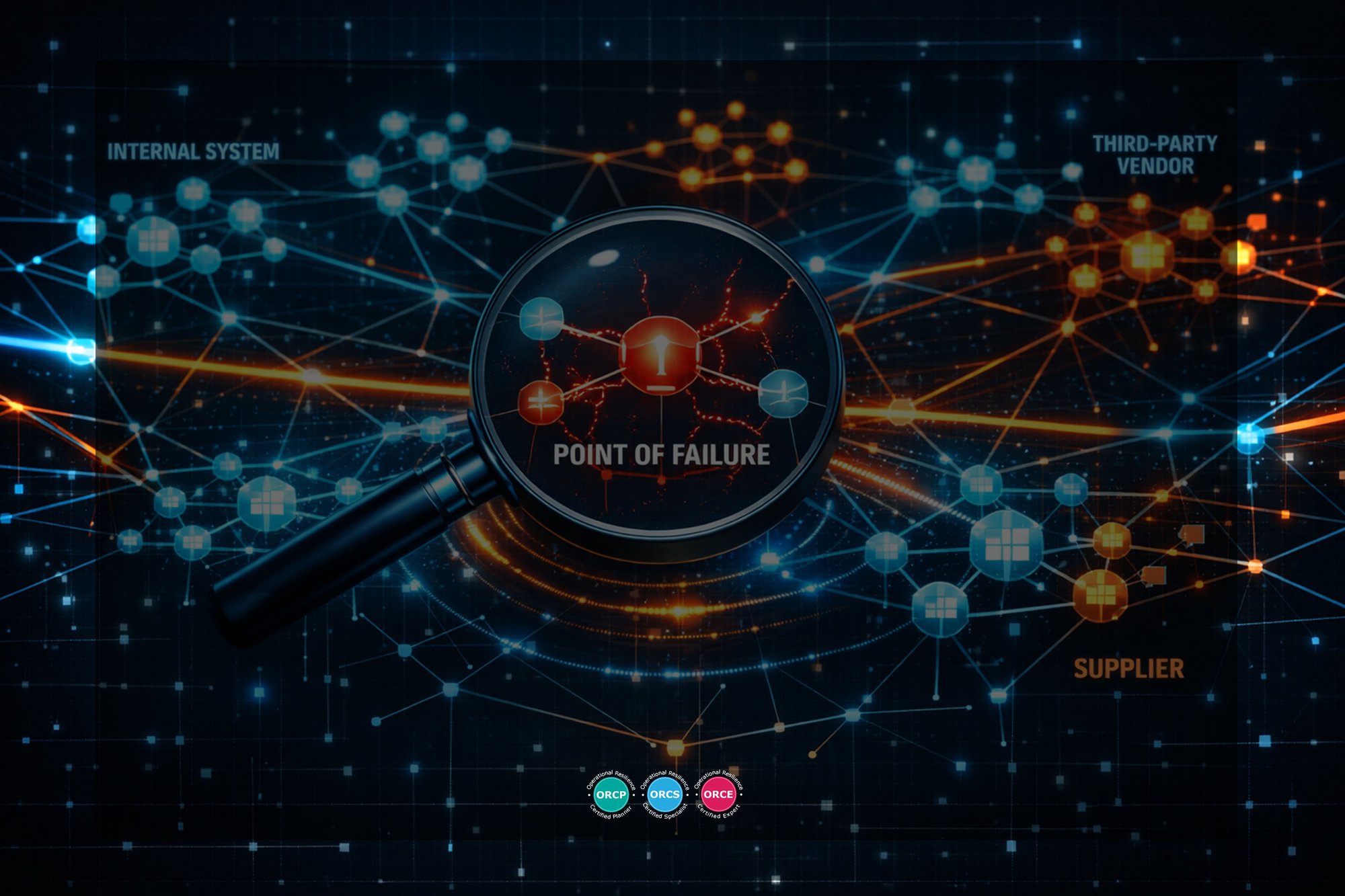
# \[OR\] \[P2\] \[S2\] \[MII\] \[C2\] Why Mapping is Critical for Operational Resilience
[](https://cta-redirect.hubspot.com/cta/redirect/3893111/0b279667-64c6-44b6-9618-1127feb5334f)
Operational resilience requires organisations to ensure that **Critical Business Services (CBS)** can continue to operate within acceptable thresholds, even during severe disruptions.
Achieving this outcome is not possible without a clear understanding of how services are delivered and what they depend on.
This is why **mapping interconnections and interdependencies** is a cornerstone of any operational resilience framework.
In today’s environment, financial institutions operate across complex ecosystems involving digital platforms, outsourced services, and interconnected infrastructures.
Disruptions are no longer isolated events—they propagate across systems, functions, and third parties.
Without structured mapping, organisations risk making decisions based on incomplete or inaccurate assumptions.
This chapter explains why mapping is critical by examining **regulatory expectations**, the importance of **risk visibility**, and how mapping supports key resilience activities such as **impact tolerance setting, scenario testing, and recovery planning**.
[](https://cta-redirect.hubspot.com/cta/redirect/3893111/dbcad25a-5ca0-4bd8-ae1b-7906de022d85)
[Moh Heng Goh](https://blog.bcm-institute.org/ebook-or/author/moh-heng-goh) May 4, 2026
###### Operational Resilience Certified Planner-Specialist-Expert
### [](https://cta-redirect.hubspot.com/cta/redirect/3893111/6072e46a-8b7a-441a-9257-0c17043af1f5)
### \[P2\] \[S2\] Chapter 2
#### [](https://cta-redirect.hubspot.com/cta/redirect/3893111/0b279667-64c6-44b6-9618-1127feb5334f)
### **Why Mapping is Critical for Operational Resilience**
#### **Introduction**
Operational resilience requires organisations to ensure that **Critical Business Services (CBS)** can continue to operate within acceptable thresholds, even during severe disruptions.
Achieving this outcome is not possible without a clear understanding of how services are delivered and what they depend on.[![\[OR\] \[P2\] \[S2\] \[MII\] \[C2\] Why Mapping is Critical for Operational Resilience](https://no-cache.hubspot.com/cta/default/3893111/a7625fb5-1205-4fc5-97d4-4b7492c2b25f.png)](https://cta-redirect.hubspot.com/cta/redirect/3893111/a7625fb5-1205-4fc5-97d4-4b7492c2b25f)
This is why **mapping interconnections and interdependencies** is a cornerstone of any operational resilience framework.
In today’s environment, financial institutions operate across complex ecosystems involving digital platforms, outsourced services, and interconnected infrastructures.
Disruptions are no longer isolated events—they propagate across systems, functions, and third parties.
Without structured mapping, organisations risk making decisions based on incomplete or inaccurate assumptions.
This chapter explains why mapping is critical by examining **regulatory expectations**, the importance of **risk visibility**, and how mapping supports key resilience activities such as **impact tolerance setting, scenario testing, and recovery planning**.
#### **Purpose of the Chapter**
[](https://cta-redirect.hubspot.com/cta/redirect/3893111/b5438182-f1e5-4248-bea5-2d5044665d8d)
The purpose of this chapter is to:
- Explain regulatory drivers for interconnection mapping
- Highlight how mapping enhances **risk visibility and vulnerability identification**
- Demonstrate how mapping supports **core operational resilience activities**
- Establish mapping as a **foundational capability**, not a compliance exercise
#### **Regulatory Expectations**
Regulators globally have shifted from traditional business continuity requirements to a broader **operational resilience mandate**, placing strong emphasis on understanding interconnections and dependencies.
##### **Monetary Authority of Singapore (MAS)**
The Monetary Authority of Singapore requires financial institutions to:
- Identify **Critical Business Services (CBS)**
- Map **dependencies and interconnections** supporting these services
- Conduct **end-to-end scenario testing**
- Ensure services remain within defined **impact tolerances**
MAS guidance emphasises that resilience must be demonstrated at the **service level**, supported by a clear understanding of dependencies across people, processes, technology, and third parties.
##### **Bangko Sentral ng Pilipinas (BSP)**
The Bangko Sentral ng Pilipinas, through BSP Circular 1203 on Operational Resilience, requires banks to:
- Map **critical operations and supporting resources**
- Identify **interdependencies across systems and third parties**
- Assess vulnerabilities that could impact financial stability
The BSP places strong emphasis on **systemic risk**, highlighting how failures in one institution may propagate across the financial system.
##### **Bank Negara Malaysia (BNM)**
The Bank Negara Malaysia requires financial institutions to:
- Understand **end-to-end service delivery**
- Identify **concentration risks and third-party dependencies**
- Ensure resilience across **digital and outsourced environments**
BNM’s operational resilience direction reinforces the need for **integrated mapping** across business, technology, and third-party ecosystems.
##### **Hong Kong Monetary Authority (HKMA)**
The Hong Kong Monetary Authority requires authorised institutions to:
- Identify **critical operations**
- Map **internal and external dependencies**
- Conduct **scenario-based stress testing**
The HKMA emphasises **cross-border and financial ecosystem interdependencies**, reflecting Hong Kong’s role as a global financial hub.
##### **Key Regulatory Theme**
Across all regulators, a consistent expectation emerges:
Organisations must **demonstrate a clear understanding of interconnections and interdependencies supporting critical services**.
This confirms that mapping is:
- Not optional
- Not a one-time exercise
- A **core requirement for operational resilience compliance**
#### **Risk Visibility and Vulnerability Identification**
##### **Moving Beyond Siloed Risk Management**
Traditional risk management approaches often focus on:
- Individual systems
- Department-level risks
- Isolated control frameworks
This creates **blind spots**, where critical dependencies remain unidentified.
Mapping interconnections eliminates these blind spots by providing a **holistic, end-to-end view** of service delivery.
##### **Identifying Hidden Dependencies**
Many dependencies are not immediately visible, such as:
- Shared infrastructure across multiple services
- Reliance on a single vendor for multiple systems
- Informal or undocumented manual processes
Mapping reveals these hidden dependencies, enabling organisations to:
- Recognise **critical reliance points**
- Assess **true exposure to disruption**
##### **Detecting Single Points of Failure**
A key outcome of mapping is the identification of:
- **Single points of failure (SPOF)**
- **Concentration risks**
- **Critical resource bottlenecks**
For example:
- A single authentication system supporting multiple CBS
- A key third-party vendor supporting multiple functions
- A specialised team with no redundancy
Without mapping, these vulnerabilities may remain undetected until a disruption occurs.
##### **Understanding Cascading Effects**
Interconnected environments are highly susceptible to **cascading failures**, where:
- A disruption in one component triggers failures in others
- Impacts spread across multiple services
Mapping enables organisations to:
- Understand **cause-and-effect relationships**
- Anticipate **chain reactions**
- Design controls to **contain disruptions**
#### **Supporting Impact Tolerance Setting**
##### **Defining Impact Tolerance**
Impact tolerance refers to the **maximum level of disruption an organisation can tolerate** for a CBS before unacceptable harm occurs.
To define meaningful impact tolerances, organisations must understand:
- What supports the service
- How disruptions propagate
- Where critical thresholds lie
##### **Role of Mapping in Impact Tolerance**
Mapping provides the necessary data to:
- Identify **critical dependencies** affecting service delivery
- Determine **time and data sensitivity**
- Assess **customer and regulatory impact**
Without mapping, impact tolerance becomes:
- Arbitrary
- Unrealistic
- Misaligned with actual operational capabilities
##### **Outcome**
Accurate mapping ensures that impact tolerances are:
- Evidence-based
- Aligned with real operational dependencies
- Defensible to regulators
#### **Supporting Scenario Testing**
##### **Importance of Scenario Testing**
Scenario testing evaluates whether an organisation can:
- Continue delivering CBS under stress
- Operate within defined impact tolerances
Regulators expect testing to be:
- Severe but plausible
- End-to-end
- Based on real dependencies
##### **Mapping as the Foundation for Testing**
Mapping enables organisations to:
- Design realistic disruption scenarios
- Identify which components to stress
- Assess cross-functional impacts
Examples:
- Cyberattack affecting multiple interconnected systems
- Third-party outage disrupting multiple CBS
- Infrastructure failure impacting upstream and downstream processes
##### **Enhancing Test Effectiveness**
With proper mapping, scenario testing becomes:
- **Comprehensive** (covers full service chain)
- **Realistic** (reflects actual dependencies)
- **Actionable** (identifies true resilience gaps)
Without mapping, testing risks become:
- Superficial
- Isolated
- Ineffective
#### **Supporting Recovery Planning**
##### **Limitations of Traditional Recovery Planning**
Traditional recovery approaches often focus on:
- Individual systems
- Predefined recovery time objectives (RTOs)
- Static recovery plans
This may not ensure **service continuity**, especially in interconnected environments.
##### **Mapping-Driven Recovery Planning**
Mapping enables organisations to:
- Prioritise recovery based on **service criticality**
- Understand **dependency sequencing**
- Coordinate recovery across multiple components
For example:
- Recovering a system without restoring its dependencies may not restore the service
- Recovery must follow the **logical sequence of interdependencies**
##### **Coordinated Recovery Across Ecosystems**
Mapping supports:
- Internal coordination across business and IT
- External coordination with third parties
- Alignment with crisis management and communication strategies
##### **Outcome**
Recovery planning becomes:
- **Service-driven**, not system-driven
- **Coordinated**, not fragmented
- **Effective in restoring end-to-end service delivery**
[](https://cta-redirect.hubspot.com/cta/redirect/3893111/2dbf77a9-2b10-4a06-b39b-ac8f1611e999)
Mapping interconnections and interdependencies is not merely a technical exercise—it is a **strategic capability** that underpins operational resilience.
Regulators across jurisdictions consistently require organisations to demonstrate a clear understanding of how their critical services are delivered and what they depend on.
This expectation reflects the reality that modern disruptions are **complex, interconnected, and systemic**.
Through mapping, organisations gain:
- **Enhanced risk visibility**
- **Identification of vulnerabilities and concentration risks**
- **A foundation for impact tolerance, scenario testing, and recovery planning**
Most importantly, mapping enables organisations to shift from a fragmented, process-centric view to a **holistic, service-centric approach**, ensuring that resilience efforts are aligned with what truly matters—the continued delivery of critical services.
In the next chapter, we will examine the **core components of interconnections and interdependencies**, breaking down the key elements that must be mapped to achieve a comprehensive and effective operational resilience framework.
[](https://cta-redirect.hubspot.com/cta/redirect/3893111/90d1498f-0cc7-4057-bec0-aca399cc07aa)
| **C1** | **C2** | **C3** | **C4** | **C5** | **C6** |
| --- | --- | --- | --- | --- | --- |
| [![\[OR\] \[P2\] \[S2\] \[MII\] \[C1\] Introduction to Interconnections and Interdependencies](https://no-cache.hubspot.com/cta/default/3893111/8cbaf41b-9671-404d-83b3-9a20c9fd69f7.png)](https://cta-redirect.hubspot.com/cta/redirect/3893111/8cbaf41b-9671-404d-83b3-9a20c9fd69f7) | [![\[OR\] \[P2\] \[S2\] \[MII\] \[C2\] Why Mapping is Critical for Operational Resilience](https://no-cache.hubspot.com/cta/default/3893111/a7625fb5-1205-4fc5-97d4-4b7492c2b25f.png)](https://cta-redirect.hubspot.com/cta/redirect/3893111/a7625fb5-1205-4fc5-97d4-4b7492c2b25f) | [![\[OR\] \[P2\] \[S2\] \[MII\] \[C3\] Core Components of Interconnections and Dependencies](https://no-cache.hubspot.com/cta/default/3893111/38a3cbd4-322a-41bd-974f-5090a2ce52aa.png)](https://cta-redirect.hubspot.com/cta/redirect/3893111/38a3cbd4-322a-41bd-974f-5090a2ce52aa) | [![\[OR\] \[P2\] \[S2\] \[MII\] \[C4\] Step 1 – Define Scope of Mapping](https://no-cache.hubspot.com/cta/default/3893111/69cc922b-c86c-4242-b85b-315a3f941e12.png)](https://cta-redirect.hubspot.com/cta/redirect/3893111/69cc922b-c86c-4242-b85b-315a3f941e12) | [![\[OR\] \[P2\] \[S2\] \[MII\] \[C5\] Step 2- Identify Data Sources](https://no-cache.hubspot.com/cta/default/3893111/622d0fcc-71bf-4c3b-a569-213cb48bd1db.png)](https://cta-redirect.hubspot.com/cta/redirect/3893111/622d0fcc-71bf-4c3b-a569-213cb48bd1db) | [![\[OR\] \[P2\] \[S2\] \[MII\] \[C6\] Step 3 – Develop Mapping Framework](https://no-cache.hubspot.com/cta/default/3893111/95581d69-3824-4acd-accf-03c2cab43765.png)](https://cta-redirect.hubspot.com/cta/redirect/3893111/95581d69-3824-4acd-accf-03c2cab43765) |
| **C7** | **C8** | **C9** | **C10** | **C11** | ** C12** |
| [![\[OR\] \[P2\] \[S2\] \[MII\] \[C7\] Step 4 – Map Processes and Resources](https://no-cache.hubspot.com/cta/default/3893111/a4ffedf2-c795-41e9-9a8b-c5e24eea7159.png)](https://cta-redirect.hubspot.com/cta/redirect/3893111/a4ffedf2-c795-41e9-9a8b-c5e24eea7159) | [![\[OR\] \[P2\] \[S2\] \[MII\] \[C8\] Step 5 – Map Interconnections and Interdependencies](https://no-cache.hubspot.com/cta/default/3893111/10f06848-f21f-457d-aa80-ca4e3b20ce9e.png)](https://cta-redirect.hubspot.com/cta/redirect/3893111/10f06848-f21f-457d-aa80-ca4e3b20ce9e) | [![\[OR\] \[P2\] \[S2\] \[MII\] \[C9\] Step 6 – Validate Mapping](https://no-cache.hubspot.com/cta/default/3893111/57d7a65a-a462-4919-9324-53e0bb207f3e.png)](https://cta-redirect.hubspot.com/cta/redirect/3893111/57d7a65a-a462-4919-9324-53e0bb207f3e) | [![\[OR\] \[P2\] \[S2\] \[MII\] \[C10\] Step 7 – Analyse Mapping Outputs](https://no-cache.hubspot.com/cta/default/3893111/44bbb252-fdf5-4026-90ba-cbbdbe9c099a.png)](https://cta-redirect.hubspot.com/cta/redirect/3893111/44bbb252-fdf5-4026-90ba-cbbdbe9c099a) | [![\[OR\] \[P2\] \[S2\] \[MII\] \[C11\] Mapping Tools and Techniques](https://no-cache.hubspot.com/cta/default/3893111/d2fab757-0d78-42dd-8553-044eead7390e.png)](https://cta-redirect.hubspot.com/cta/redirect/3893111/d2fab757-0d78-42dd-8553-044eead7390e) | [![\[OR\] \[P2\] \[S2\] \[MII\] \[C12\] Standard Templates and Data Structures](https://no-cache.hubspot.com/cta/default/3893111/4f04214c-3a0f-4bed-b2f8-6352c6d3cda0.png)](https://cta-redirect.hubspot.com/cta/redirect/3893111/4f04214c-3a0f-4bed-b2f8-6352c6d3cda0) |
| **C13** | **C14** | **C15** | **C16** | **C17** | ** C18** |
| [![\[OR\] \[P2\] \[S2\] \[MII\] \[C13\] Integration with Operational Resilience Framework](https://no-cache.hubspot.com/cta/default/3893111/c9628dd2-bbcb-4b54-b5b5-490066640d6d.png)](https://cta-redirect.hubspot.com/cta/redirect/3893111/c9628dd2-bbcb-4b54-b5b5-490066640d6d) | [![\[OR\] \[P2\] \[S2\] \[MII\] \[C14\] Mapping Third-Party and Supply Chain Dependencies](https://no-cache.hubspot.com/cta/default/3893111/0c13b720-3d3e-4452-91e4-b9533260b3a4.png)](https://cta-redirect.hubspot.com/cta/redirect/3893111/0c13b720-3d3e-4452-91e4-b9533260b3a4) | [![\[OR\] \[P2\] \[S2\] \[MII\] \[C15\] Mapping for Digital and Cloud Environments](https://no-cache.hubspot.com/cta/default/3893111/1c90de74-af6b-44d3-ae4f-26d01eac3cf7.png)](https://cta-redirect.hubspot.com/cta/redirect/3893111/1c90de74-af6b-44d3-ae4f-26d01eac3cf7) | [![\[OR\] \[P2\] \[S2\] \[MII\] \[C16\] Common Challenges and Pitfalls](https://no-cache.hubspot.com/cta/default/3893111/32bbd8d7-f947-42ac-9db9-b88b0b156813.png)](https://cta-redirect.hubspot.com/cta/redirect/3893111/32bbd8d7-f947-42ac-9db9-b88b0b156813) | [![\[OR\] \[P2\] \[S2\] \[MII\] \[C17\] Case Study – Banking Sector CBS Mapping](https://no-cache.hubspot.com/cta/default/3893111/5a846fed-f810-4f6b-a1d8-0c2100f0eeac.png)](https://cta-redirect.hubspot.com/cta/redirect/3893111/5a846fed-f810-4f6b-a1d8-0c2100f0eeac) | [![\[OR\] \[P2\] \[S2\] \[MII\] \[C18\] Governance and Ownership of Mapping](https://no-cache.hubspot.com/cta/default/3893111/44ed11f0-5263-4485-98db-725a423c5fd6.png)](https://cta-redirect.hubspot.com/cta/redirect/3893111/44ed11f0-5263-4485-98db-725a423c5fd6) |
| **C19** | **C20** | **C21** | **C22** | | |
| [![\[OR\] \[P2\] \[S2\] \[MII\] \[C19\] Using Mapping for Scenario Testing](https://no-cache.hubspot.com/cta/default/3893111/b7bf0bc8-b382-4892-821d-c7c867303f14.png)](https://cta-redirect.hubspot.com/cta/redirect/3893111/b7bf0bc8-b382-4892-821d-c7c867303f14) | [![\[OR\] \[P2\] \[S2\] \[MII\] \[C20\] Maintaining and Updating Mapping](https://no-cache.hubspot.com/cta/default/3893111/41d34d1f-78bd-4346-845e-b0b86232cfa6.png)](https://cta-redirect.hubspot.com/cta/redirect/3893111/41d34d1f-78bd-4346-845e-b0b86232cfa6) | [![\[OR\] \[P2\] \[S2\] \[MII\] \[C21\] Key Takeaways and Future Direction](https://no-cache.hubspot.com/cta/default/3893111/d8414f6b-4b4e-4a50-adb3-963546f13951.png)](https://cta-redirect.hubspot.com/cta/redirect/3893111/d8414f6b-4b4e-4a50-adb3-963546f13951) | [![\[OR\] \[P2\] \[S2\] \[MII\] \[C22\] Back Cover](https://no-cache.hubspot.com/cta/default/3893111/0f96fecf-9a98-4404-8377-d37c1233df10.png)](https://cta-redirect.hubspot.com/cta/redirect/3893111/0f96fecf-9a98-4404-8377-d37c1233df10) | | |
#### More Information About OR-5000 \[OR-5\] or OR-300 \[OR-3\]
To learn more about the course and schedule, click the buttons below for the OR-300 Operational Resilience Implementer course and the OR-5000 Operational Resilience Expert Implementer course.
| [](https://cta-redirect.hubspot.com/cta/redirect/3893111/3530eccb-515d-401e-afc2-3469e26d7fbf) | [](https://cta-redirect.hubspot.com/cta/redirect/3893111/fdd4fa9c-ed69-40c1-925f-4eb6a1c5c255) | [](https://cta-redirect.hubspot.com/cta/redirect/3893111/77a34b84-0a6d-44f8-b8d6-6ab04cdf5edd) |
| --- | --- | --- |
| [](https://cta-redirect.hubspot.com/cta/redirect/3893111/6e5c0cda-39b9-4bbd-b3d4-4cf46a790b14) | [](https://cta-redirect.hubspot.com/cta/redirect/3893111/a68a08aa-36d3-4216-9551-202c9fde06ea) | [![ \[BL-OR\] \[3-4-5\] View Schedule](https://no-cache.hubspot.com/cta/default/3893111/d0d733a1-16c0-4b68-a26d-adbfd4fc6069.png)](https://cta-redirect.hubspot.com/cta/redirect/3893111/d0d733a1-16c0-4b68-a26d-adbfd4fc6069) |
| [![\[BL-OR\] \[3\] FAQ OR-300](https://no-cache.hubspot.com/cta/default/3893111/f20c71b4-f5e8-4aa5-8056-c374ca33a091.png)](https://cta-redirect.hubspot.com/cta/redirect/3893111/f20c71b4-f5e8-4aa5-8056-c374ca33a091) | If you have any questions, click to contact us.[![Email to Sales Team \[BCM Institute\]](https://no-cache.hubspot.com/cta/default/3893111/3c53daeb-2836-4843-b0e0-645baee2ab9e.png)](https://cta-redirect.hubspot.com/cta/redirect/3893111/3c53daeb-2836-4843-b0e0-645baee2ab9e) | [](https://cta-redirect.hubspot.com/cta/redirect/3893111/7f2718a4-ea80-4f84-a319-dc2d4df37a46) |
| [](https://cta-redirect.hubspot.com/cta/redirect/3893111/74b1e556-8cd2-4a74-8821-db1804534955) | [](https://cta-redirect.hubspot.com/cta/redirect/3893111/f2bd8eb1-32d2-4732-9267-ea53223cf58f) | [](https://cta-redirect.hubspot.com/cta/redirect/3893111/084e620a-46c5-419a-82ed-6a681d15c0b6) |
#### **Comments:**
---

---

---

---


All rights reserved. Copyright 2026
```json
{
"@context" : "https://schema.org",
"@type" : "BlogPosting",
"author" : {
"@type" : "Person",
"name" : "Moh Heng Goh",
"url" : "https://blog.bcm-institute.org/ebook-or/author/moh-heng-goh"
},
"dateModified" : "2026-05-15T14:11:32.843Z",
"datePublished" : "2026-05-04T08:54:26.000Z",
"headline" : "[OR] [P2] [S2] [MII] [C2] Why Mapping is Critical for Operational Resilience",
"mainEntityOfPage" : {
"@id" : "https://blog.bcm-institute.org/ebook-or/or-p2-s2-mii-c2-why-mapping-is-critical-for-operational-resilience",
"@type" : "WebPage"
},
"publisher" : {
"@type" : "Organization",
"logo" : {
"@type" : "ImageObject",
"url" : "https://blog.bcm-institute.org/hubfs/BCMI%20Logo.png"
},
"name" : "BCMI Pte Ltd"
}
}
```