---
title: [OR] [MBSB] [E3] [C1] Starting Your OR Implementation
description: [OR] [MBSB] [E3] [C1] Starting Your OR Implementation
image: https://blog.bcm-institute.org/hubfs/MBSB%20Graphic%20Folder/%5BOR%5D%20%5BMBSB%5D%20%5BE3%5D%20%5BC1%5D%20Starting%20Your%20OR%20Implementation.jpg
---
.
[](http://www.bcm-institute.org/)
- [Home](https://www.bcm-institute.org/)
- [About Us](https://www.bcm-institute.org/about-us-3/)
- [A President’s Perspective](https://www.bcm-institute.org/about-us/a-presidents-perspective/)
- [Our History](https://www.bcm-institute.org/about-us/our-history/)
- [Our Advisory Council](https://www.bcm-institute.org/about-us/our-advisory-council/)
- [Customers’ Testimonials](https://www.bcm-institute.org/about-us/customers-testimonials/)
- [Credential Verification](https://www.bcm-institute.org/about-us/credential-verification/)
- [Courses](https://blog.bcm-institute.org/blog/course-fees-for-blended-learning-courses-master-catalog)
- [ISO 22301 Business Continuity Management System Audit](https://blog.bcm-institute.org/audit/business-continuity-management-audit-courses)
- [ISO 22301 Business Continuity Management](https://blog.bcm-institute.org/bcm/business-continuity-management-courses)
- [Crisis Communication](https://blog.bcm-institute.org/crisis-communication/crisis-communication-courses)
- [Crisis Management](https://blog.bcm-institute.org/en/crisis-management/courses)
- [IT Disaster Recovery](https://blog.bcm-institute.org/it-disaster-recovery/courses)
- [Operational Resilience](https://blog.bcm-institute.org/operational-resilience/courses)
- [Operational Resilience Audit](https://blog.bcm-institute.org/operational-resilience-audit/courses)
- [Certification](https://blog.bcm-institute.org/certification/types-of-certifications-offered)
- [ISO 22301 BCMS Audit Certification](https://blog.bcm-institute.org/certification/business-continuity-management-audit-certification)
- [ISO22301 Business Continuity Management Certification](https://blog.bcm-institute.org/bcm/business-continuity-management-certification)
- [Crisis Communication Certification](https://blog.bcm-institute.org/crisis-communication/crisis-communication-certification)
- [Crisis Management Certification](https://blog.bcm-institute.org/en/crisis-management/crisis-management-certification)
- [IT Disaster Recovery Planning Certification](https://blog.bcm-institute.org/it-disaster-recovery/it-disaster-recovery-certification)
- [Operational Resilience Certification](https://blog.bcm-institute.org/operational-resilience/operational-resilience-certification)
- [Operational Resilience Audit Certification](https://blog.bcm-institute.org/operational-resilience-audit)
- [Seminars](https://blog.bcm-institute.org/meet-the-expert/mte-webinar-mainpage)
- [Store](https://www.bcm-institute.org/store-2/)
- [Contact Us](http://www.bcm-institute.org/about-us/contact-us/)
-
-
###### Operational Resilience in Action: The MBSB Approach

# \[OR\] \[MBSB\] \[E3\] \[C1\] Starting Your OR Implementation
[](https://cta-redirect.hubspot.com/cta/redirect/3893111/567eecca-dbad-4a1a-8465-5d45335ce5da)
[](https://cta-redirect.hubspot.com/cta/redirect/3893111/db019f65-9616-4b09-a7bf-c3c1dfb402b7)Operational resilience moves from concept to reality when an organisation begins applying its framework to the business services that matter most.
Understanding the organisation, establishing an Operational Resilience (OR) Planning Methodology, defining governance arrangements, and identifying Critical Business Services (CBSs) provide the foundation.
The next step is to translate that foundation into practical implementation.
This third and final eBook in the Operational **Resilience in Action: The MBSB Approach** series focuses on that transition.
Titled **Starting Your OR Implementation**, this eBook is part of BCM Institute's Training-led Implementation and is designed to give MBSB a structured approach to begin implementing operational resilience across its identified Critical Business Services.
[](https://cta-redirect.hubspot.com/cta/redirect/3893111/94432910-0e52-4ad3-8fdd-8768b5c08146)
It brings together the implementation submissions prepared by the respective business units and provides a consistent basis for documenting, reviewing, challenging, and improving these services' resilience.

[Dr Goh Moh Heng](https://blog.bcm-institute.org/ebook-or/author/dr-goh-moh-heng) Aug 27, 2026
###### Operational Resilience Certified Planner-Specialist-Expert
#### [](https://cta-redirect.hubspot.com/cta/redirect/3893111/d779f9ab-aec0-4cdd-a906-81e7841c3e1c) eBook 3: Chapter 1


### Setting the Context: From Planning to Execution
[](https://cta-redirect.hubspot.com/cta/redirect/3893111/9792ea1e-f1cc-4e62-9eef-eeb9e6de5141)
Operational resilience moves from concept to reality when an organisation begins applying its framework to the business services that matter most.
eBook 1: Understanding the organisation, eBook 2: Implementing an Operational Resilience (OR) Planning Methodology, defining governance arrangements, and identifying Critical Business Services (CBSs) provide the foundation.
The next step is to translate that foundation into practical implementation.
This third and final eBook in the **Operational Resilience in Action: The MBSB Approach** series focuses on that transition.
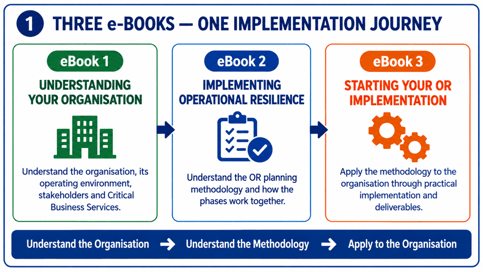eBook 3: Starting Your OR Implementation provides MBSB with a structured approach to begin implementing operational resilience across its identified Critical Business Services.
It brings together the implementation submissions prepared by the respective business units and provides a consistent basis for documenting, reviewing, challenging, and improving these services' resilience.
The emphasis is practical. Rather than explaining operational resilience only as a concept, the eBook demonstrates how MBSB can progressively develop the information required to understand how its Critical Business Services are delivered, what they depend upon, how much disruption can be tolerated, what could seriously disrupt them, and whether existing resilience arrangements are capable of keeping disruption within acceptable limits.
#### [](https://cta-redirect.hubspot.com/cta/redirect/3893111/78f340d2-c422-43df-aadb-d2347dde326e)
#### **Building on the Earlier eBooks**
[](https://cta-redirect.hubspot.com/cta/redirect/3893111/9792ea1e-f1cc-4e62-9eef-eeb9e6de5141)**Starting Your OR Implementation** should be read together with the two preceding eBooks in the series:
- **Understanding Your Organisation** — establishes the organisational, business, regulatory, governance, and operating context in which MBSB implements operational resilience.
- **Implementing OR Planning Methodology** — guides applying the Operational Resilience Planning Methodology and establishing the structure required to implement and manage the OR programme.
- **Starting Your OR Implementation** — converts that understanding and methodology into practical implementation activities for MBSB's Critical Business Services.
The first two eBooks therefore serve as **pre-reading and implementation guidance** for this final eBook.
The progression can be viewed simply as:
##### **Understand the Organisation → Establish the OR Methodology → Implement OR for Critical Business Services**
This third eBook translates the outputs developed in the earlier stages into detailed, service-level resilience information.
#### **Purpose of This eBook**
[](https://cta-redirect.hubspot.com/cta/redirect/3893111/db019f65-9616-4b09-a7bf-c3c1dfb402b7)This eBook kicks off the structured submission of information required for MBSB's operational resilience implementation project.
Each Critical Business Service should be examined consistently so that MBSB can progressively develop an end-to-end understanding of how the service operates and how it could withstand disruption.
The eBook therefore provides a common implementation structure for business units to document their respective Critical Business Services and supporting arrangements.
The resulting submissions should enable MBSB to:
- develop greater visibility of how each Critical Business Service is delivered;
- identify the processes and activities necessary to maintain service delivery;
- understand internal and external interconnections and dependencies;
- establish appropriate impact tolerances;
- identify severe but plausible disruption scenarios;
- test whether services can remain within their established impact tolerances;
- identify vulnerabilities, weaknesses, and resilience gaps;
- establish improvement actions where existing capabilities are insufficient; and
- provide management with a more consistent view of operational resilience across the organisation.
The objective is not simply to produce documentation. The information generated should support decision-making, prioritisation, investment, scenario testing, remediation, and ongoing management of operational resilience.
[](https://cta-redirect.hubspot.com/cta/redirect/3893111/29b32779-5983-4232-9cfd-e121ad0db36f)
#### **MBSB Critical Business Services**
For this implementation, the following Critical Business Services form the working CBS catalogue for MBSB: 
| CBS | Critical Business Service |
| --- | --- |
| CBS-1 | Customer Deposit and Account Access Services |
| CBS-2 | Domestic Funds Transfer and Payment Services |
| CBS-3 | Digital Banking Services |
| CBS-4 | Cash Access and Cash Transaction Services |
| CBS-5 | Financing Account Servicing and Repayment Services |
| CBS-6 | Corporate Payment and Bulk Transaction Services |
| CBS-7 | High-Value and Interbank Payment Services |
| CBS-8 | Customer Transaction Authentication and Authorisation Services |
| CBS-9 | Customer Support and Assistance During Banking Disruptions |
[](https://cta-redirect.hubspot.com/cta/redirect/3893111/9f906ebc-f9d2-4053-9e6f-586799079049)[](https://cta-redirect.hubspot.com/cta/redirect/3893111/468604f8-f465-434b-9260-8bd314f9501f)These services provide the starting point for the detailed implementation activities covered in this eBook.
The catalogue should not be regarded as static.
As MBSB's products, delivery channels, technologies, outsourcing arrangements, customer expectations, and regulatory obligations evolve, the organisation should periodically review whether the services identified as critical remain appropriate.
#### [](https://cta-redirect.hubspot.com/cta/redirect/3893111/06de788e-e841-48d3-92e8-735c9e4577f1)The Five OR Implementation Stages
The implementation is organised into five sequential, interconnected stages.
##### **[](https://cta-redirect.hubspot.com/cta/redirect/3893111/51659e94-db97-4e76-bfc4-5cae0e0a7e0c)Step 1 — Outline Detailed Processes for CBS \[DP\]**
The first stage develops a detailed understanding of **how each Critical Business Service is delivered end-to-end**.
A Critical Business Service may seem straightforward from the customer's perspective, but its delivery can involve many processes, systems, business units, people, facilities, data flows, third parties, and supporting activities.
The **Detailed Processes \[DP\]** stage breaks the CBS into its constituent processes and activities.
For example, delivering a payment service may involve customer initiation, authentication, transaction validation, processing, fraud screening, payment routing, settlement, confirmation, exception handling, and customer support.
Documenting these processes establishes the foundation for the subsequent resilience analysis.
**Key question:**
##### **What processes and activities must operate for this Critical Business Service to be delivered successfully?**
##### **[](https://cta-redirect.hubspot.com/cta/redirect/3893111/6072e46a-8b7a-441a-9257-0c17043af1f5)Step 2 — Map Interconnections and Interdependencies \[MII\]**
Once MBSB understands the detailed processes, it needs to identify the resources, relationships, and dependencies that support them.
The **Map Interconnections and Interdependencies \[MII\]** stage develops an end-to-end view of the people, processes, technology, information, facilities, third parties, infrastructure, and other resources that the Critical Business Service depends on.
This stage should also consider dependencies **between Critical Business Services**.
For example, Digital Banking Services may depend upon Customer Transaction Authentication and Authorisation Services. Payment services may rely on common technology platforms, telecommunications infrastructure, external payment networks, data centres, cloud services, or third-party providers.
Understanding these relationships helps identify:
- single points of failure;
- concentrations of dependency;
- common resources supporting multiple CBSs;
- critical third parties;
- technology dependencies;
- upstream and downstream dependencies; and
- potential vulnerabilities that may disrupt and propagate across services.
**Key question:**
##### **What does this Critical Business Service depend upon, and what depends upon it?**
##### **[](https://cta-redirect.hubspot.com/cta/redirect/3893111/00e8044a-8a62-4f8f-be7c-9c267d8b3dfc)Step 3 — Establish Impact Tolerances \[iTo\]**
Operational resilience recognises that disruptions cannot always be prevented.
The organisation must therefore determine the maximum level of disruption it can tolerate before the consequences become unacceptable.
The **Establish Impact Tolerances \[iTo\]** stage defines this boundary for each Critical Business Service.
Impact tolerances should be informed by the potential consequences of disruption, including impacts on customers, financial position, operations, regulatory obligations, reputation, counterparties, and, where relevant, the broader financial ecosystem.
Depending upon the service, an impact tolerance may incorporate measures such as:
- maximum duration of disruption;
- number or proportion of customers affected;
- transaction volumes or values affected;
- financial exposure;
- backlog levels;
- service availability; or
- other service-specific thresholds.
Impact tolerance then becomes an important reference point for scenario design and testing.
**Key question:**
##### **How much disruption can MBSB tolerate before the impact becomes unacceptable?**
##### **Step 4 — Identify Severe but Plausible Scenarios \[SbPS\]**
Once MBSB has established dependencies and impact tolerances, it can consider the circumstances that could severely disrupt each Critical Business Service.
The **Identify Severe but Plausible Scenarios \[SbPS\]** stage focuses on credible events severe enough to challenge existing resilience arrangements.
These scenarios should not be limited to historical incidents. They should consider circumstances that could reasonably occur even if MBSB has not previously experienced them.
Examples may include:
- prolonged technology outages;
- cyber incidents;
- telecommunications failures;
- disruption to critical third parties;
- loss or corruption of critical data;
- simultaneous failure of primary and recovery arrangements;
- unavailability of key operational locations;
- significant workforce disruption;
- payment infrastructure disruption; and
- combinations of events that create cascading impacts.
Scenario selection should reflect the CBS's characteristics and dependencies rather than applying identical scenarios to every service.
**Key question:**
##### **What severe but credible events could cause this Critical Business Service to approach or exceed its impact tolerance?**
##### **[](https://cta-redirect.hubspot.com/cta/redirect/3893111/58ea4ab9-998a-451c-bb54-801ae4cb782d)Step 5 — Perform Scenario Testing \[ST\]**
The final stage converts the preceding analysis into practical resilience validation.
**Scenario Testing \[ST\]** evaluates whether MBSB can continue delivering, recover, or otherwise manage a Critical Business Service during a severe but plausible disruption without exceeding its established impact tolerance.
Testing should examine more than whether an existing continuity or recovery plan can be activated. It should evaluate the service from an end-to-end operational resilience perspective.
This may include assessing:
- detection and escalation;
- incident and crisis management;
- business continuity arrangements;
- technology recovery;
- alternative operating procedures;
- third-party response;
- customer communications;
- management decision-making;
- workarounds;
- recovery priorities;
- cross-functional coordination; and
- the ability to remain within the impact tolerance.
The outcome should identify both demonstrated resilience capabilities and areas requiring improvement.
**Key question:**
##### **Can MBSB withstand and recover from the scenario without exceeding the established impact tolerance?**
#### **The Implementation Flow**
The five stages are deliberately connected:
[](https://cta-redirect.hubspot.com/cta/redirect/3893111/5951b82b-f0be-4192-bb8d-085db66a86f9)
Each stage provides information required by the next.
Detailed process information enables dependency identification. Dependency mapping reveals potential vulnerabilities and informs meaningful impact tolerances.
Impact tolerances establish the boundary against which severe but plausible scenarios can be considered. Those scenarios then provide the basis for scenario testing.
The result is an implementation process that moves from **understanding the service** to **demonstrating its resilience**.
#### **Business Unit Participation**
A central OR, BCM, or Risk function cannot implement operational resilience effectively on its own.
Business units responsible for Critical Business Services play an important role because they possess the operational knowledge needed to explain how those services function.
Their submissions should therefore reflect practical operating knowledge rather than merely reproduce policies, procedures, or existing continuity documentation.
Business units should be able to explain:
##### **How the service operates → What supports it → What could disrupt it → How much disruption is tolerable → Whether MBSB can remain within that tolerance**
Central OR, BCM, Risk, Technology, Cybersecurity, Third-Party Risk, and other relevant functions can provide methodology, facilitation, review, challenge, and specialist input.
This combination of **business ownership and specialist challenge** is important for developing credible operational resilience assessments.
#### **Alignment with Bank Negara Malaysia Expectations**
As a Malaysian financial services institution, MBSB operates within the regulatory environment established by **Bank Negara Malaysia (BNM)**.
Accordingly, consider the implementation approach alongside applicable BNM requirements and supervisory expectations relating to business continuity, technology risk, operational risk, outsourcing and third-party arrangements, cyber resilience, incident management, and broader operational resilience.
Do not treat implementation as an isolated compliance exercise.
Instead, operational resilience should bring together relevant capabilities across MBSB, enabling the organisation to develop a service-centred understanding of its ability to withstand disruption.
This eBook therefore provides an implementation structure that connects MBSB's existing risk management and resilience capabilities around the continued delivery of its Critical Business Services.
#### **Training-Led Implementation Approach**
This eBook is part of the value-added implementation support BCM Institute provides to organisations undertaking its **training-led operational resilience implementation approach**.
Under this approach, participants not only learn the OR methodology during certification or competency-based training. They progressively apply the methodology to their own organisation.
Training provides knowledge and implementation guidance, while project submissions offer the opportunity to apply that knowledge to real-world Critical Business Services.
The approach can be summarised as:
[](https://cta-redirect.hubspot.com/cta/redirect/3893111/b5bb56a5-de62-4593-947c-845b2b21f30b)
This helps bridge the gap between professional education and organisational implementation.
For MBSB, the submissions developed through the five stages can progressively contribute to a practical body of operational resilience information that can be reviewed, challenged, updated, and used as the OR programme matures.
#### **What a Completed CBS Submission Should Demonstrate**
After the five stages, each Critical Business Service submission should provide a coherent resilience story.
It should enable management and reviewers to understand:
| Implementation Question | Expected Output |
| --- | --- |
| How is the CBS delivered? | Detailed Processes \[DP\] |
| What supports and connects the CBS? | Interconnects and Interdependencies \[MII\] |
| How much disruption is acceptable? | Impact Tolerance \[iTo\] |
| What could severely disrupt the CBS? | Severe but Plausible Scenarios \[SbPS\] |
| Can the CBS withstand the disruption? | Scenario Testing \[ST\] |
| What weaknesses remain? | Findings, gaps and vulnerabilities |
| What needs to improve? | Remediation and resilience improvement actions |
This creates traceability from service delivery through to resilience validation and improvement.
#### **Moving from Planning to Implementation**
Operational resilience becomes meaningful when an organisation can demonstrate that it understands its critical services and has taken practical steps to ensure they can withstand disruption.
For MBSB, the nine identified Critical Business Services provide the focal point for this implementation.
The work begins by understanding each service in detail. It then progressively examines dependencies, tolerance for disruption, credible threats to service delivery, and the effectiveness of MBSB's existing resilience arrangements.
The implementation journey can therefore be expressed as:
##### **Understand the CBS → Map the CBS → Set the Tolerance → Challenge the CBS → Test the CBS → Improve Resilience**
The chapters that follow compile and structure the submissions from the respective business units across the five implementation stages.
Together, these submissions provide the basis for moving MBSB's Operational Resilience programme from **methodology and planning into practical implementation, validation, and continuous improvement**.
The ultimate objective is not to demonstrate that disruption will never occur.
It is to develop sufficient understanding, preparedness, and resilience so that, when disruption occurs, MBSB is better positioned to protect the continued delivery of the Critical Business Services that matter to its customers, stakeholders, and the wider financial system.
[](https://cta-redirect.hubspot.com/cta/redirect/3893111/3aefb2d2-3110-47c1-ad4f-d3e6e5381066)
Blogs marked \[x\] are under construction
[](https://cta-redirect.hubspot.com/cta/redirect/3893111/8c32162b-ac29-4c9c-9413-3d8869a65490)
| **eBook 3: Starting Your OR Implementation** |
| --- |
| **CBS-1** | **CBS-2 \[x\]** | **CBS-3 \[x\]** | **CBS-4 \[x\]** | **CBS-5 \[x\]** | **List of CBS** |
| --- | --- | --- | --- | --- | --- |
| [](https://cta-redirect.hubspot.com/cta/redirect/3893111/c27838e1-e3c1-42fd-ac7a-9c8f109a8f39) | [](https://cta-redirect.hubspot.com/cta/redirect/3893111/413aa19f-1c5e-4192-a4ce-f7623a422f33) | [](https://cta-redirect.hubspot.com/cta/redirect/3893111/c264bded-2ba8-499f-8776-551ed90f86be) | [](https://cta-redirect.hubspot.com/cta/redirect/3893111/c2d1e3a3-5c66-4bb5-ad52-ff47a2004d19) | [](https://cta-redirect.hubspot.com/cta/redirect/3893111/21f9a85e-9b81-4f58-bf0a-d37a13b08b20) | [](https://cta-redirect.hubspot.com/cta/redirect/3893111/468604f8-f465-434b-9260-8bd314f9501f) |
| **CBF-6 \[x\]** | **CBS-7 \[x\]** | **CBS-8 \[x\]** | **eBook 1** | **eBook 2** | **eBook 3** |
| [](https://cta-redirect.hubspot.com/cta/redirect/3893111/2453b356-f23e-4167-9ae3-6390b9fa7448) | [](https://cta-redirect.hubspot.com/cta/redirect/3893111/d6755aa3-fe6a-409b-ac62-e333a8c698fa) | [](https://cta-redirect.hubspot.com/cta/redirect/3893111/a04c298c-943f-43a1-ae41-4009623ff7a1) | [](https://cta-redirect.hubspot.com/cta/redirect/3893111/3867d3d9-951c-4b8b-83d3-d0294a5e27f8) | [](https://cta-redirect.hubspot.com/cta/redirect/3893111/23693331-a4a4-43f3-8b58-f1dee8c34550) | [](https://cta-redirect.hubspot.com/cta/redirect/3893111/db019f65-9616-4b09-a7bf-c3c1dfb402b7) |
| **Consolidated Report (CR)** | | | | | |
| **DP \[x\]** | **MD \[x\]** | **MPR \[x\]** | **ITo \[x\]** | **SuPS \[x\]** | **ST \[x\]** |
| **[](https://cta-redirect.hubspot.com/cta/redirect/3893111/2ed59124-3a65-48e5-aa14-8596578585f9)** | **[](https://cta-redirect.hubspot.com/cta/redirect/3893111/5341285b-11e4-4f7f-bdcd-af246434ddb3)** | **[](https://cta-redirect.hubspot.com/cta/redirect/3893111/dfc007a2-14de-479a-ba96-c4a2cc531cee)** | **[](https://cta-redirect.hubspot.com/cta/redirect/3893111/c922c2b8-e63b-4305-9e8c-e7491707b5bc)** | **[](https://cta-redirect.hubspot.com/cta/redirect/3893111/2447d25d-92f1-444d-87c8-55563195f14e)** | **[](https://cta-redirect.hubspot.com/cta/redirect/3893111/9cc4faa3-60cb-4b09-8582-f9edd8103ed0)** |
**[](https://cta-redirect.hubspot.com/cta/redirect/3893111/084e620a-46c5-419a-82ed-6a681d15c0b6)**[](https://cta-redirect.hubspot.com/cta/redirect/3893111/309c3a80-4c3c-4eb9-811d-bd401ccb1610)For organisations looking to accelerate their journey, BCM Institute’s training and certification programs, including the **OR-5000 Operational Resilience Expert Implementer course**, provide in-depth insights and practical toolkits to embed this model effectively.
#### More Information About OR-5000 \[OR-5\] or OR-300 \[OR-3\]
Gain Competency: For organisations looking to accelerate their journey, BCM Institute’s training and certification programs, including the OR-5000 Operational Resilience Expert Implementer course, provide in-depth insights and practical toolkits for effectively embedding this model.
To learn more about the course and schedule, click the buttons below for the \[OR-3\] OR-300 Operational Resilience Implementer course and the \[OR-5\] OR-5000 Operational Resilience Expert Implementer course.
| [](https://cta-redirect.hubspot.com/cta/redirect/3893111/3530eccb-515d-401e-afc2-3469e26d7fbf) | [](https://cta-redirect.hubspot.com/cta/redirect/3893111/fdd4fa9c-ed69-40c1-925f-4eb6a1c5c255) | [](https://cta-redirect.hubspot.com/cta/redirect/3893111/77a34b84-0a6d-44f8-b8d6-6ab04cdf5edd) |
| --- | --- | --- |
| [](https://cta-redirect.hubspot.com/cta/redirect/3893111/6e5c0cda-39b9-4bbd-b3d4-4cf46a790b14) | [](https://cta-redirect.hubspot.com/cta/redirect/3893111/a68a08aa-36d3-4216-9551-202c9fde06ea) | [](https://cta-redirect.hubspot.com/cta/redirect/3893111/d0d733a1-16c0-4b68-a26d-adbfd4fc6069) |
| [](https://cta-redirect.hubspot.com/cta/redirect/3893111/f20c71b4-f5e8-4aa5-8056-c374ca33a091) | If you have any questions, click to contact us.[](https://cta-redirect.hubspot.com/cta/redirect/3893111/3c53daeb-2836-4843-b0e0-645baee2ab9e) | [](https://cta-redirect.hubspot.com/cta/redirect/3893111/7f2718a4-ea80-4f84-a319-dc2d4df37a46) |
| [](https://cta-redirect.hubspot.com/cta/redirect/3893111/74b1e556-8cd2-4a74-8821-db1804534955) | [](https://cta-redirect.hubspot.com/cta/redirect/3893111/f2bd8eb1-32d2-4732-9267-ea53223cf58f) | [](https://cta-redirect.hubspot.com/cta/redirect/3893111/084e620a-46c5-419a-82ed-6a681d15c0b6) |
#### **Your Comments Here:**

---

---

---

---


All rights reserved. Copyright 2026
```json
{
"@context" : "https://schema.org",
"@type" : "BlogPosting",
"author" : {
"@type" : "Person",
"name" : "Dr Goh Moh Heng",
"url" : "https://blog.bcm-institute.org/ebook-or/author/dr-goh-moh-heng"
},
"dateModified" : "2026-10-28T15:57:05.228Z",
"datePublished" : "2026-08-27T06:41:49.000Z",
"headline" : "[OR] [MBSB] [E3] [C1] Starting Your OR Implementation",
"mainEntityOfPage" : {
"@id" : "https://blog.bcm-institute.org/ebook-or/or-mbsb-e3-c1-starting-your-or-implementation",
"@type" : "WebPage"
},
"publisher" : {
"@type" : "Organization",
"logo" : {
"@type" : "ImageObject",
"url" : "https://blog.bcm-institute.org/hubfs/BCMI%20Logo.png"
},
"name" : "BCMI Pte Ltd"
}
}
```