---
title: [OR] [LSEG] [E3] [CBS] [2] [ST] Perform Scenario Testing
description: [OR] [LSEG] [E3] [CBS] [2] [ST] Perform Scenario Testing
image: https://blog.bcm-institute.org/hubfs/LSEG%20Graphic%20Folder/LSEG%20CBS%201%20Morepost/%5BOR%5D%20%5BLSEG%5D%20%5BE3%5D%20%5BCBS%5D%20%5B1%5D%20%5BST%5D%20Deposit%20and%20Account%20Services.jpg
---
. .
[](http://www.bcm-institute.org/)
- [Home](https://www.bcm-institute.org/)
- [About Us](https://www.bcm-institute.org/about-us-3/)
- [A President’s Perspective](https://www.bcm-institute.org/about-us/a-presidents-perspective/)
- [Our History](https://www.bcm-institute.org/about-us/our-history/)
- [Our Advisory Council](https://www.bcm-institute.org/about-us/our-advisory-council/)
- [Customers’ Testimonials](https://www.bcm-institute.org/about-us/customers-testimonials/)
- [Credential Verification](https://www.bcm-institute.org/about-us/credential-verification/)
- [Courses](https://blog.bcm-institute.org/blog/course-fees-for-blended-learning-courses-master-catalog)
- [ISO 22301 Business Continuity Management System Audit](https://blog.bcm-institute.org/audit/business-continuity-management-audit-courses)
- [ISO 22301 Business Continuity Management](https://blog.bcm-institute.org/bcm/business-continuity-management-courses)
- [Crisis Communication](https://blog.bcm-institute.org/crisis-communication/crisis-communication-courses)
- [Crisis Management](https://blog.bcm-institute.org/en/crisis-management/courses)
- [IT Disaster Recovery](https://blog.bcm-institute.org/it-disaster-recovery/courses)
- [Operational Resilience](https://blog.bcm-institute.org/operational-resilience/courses)
- [Operational Resilience Audit](https://blog.bcm-institute.org/operational-resilience-audit/courses)
- [Certification](https://blog.bcm-institute.org/certification/types-of-certifications-offered)
- [ISO 22301 BCMS Audit Certification](https://blog.bcm-institute.org/certification/business-continuity-management-audit-certification)
- [ISO22301 Business Continuity Management Certification](https://blog.bcm-institute.org/bcm/business-continuity-management-certification)
- [Crisis Communication Certification](https://blog.bcm-institute.org/crisis-communication/crisis-communication-certification)
- [Crisis Management Certification](https://blog.bcm-institute.org/en/crisis-management/crisis-management-certification)
- [IT Disaster Recovery Planning Certification](https://blog.bcm-institute.org/it-disaster-recovery/it-disaster-recovery-certification)
- [Operational Resilience Certification](https://blog.bcm-institute.org/operational-resilience/operational-resilience-certification)
- [Operational Resilience Audit Certification](https://blog.bcm-institute.org/operational-resilience-audit)
- [Seminars](https://blog.bcm-institute.org/meet-the-expert/mte-webinar-mainpage)
- [Store](https://www.bcm-institute.org/store-2/)
- [Contact Us](http://www.bcm-institute.org/about-us/contact-us/)
-
-
###### Strengthening Resilience at London Stock Exchange Group: An Enterprise Approach
# \[OR\] \[LSEG\] \[E3\] \[CBS\] \[2\] \[ST\] Perform Scenario Testing
[![\[OR\] \[LSEG\] Title Banner](https://no-cache.hubspot.com/cta/default/3893111/e5fb2472-3075-4496-abe9-d61a97c1d197.png)](https://cta-redirect.hubspot.com/cta/redirect/3893111/e5fb2472-3075-4496-abe9-d61a97c1d197)
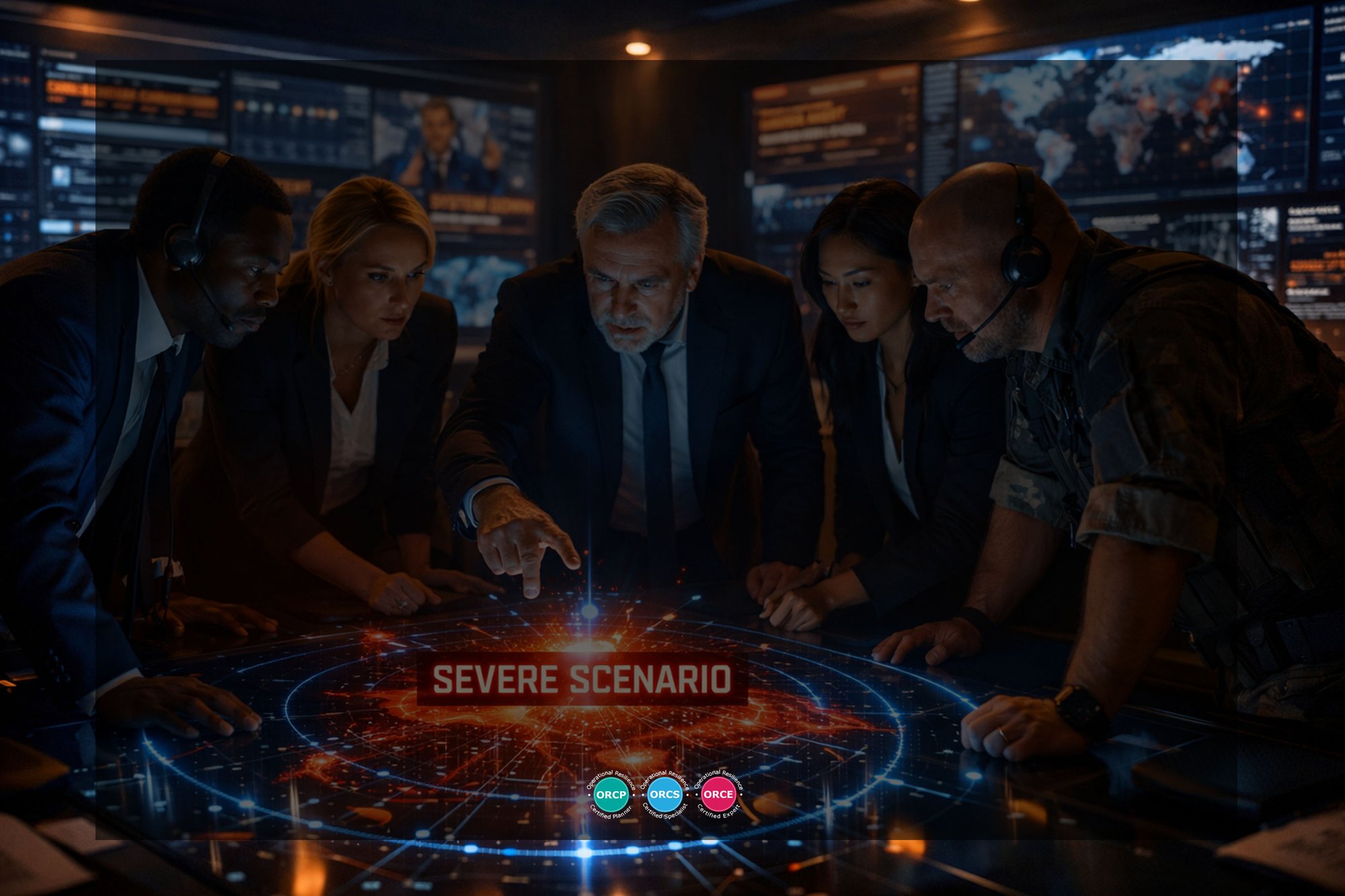
Scenario testing is a core element of operational resilience because it enables organisations to validate whether critical business services can continue operating within established impact tolerances during disruptive events.
Rather than relying solely on documentation or assumptions, scenario testing assesses the resilience of end-to-end business services by evaluating the organisation’s ability to prevent, adapt to, respond to, recover from, and learn from severe but plausible events.
According to the BCM Institute Operational Resilience guidance, testing should focus on realistic disruption scenarios involving people, processes, technology, facilities, cyber risks, and third-party dependencies.
For a market infrastructure organisation such as London Stock Exchange Group (LSEG), exchange trading services are highly time-sensitive and systemically important, and any disruption can affect market integrity, participants, regulators, and broader financial stability.
[](https://cta-redirect.hubspot.com/cta/redirect/3893111/3c32e9b3-ea88-44c3-9182-fa3e6a9aadee)
[Moh Heng Goh](https://blog.bcm-institute.org/ebook-or/author/moh-heng-goh) Jun 5, 2026
###### Operational Resilience Certified Planner-Specialist-Expert
### [](https://cta-redirect.hubspot.com/cta/redirect/3893111/4cf01773-45f9-4125-9759-f4ef6452c39f)
### [](https://cta-redirect.hubspot.com/cta/redirect/3893111/3c32e9b3-ea88-44c3-9182-fa3e6a9aadee)CBS-2 Market Data Distribution Services
[![\[OR\] \[LSEG\] \[E3\] \[CBS\] \[2\] \[ST\] Perform Scenario Testing](https://no-cache.hubspot.com/cta/default/3893111/b92a7267-1310-4d2a-9ae8-ab11d711b5ff.png)](https://cta-redirect.hubspot.com/cta/redirect/3893111/b92a7267-1310-4d2a-9ae8-ab11d711b5ff)
Scenario testing is a fundamental component of operational resilience, enabling the London Stock Exchange Group (LSEG) to assess whether its critical business services can continue to operate within established impact tolerances during severe yet plausible disruption events.
For CBS-2 Market Data Distribution Services, scenario testing provides assurance that the end-to-end market data ecosystem—from source acquisition and validation through distribution, customer delivery, and resilience administration—can withstand operational, technological, cyber, third-party, and infrastructure-related disruptions.
By simulating realistic adverse conditions, LSEG can identify vulnerabilities, validate recovery capabilities, assess the effectiveness of controls, and strengthen preparedness across people, processes, technology, facilities, and external dependencies.
The scenario testing activities presented in this chapter align with operational resilience principles and incorporate the growing interrelationships among cyber risks, ICT disruptions, data integrity threats, and business service continuity.
The objective is not only to test recovery procedures but also to demonstrate that market participants, customers, regulators, and other stakeholders continue to receive critical market data services during periods of stress.
Through regular testing, analysis of outcomes, and implementation of lessons learned, LSEG can continuously enhance the resilience of its Market Data Distribution Services and support the stability and integrity of the financial markets it serves.
The following table provides recommended Operational Resilience Scenario Testing activities for **CBS-2 Market Data Distribution Services** within the London Stock Exchange Group (LSEG).
The scenarios align with operational resilience principles and focus on severe yet plausible disruptions that affect the end-to-end market data lifecycle.
Each scenario incorporates cyber and ICT risk considerations and demonstrates proactive risk management actions to evidence resilience capability.
[![Banner \[Table\] \[OR\] \[E3\] Perform Scenario Testing](https://no-cache.hubspot.com/cta/default/3893111/a45e9708-7139-4f4e-8e0e-41179f5cacc3.png)](https://cta-redirect.hubspot.com/cta/redirect/3893111/a45e9708-7139-4f4e-8e0e-41179f5cacc3)
Table P6: Perform Scenario Testing for CBS-2
| Sub-CBS Code | Sub-CBS Process | Recommended Scenario Test | Cyber & ICT Risk Integration | Evidence of Proactive Risk Management |
| --- | --- | --- | --- | --- |
| 2.1 | Market Data Source Acquisition and Feed Collection | Simulate loss of primary exchange market data feed from multiple exchanges simultaneously | Telecommunications outage, DDoS attack on feed gateways, API failure | Alternate feed activation test, redundant connectivity validation, supplier failover records |
| 2.2 | Market Data Validation and Quality Verification | Inject corrupted market data records and invalid pricing updates into the validation environment | Data integrity attack, malware manipulation of inbound data | Data quality exception reports, validation rule testing records, anomaly detection logs |
| 2.3 | Market Data Normalisation and Data Transformation | Simulate the failure of the transformation engine during peak trading hours | Application failure, software defect, cloud service degradation | Transformation recovery procedures, automated rollback testing, and resilience architecture reviews |
| 2.4 | Instrument and Reference Data Association | Test inaccurate reference data mapping affecting multiple instruments | Master data corruption, unauthorised database modification | Reference data reconciliation reports, governance reviews, and control testing evidence |
| 2.5 | Real-Time Tick Data Processing | Simulate processing engine overload caused by extreme market volatility | Resource exhaustion, algorithm malfunction, infrastructure bottleneck | Capacity stress test reports, scaling validation results, performance monitoring dashboards |
| 2.6 | Market Data Aggregation and Consolidation | Simulate failure of the primary aggregation platform consolidating global feeds | Server failure, cluster outage, storage corruption | High-availability failover testing, resilience drills, and platform recovery evidence |
| 2.7 | Data Enrichment and Analytics Processing | Simulate disruption of analytics engines supporting value-added market data products | Analytics platform compromise, cloud processing failure | Recovery time testing, backup analytics activation records, and cyber recovery exercises |
| 2.8 | Entitlement and Subscriber Access Management | Simulate corruption of the entitlement database, causing subscriber access errors | Identity management compromise, privileged account abuse | IAM testing reports, access review records, and entitlement reconciliation evidence |
| 2.9 | Data Feed Publication and Distribution | Simulate a complete outage of the distribution infrastructure serving global clients | DDoS attack, messaging middleware failure, CDN disruption | Distribution failover exercises, traffic rerouting evidence, and client notification testing |
| 2.10 | Low-Latency Data Delivery and Network Routing | Simulate latency spikes and network congestion across critical delivery routes | Network attack, router misconfiguration, carrier outage | Network resilience testing, latency monitoring records, and route diversity validation |
| 2.11 | API Gateway and Connectivity Services | Simulate an API gateway failure affecting customer access to market data | API exploitation attack, authentication failure, gateway outage | API resilience testing, penetration testing results, and gateway failover validation |
| 2.12 | Market Data Synchronisation and Time Management | Simulate failure of enterprise time synchronisation infrastructure | NTP compromise, GPS timing disruption, clock drift attack | Time synchronisation testing records, alternate timing source validation, and monitoring reports |
| 2.13 | Historical Data Capture and Archiving | Simulate failure of the archival platform and inability to retrieve historical records | Storage corruption, ransomware attack, backup compromise | Backup restoration tests, archival integrity verification, and recovery drill evidence |
| 2.14 | Customer Delivery Channel Integration | Simulate an outage affecting multiple customer delivery channels simultaneously | Middleware compromise, integration platform outage | Customer channel failover tests, integration resilience reports, and recovery exercises |
| 2.15 | Exception Handling and Data Recovery Management | Simulate widespread market data corruption requiring bulk recovery operations | Cyber-induced data corruption, database failure | Data recovery testing records, incident simulations, restoration success metrics |
| 2.16 | Market Data Monitoring and Performance Surveillance | Simulate failure of monitoring tools during a market data degradation event | SIEM outage, monitoring platform compromise | Secondary monitoring activation, observability testing, and incident detection metrics |
| 2.17 | Incident Response and Service Restoration | Conduct an end-to-end cyberattack simulation impacting market data services | Ransomware, destructive malware, and insider threat | Incident response exercise reports, crisis management records, and lessons learned register |
| 2.18 | Regulatory Reporting and Data Compliance Monitoring | Simulate regulatory reporting failures due to missing or inaccurate market data | Compliance system outage, data integrity compromise | Regulatory reporting testing, compliance audit results, and remediation tracking |
| 2.19 | Cybersecurity Monitoring for Data Infrastructure | Conduct an advanced persistent threat (APT) simulation targeting market data infrastructure | APT attack, lateral movement, credential compromise | Threat hunting reports, SOC exercise results, cyber maturity assessments |
| 2.20 | Business Continuity and Resilience Administration | Simulate a prolonged regional data centre outage impacting market data operations | Data centre failure, cloud region outage, cyber-physical disruption | BCP exercise reports, alternate site activation records, resilience governance reviews |
#### **Recommended Enterprise-Wide End-to-End Scenario Tests**
In addition to individual Sub-CBS testing, LSEG should conduct integrated scenario tests covering the complete CBS-2 Market Data Distribution Services value chain.
| Scenario Test | Scope | Cyber & ICT Linkage | Evidence of Proactive Risk Management |
| --- | --- | --- | --- |
| Exchange Feed Loss During Peak Trading | 2.1 to 2.10 | Connectivity failure, supplier outage | Third-party resilience assessments, recovery exercise reports |
| Ransomware Attack on Market Data Platform | 2.2 to 2.20 | Cybersecurity incident, data encryption | Cyber recovery testing, immutable backup validation |
| Data Corruption Across Market Data Lifecycle | 2.2 to 2.18 | Data integrity compromise | Data reconciliation reports, recovery testing evidence |
| Cloud Service Provider Regional Outage | 2.5 to 2.20 | Cloud infrastructure failure | Multi-region failover testing, cloud resilience assessments |
| Global DDoS Attack on Data Distribution Services | 2.9 to 2.14 | Network and application attack | DDoS mitigation exercises, network resilience reports |
| Time Synchronisation Failure Across Trading Ecosystem | 2.12 and dependent services | Critical ICT infrastructure failure | Alternate timing source tests, synchronisation recovery evidence |
| Insider Threat: Manipulating Market Data | 2.2 to 2.18 | Privileged access abuse | User activity monitoring reports, access governance testing |
| Simultaneous Cyber and Physical Facility Disruption | Entire CBS-2 | Combined cyber and operational event | Crisis management exercises, business continuity testing results |
#### **Key Evidence Expected from Scenario Testing**
To demonstrate operational resilience maturity and proactive risk management, LSEG should maintain evidence, including:
1. Scenario test plans and approved test objectives.
2. Impact tolerance measurement results.
3. Recovery Time Objective (RTO) and Recovery Point Objective (RPO) achievement records.
4. Cybersecurity monitoring and threat detection reports.
5. Third-party resilience assessment results.
6. Failover and recovery exercise reports.
7. Crisis management and incident response logs.
8. Lessons learned and remediation tracking registers.
9. Board and executive review documentation.
10. Continuous improvement actions and resilience enhancement programmes.
This approach aligns scenario testing with operational resilience expectations by validating whether **CBS-2 Market Data Distribution Services** can remain within established impact tolerances during severe but plausible operational, cyber, technology, third-party, and data integrity disruption scenarios.
[![Banner \[Summing\] \[OR\] \[E3\] Perform Scenario Testing](https://no-cache.hubspot.com/cta/default/3893111/11895c06-91e9-4cec-acb6-4356741952e4.png)](https://cta-redirect.hubspot.com/cta/redirect/3893111/11895c06-91e9-4cec-acb6-4356741952e4)
The successful execution of scenario testing for CBS-2 Market Data Distribution Services enables the London Stock Exchange Group to validate its operational resilience under a range of severe yet plausible disruption scenarios.
The testing programme demonstrates the organisation’s ability to identify emerging risks, respond effectively to incidents, recover critical functions within acceptable timeframes, and maintain the delivery of essential market data services to customers and market participants.
By integrating cyber resilience, technology resilience, third-party dependency management, and business continuity considerations into each test scenario, LSEG establishes a comprehensive and realistic assessment of its operational preparedness.
Scenario testing should not be viewed as a one-time compliance exercise but as a continuous improvement mechanism that strengthens resilience maturity across the organisation.
The insights gained from testing provide valuable evidence of proactive risk management, support governance and regulatory oversight, and drive enhancements to operational processes, technology platforms, incident response capabilities, and recovery strategies.
Through ongoing testing, review, and remediation, LSEG can continue to improve its ability to withstand disruption, protect market integrity, and ensure the reliable delivery of market data services in an increasingly complex and interconnected operating environment.

| **eBook 3: Starting Your OR Implementation** | | | | | |
| --- | --- | --- | --- | --- | --- |
| **CBS-2 Market Data Distribution Services** | | | | | |
| **DP** | **MIIC** | **MIID** | **ITo** | **SbPS** | **ST** |
| [![\[OR\] \[LSEG\] \[E3\] \[CBS\] \[2\] \[DP\] Market Data Distribution Services](https://no-cache.hubspot.com/cta/default/3893111/c154d55c-1c46-4ba5-a805-f4a2a04ee3d2.png)](https://cta-redirect.hubspot.com/cta/redirect/3893111/c154d55c-1c46-4ba5-a805-f4a2a04ee3d2) | [![\[OR\] \[LSEG\] \[E3\] \[CBS\] \[2\] \[MIIC\] Map Interconnects](https://no-cache.hubspot.com/cta/default/3893111/2d5afff3-c627-400a-8095-ae9193979fb7.png)](https://cta-redirect.hubspot.com/cta/redirect/3893111/2d5afff3-c627-400a-8095-ae9193979fb7) | [![\[OR\] \[LSEG\] \[E3\] \[CBS\] \[2\] \[MIID\] Map Interdependencies](https://no-cache.hubspot.com/cta/default/3893111/aee20769-da71-4980-9cc7-ea6f8808bd4b.png)](https://cta-redirect.hubspot.com/cta/redirect/3893111/aee20769-da71-4980-9cc7-ea6f8808bd4b) | [![\[OR\] \[LSEG\] \[E3\] \[CBS\] \[2\] \[ITo\] Establish Impact Tolerances](https://no-cache.hubspot.com/cta/default/3893111/e2a01578-eb4b-4658-b519-2d2e0d87120e.png)](https://cta-redirect.hubspot.com/cta/redirect/3893111/e2a01578-eb4b-4658-b519-2d2e0d87120e) | [![\[OR\] \[LSEG\] \[E3\] \[CBS\] \[2\] \[SbPS\] Identify Severe but Plausible Scenarios](https://no-cache.hubspot.com/cta/default/3893111/7cfaba51-aeef-4aee-a047-c72b867241d1.png)](https://cta-redirect.hubspot.com/cta/redirect/3893111/7cfaba51-aeef-4aee-a047-c72b867241d1) | [![\[OR\] \[LSEG\] \[E3\] \[CBS\] \[2\] \[ST\] Perform Scenario Testing](https://no-cache.hubspot.com/cta/default/3893111/b92a7267-1310-4d2a-9ae8-ab11d711b5ff.png)](https://cta-redirect.hubspot.com/cta/redirect/3893111/b92a7267-1310-4d2a-9ae8-ab11d711b5ff) |
[](https://cta-redirect.hubspot.com/cta/redirect/3893111/084e620a-46c5-419a-82ed-6a681d15c0b6)Gain Competency: For organisations looking to accelerate their journey, BCM Institute’s training and certification programs, including the OR-5000 Operational Resilience Expert Implementer course, provide in-depth insights and practical toolkits for effectively embedding this model.
#### More Information About OR-5000 \[OR-5\] or OR-300 \[OR-3\]
To learn more about the course and schedule, click the buttons below for the OR-300 Operational Resilience Implementer course and the OR-5000 Operational Resilience Expert Implementer course.
| [](https://cta-redirect.hubspot.com/cta/redirect/3893111/3530eccb-515d-401e-afc2-3469e26d7fbf) | [](https://cta-redirect.hubspot.com/cta/redirect/3893111/fdd4fa9c-ed69-40c1-925f-4eb6a1c5c255) | [](https://cta-redirect.hubspot.com/cta/redirect/3893111/77a34b84-0a6d-44f8-b8d6-6ab04cdf5edd) |
| --- | --- | --- |
| [](https://cta-redirect.hubspot.com/cta/redirect/3893111/6e5c0cda-39b9-4bbd-b3d4-4cf46a790b14) | [](https://cta-redirect.hubspot.com/cta/redirect/3893111/a68a08aa-36d3-4216-9551-202c9fde06ea) | [![ \[BL-OR\] \[3-4-5\] View Schedule](https://no-cache.hubspot.com/cta/default/3893111/d0d733a1-16c0-4b68-a26d-adbfd4fc6069.png)](https://cta-redirect.hubspot.com/cta/redirect/3893111/d0d733a1-16c0-4b68-a26d-adbfd4fc6069) |
| [![\[BL-OR\] \[3\] FAQ OR-300](https://no-cache.hubspot.com/cta/default/3893111/f20c71b4-f5e8-4aa5-8056-c374ca33a091.png)](https://cta-redirect.hubspot.com/cta/redirect/3893111/f20c71b4-f5e8-4aa5-8056-c374ca33a091) | If you have any questions, click to contact us.[![Email to Sales Team \[BCM Institute\]](https://no-cache.hubspot.com/cta/default/3893111/3c53daeb-2836-4843-b0e0-645baee2ab9e.png)](https://cta-redirect.hubspot.com/cta/redirect/3893111/3c53daeb-2836-4843-b0e0-645baee2ab9e) | [](https://cta-redirect.hubspot.com/cta/redirect/3893111/7f2718a4-ea80-4f84-a319-dc2d4df37a46) |
| [](https://cta-redirect.hubspot.com/cta/redirect/3893111/74b1e556-8cd2-4a74-8821-db1804534955) | [](https://cta-redirect.hubspot.com/cta/redirect/3893111/f2bd8eb1-32d2-4732-9267-ea53223cf58f) | [](https://cta-redirect.hubspot.com/cta/redirect/3893111/084e620a-46c5-419a-82ed-6a681d15c0b6) |
#### **Comments:**

---

---

---

---


All rights reserved. Copyright 2026
```json
{
"@context" : "https://schema.org",
"@type" : "BlogPosting",
"author" : {
"@type" : "Person",
"name" : "Moh Heng Goh",
"url" : "https://blog.bcm-institute.org/ebook-or/author/moh-heng-goh"
},
"dateModified" : "2026-06-05T06:18:47.526Z",
"datePublished" : "2026-06-05T05:00:39.000Z",
"headline" : "[OR] [LSEG] [E3] [CBS] [2] [ST] Perform Scenario Testing",
"mainEntityOfPage" : {
"@id" : "https://blog.bcm-institute.org/ebook-or/or-lseg-e3-cbs-2-st-perform-scenario-testing",
"@type" : "WebPage"
},
"publisher" : {
"@type" : "Organization",
"logo" : {
"@type" : "ImageObject",
"url" : "https://blog.bcm-institute.org/hubfs/BCMI%20Logo.png"
},
"name" : "BCMI Pte Ltd"
}
}
```