---
title: "[BCM] [SAESL] [E2] [C9] Summary for Business Continuity Management Planning Methodology for Singapore Aero Engine Services Private Limited"
description: Summary of the seven-phase BCM planning methodology for SAESL, linking project, risk, impact, strategy, plan, exercise and programme management.
---
.
[](http://www.bcm-institute.org/)
- [Home](https://www.bcm-institute.org/)
- [About Us](https://www.bcm-institute.org/about-us-3/)
- [A President’s Perspective](https://www.bcm-institute.org/about-us/a-presidents-perspective/)
- [Our History](https://www.bcm-institute.org/about-us/our-history/)
- [Our Advisory Council](https://www.bcm-institute.org/about-us/our-advisory-council/)
- [Customers’ Testimonials](https://www.bcm-institute.org/about-us/customers-testimonials/)
- [Credential Verification](https://www.bcm-institute.org/about-us/credential-verification/)
- [Courses](https://blog.bcm-institute.org/blog/course-fees-for-blended-learning-courses-master-catalog)
- [ISO 22301 Business Continuity Management System Audit](https://blog.bcm-institute.org/audit/business-continuity-management-audit-courses)
- [ISO 22301 Business Continuity Management](https://blog.bcm-institute.org/bcm/business-continuity-management-courses)
- [Crisis Communication](https://blog.bcm-institute.org/crisis-communication/crisis-communication-courses)
- [Crisis Management](https://blog.bcm-institute.org/en/crisis-management/courses)
- [IT Disaster Recovery](https://blog.bcm-institute.org/it-disaster-recovery/courses)
- [Operational Resilience](https://blog.bcm-institute.org/operational-resilience/courses)
- [Operational Resilience Audit](https://blog.bcm-institute.org/operational-resilience-audit/courses)
- [Certification](https://blog.bcm-institute.org/certification/types-of-certifications-offered)
- [ISO 22301 BCMS Audit Certification](https://blog.bcm-institute.org/certification/business-continuity-management-audit-certification)
- [ISO22301 Business Continuity Management Certification](https://blog.bcm-institute.org/bcm/business-continuity-management-certification)
- [Crisis Communication Certification](https://blog.bcm-institute.org/crisis-communication/crisis-communication-certification)
- [Crisis Management Certification](https://blog.bcm-institute.org/en/crisis-management/crisis-management-certification)
- [IT Disaster Recovery Planning Certification](https://blog.bcm-institute.org/it-disaster-recovery/it-disaster-recovery-certification)
- [Operational Resilience Certification](https://blog.bcm-institute.org/operational-resilience/operational-resilience-certification)
- [Operational Resilience Audit Certification](https://blog.bcm-institute.org/operational-resilience-audit)
- [Seminars](https://blog.bcm-institute.org/meet-the-expert/mte-webinar-mainpage)
- [Store](https://www.bcm-institute.org/store-2/)
- [Contact Us](http://www.bcm-institute.org/about-us/contact-us/)
-
-
###### Building Resilient Operations: Implementing Business Continuity Management at SAESL

# \[BCM\] \[SAESL\] \[E2\] \[C9\] Summary for Business Continuity Management Planning Methodology for Singapore Aero Engine Services Private Limited
[](https://cta-redirect.hubspot.com/cta/redirect/3893111/c9d0ea0f-9f66-4232-97e2-6be3fe001e05)
Chapters 1 to 8 describe the business continuity management (BCM) planning methodology for SAESL. The methodology consists of seven phases that together meet the planning and operation requirements of ISO 22301. This summary revisits each phase, shows how they fit together, and sets out the points that matter most to SAESL. It then suggests how the BCM team might begin. All SAESL-specific figures and examples in the eBook are illustrative until SAESL confirms them.
[](https://cta-redirect.hubspot.com/cta/redirect/3893111/7789ece9-0b11-4cae-9f32-d34d7eb1688a)
[Moh Heng Goh](https://blog.bcm-institute.org/bcm-v2/author/moh-heng-goh) Nov 14, 2026
## Introduction
Singapore Aero Engine Services Private Limited (SAESL) repairs and overhauls Rolls-Royce Trent engines for airlines worldwide, and its customers, aviation authorities, and staff depend on that work continuing, even when something goes wrong. This chapter closes *Implementing Business Continuity Management for Singapore Aero Engine Services Private Limited*, the second eBook in the series *Building Resilient Operations: Implementing Business Continuity Management at SAESL*.
[](https://cta-redirect.hubspot.com/cta/redirect/3893111/c9d0ea0f-9f66-4232-97e2-6be3fe001e05)
[](https://cta-redirect.hubspot.com/cta/redirect/3893111/ed46e362-3b5a-4a67-95cd-d0df7fae8af4)
[](https://cta-redirect.hubspot.com/cta/redirect/3893111/9e98b285-f794-4c23-832a-de0d02e15c19)Chapters 1 to 8 described the business continuity management (BCM) planning methodology for SAESL. The methodology consists of seven phases that together meet the planning and operation requirements of ISO 22301. This summary revisits each phase, shows how they fit together, and sets out the points that matter most to SAESL. It then suggests how the BCM team might begin. All SAESL-specific figures and examples in the eBook are illustrative until SAESL confirms them.
## The Methodology in Brief
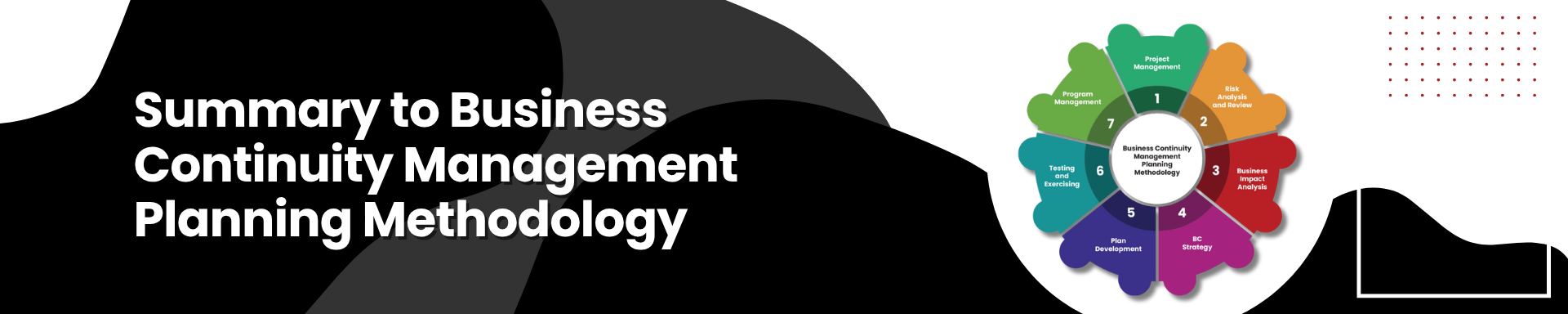
The methodology has seven phases:
- Project Management (PM);
- Risk Analysis and Review (RAR);
- Business Impact Analysis (BIA);
- Business Continuity Strategy (BCS);
- Plan Development (PD);
- Testing and Exercising (TE);
- Program Management (PgM).
The first six form a planning cycle. The seventh keeps the programme alive and feeds lessons back to the earlier phases. Together they answer six practical questions. How will the work be organised? What could go wrong? What would it cost if a function stopped? How will SAESL protect and recover each function? What should people do? How does SAESL know that it will work, and keep it that way?
## Phase 1: Project Management
Chapter 2 explained that a BCM programme needs a clear start. The project management phase sets the scope, objectives, executive sponsor, steering committee, and project team. It produces a project charter, a responsibility matrix, a plan with realistic dates, a list of project risks and a communication plan.
For SAESL, the main lessons were to scope the programme across overhaul, repair, testing, and support; schedule workshops around production commitments; and run the project under the same document control that SAESL applies to its quality records. Including the safety management system (SMS) manager on the steering committee links continuity and safety from the outset.
## Phase 2: Risk Analysis and Review
Chapter 3 described four steps: identify, assess, mitigate and review. The illustrative risk register used ten reference codes, R1 to R10:
- R1, parts supply interruption;
- R2, test facility failure;
- R3, cyber incident;
- R4, information system outage;
- R5, loss of approval;
- R6, loss of skilled people;
- R7, premises damage or utility failure;
- R8, supplier or sub-contractor failure;
- R9, logistics disruption;
- R10, extreme weather.
Risks are scored for likelihood and impact on a defined scale, compared with the level management will accept, and treated by avoiding, reducing, sharing or accepting them. The register is reviewed on a schedule and when a trigger occurs. The most important point for SAESL is that compliance risk, and R5 in particular, deserves its own place in the register because the approvals held by SAESL are as important as its equipment.
## Phase 3: Business Impact Analysis
Chapter 4 moved from causes to consequences. The BIA measures how the impact of a disruption grows over time and records the maximum tolerable period of disruption (MTPD), recovery time objective (RTO), minimum business continuity objective (MBCO), recovery point objective (RPO) and dependencies for each critical business function (CBF).
SAESL has 25 CBFs, coded CBF-01 to CBF-25, from engine maintenance, repair and overhaul operations through to executive leadership. The illustrative results placed them in four tiers. Tier 1 functions, with RTOs of four hours to one day, protect people, systems, security and crisis response. Tier 2 functions produce, certify and deliver engines and their records. Tier 3 functions are support activities that can wait briefly. Tier 4 functions tolerate the longest outages. Three features shaped the analysis: regulatory reporting deadlines such as the three-day reporting expectation under the CAAS rules for maintenance organisations, the long production cycle of an overhaul, and shared dependencies on information technology, records and facilities.
## Phase 4: Business Continuity Strategy
Chapter 5 turned the BIA into choices. For each CBF, the team selects prevention, mitigation, and recovery measures that meet the RTO, target the MBCO, and cost less than the impact avoided. To keep the work practical, the 25 CBFs were grouped into six sets:
- engine operations;
- quality, safety and regulatory functions;
- supply and logistics functions;
- technology and information functions;
- customer, communication and leadership functions;
- corporate and site support functions.
The critical check for SAESL is that every strategy keeps the organisation within the conditions of its approvals. An alternative site, supplier or method is useful only if the approval holders and authorities accept it. This check should take place when the strategy is chosen, not during an incident.
## Phase 5: Plan Development
Chapter 6 showed how strategies become written plans through three stages. First, the BCM coordinator designs the plan template and determines the recovery organisation. Second, a writing workshop guides the plan writers, and each business unit BCM coordinator completes the template for their unit. Third, the coordinators and business unit heads validate the plans for completeness and coverage, and the steering committee approves and issues them.
The plans should be short enough to use in a crisis, share a common structure, name alternates for every role and include notification duties to authorities and customers. They should also be available offline, because systems may be down when they are needed most.
## Phase 6: Testing and Exercising
Chapter 7 described six types of exercise in two groups. The initial tests are component tests, call notification tests and walkthroughs. The advanced tests are integrated tests, simulation tests and live tests. SAESL should begin with the basic tests, correct what they reveal and move to the advanced tests once the basics work. Live tests at SAESL must never put people, airworthiness or customer property at risk.
On the regulatory side, the Civil Aviation Authority of Singapore (CAAS) guidance on safety management systems expects emergency response plans to be regularly tested through exercises and reviewed. It applies to approved maintenance organisations, and it makes sense to plan BCM exercises and SMS exercises together. The guidance is advisory and does not fix an exercise frequency in the parts reviewed \[verify\], so SAESL should confirm its application with CAAS.
## Phase 7: Program Management
Chapter 8 explained how the programme stays current. Governance and ownership make people accountable. Scheduled reviews and change triggers keep plans accurate. Awareness and training prepare people. Performance measures make readiness visible. Audit and management review provide assurance and drive improvement. For SAESL, the approvals register and a supplier continuity check are practical additions, and the regulatory liaison function (CBF-07) is well placed to own the first.
## How the Phases Work Together
The phases are linked by their outputs. The project charter scopes the risk analysis and the BIA. The risk register and the BIA together shape the strategies. The strategies fix the content of the plans. The exercises prove the plans and reveal gaps. Programme management brings those gaps back into the earlier phases through review and change triggers.
Two threads run through all seven phases for SAESL. The first is **continuity of compliance**: every phase asks what a disruption would do to the organisation's ability to keep its approvals, records and release authority. The second is **shared dependencies**: information technology, engineering records, facilities and a small number of critical suppliers support nearly every function, so they set the real order of recovery.
## SAESL's Position in Brief
SAESL's circumstances explain why this methodology suits it. It is a joint venture of Rolls-Royce Plc and SIA Engineering Company with a workforce of over 1,000 and capacity to repair and overhaul over 300 Trent engines a year. It holds airworthiness approvals from 13 authorities, including CAAS, and serves airlines on six continents. In an organisation like this, a disruption is judged not only by lost output but also by lost trust. A structured, documented and tested BCM programme is a practical way to protect that trust. More information on the organisation is available on the [SAESL website](https://www.saesl.com.sg).
## Pitfalls the Methodology Helps SAESL Avoid
Organisations that implement BCM commonly meet the same difficulties. The seven phases are designed to prevent them.
- **Plans without priorities:** teams write plans for everything and protect nothing well. The BIA gives a ranked list, so effort goes first to Tier 1 and Tier 2 functions.
- **Strategies that no one can afford or approve:** the strategy phase tests every option for cost and for acceptability to approval holders before the plan is written.
- **Plans that sit on a shelf:** the exercise programme proves them, and programme management reviews them on a fixed calendar and after every change.
- **Unclear ownership:** the project phase names a sponsor, a steering committee and a coordinator, and every plan has an owner and an alternate.
- **Duplicated effort with safety management:** linking the risk register, the exercises and the change process to the SMS stops two systems from drifting apart.
None of these pitfalls is unique to SAESL, but each is more costly in an organisation where records, approvals and customer commitments leave little room for improvisation.
## Roles at a Glance
Four groups carry the programme. Senior management sponsors it, approves its policy and takes part in the annual management review. The steering committee oversees progress and resolves priority conflicts. The BCM coordinator runs the methodology and supports the business units. The business unit BCM coordinators own the BIA input, plans, and exercises in their units. Everyone who holds a role in a plan, as a team member or an alternate, also shares responsibility for knowing it and taking part in exercises.
## Getting Started: An Illustrative First Steps Plan
The BCM team might begin as follows.
1. **Confirm the foundation:** check that the scope, objectives, assumptions and BCM team from eBook 1 are approved and current.
2. **Launch the project:** approve the charter, name the sponsor and steering committee and publish the plan.
3. **Review the risks:** validate R1 to R10 with business units and add anything missing.
4. **Start the BIA with the Tier 1 and Tier 2 functions:** test the illustrative RTOs and MTPDs and replace them with real figures.
5. **Choose strategies:** agree the measures for the highest-priority groups and check them against approval conditions.
6. **Write and validate the first plans:** start with information technology, engine operations and crisis management.
7. **Exercise:** hold a call notification test and a walkthrough for the crisis management team.
8. **Set the programme rhythm:** agree review dates, change triggers and performance measures.
The next eBook in the series, *Starting Your BCM Implementation for Singapore Aero Engine Services Private Limited*, takes these steps into practice.
## Points to Confirm Before Relying on the Examples
The figures in this eBook illustrate how each phase works. Before SAESL relies on them, it should confirm the risk ratings, tiers, RTOs, MTPDs, owners and dates through its own workshops and approve them at steering committee level. It should also confirm with CAAS how the regulatory expectations described in Chapters 4 and 7 apply to the organisation, and check whether newer amendments of the cited requirements exist. Recording these confirmations in the programme file shows that the methodology was applied with care and not just copied.
## Summary Table
**Table 9: Summary for Business Continuity Management Planning Methodology for Singapore Aero Engine Services Private Limited**
| **Phase** | **Chapter** | **Key output** | **Main point for SAESL** |
| --- | --- | --- | --- |
| **Project Management (PM)** | 2 | Charter, plan, roles | Scope across all operations; controlled documents |
| **Risk Analysis and Review (RAR)** | 3 | Risk register R1 to R10 | Compliance risk treated as a core category |
| **Business Impact Analysis (BIA)** | 4 | Tiers, RTOs and MTPDs for CBF-01 to CBF-25 | Regulatory deadlines and shared dependencies |
| **Business Continuity Strategy (BCS)** | 5 | Strategies for six groups of CBFs | Strategies must stay within approval conditions |
| **Plan Development (PD)** | 6 | Validated BC plans | Notification duties and offline copies |
| **Testing and Exercising (TE)** | 7 | Exercise programme and reports | Combine BCM and SMS exercises |
| **Program Management (PgM)** | 8 | Governance, reviews, measures | Approvals register and supplier checks |
All SAESL-specific entries are illustrative and must be confirmed by SAESL.
## [](https://cta-redirect.hubspot.com/cta/redirect/3893111/b5945536-415f-4c64-9e05-c7b4d4f26c76)
## Conclusion
The seven-phase methodology gives SAESL a complete route from a scoped project to a maintained and tested BCM programme. Each phase has a defined purpose and output, and each hands its results to the next. For SAESL, the essential themes are protecting the continuity of its approvals and records, and managing the dependencies that cut across the organisation.
A programme of this kind succeeds through steady, visible progress: a first set of plans, a first exercise, a first review. SAESL can start with the highest-priority functions and extend the programme as experience grows.
## Sources
- [CAAS: Advisory Circular AC 1-3 (Rev 9), Safety Management System](https://isomer-user-content.by.gov.sg/175/25989037-180b-424c-b461-3752cc322d7c/ac-1-3(rev-9)-safety-management-system.pdf)
- [CAAS: SAR-145 (Amendment 18)](https://www.caas.gov.sg/docs/default-source/docs---srg/sar-145-(amdm-18).pdf)
- [SAESL: Company Profile](https://www.saesl.com.sg/about-us/company-profile/)
**Continue reading:** Chapter 10, the back cover of *Implementing Business Continuity Management for Singapore Aero Engine Services Private Limited*, summarises the eBook and shows how BCM Institute can support the BCM coordinators who put it into practice.
| Building Resilient Operations: Implementing Business Continuity Management at SAESL | | | | |
| --- | --- | --- | --- | --- |
| **eBook 2: Implementing Business Continuity Management** | | | | |
| **C1** | **C2** | **C3** | **C4** | **C5** |
| [](https://cta-redirect.hubspot.com/cta/redirect/3893111/5293770c-bccd-4cd7-ad66-f9b98acec36d) | [](https://cta-redirect.hubspot.com/cta/redirect/3893111/37371db8-20ba-4d3c-b0d7-bfbb491334c2) | [](https://cta-redirect.hubspot.com/cta/redirect/3893111/4c7ba3f8-467b-4cf6-bb15-08d57681de85) | [](https://cta-redirect.hubspot.com/cta/redirect/3893111/4af9a280-d158-4276-b5e9-76b765cc21cb) | [](https://cta-redirect.hubspot.com/cta/redirect/3893111/6be24b63-6244-407f-87cd-411083ce616e) |
| **C6** | **C7** | **C8** | **C9** | **C10** |
| [](https://cta-redirect.hubspot.com/cta/redirect/3893111/0ff5e2e1-09fb-4a8b-86d8-affab470e534) | [](https://cta-redirect.hubspot.com/cta/redirect/3893111/8d72106d-fbed-4c4f-9fd1-14070e628e97) | [](https://cta-redirect.hubspot.com/cta/redirect/3893111/d7dff66c-b830-46aa-bb7e-2d2fdf67a4df) | [](https://cta-redirect.hubspot.com/cta/redirect/3893111/9e98b285-f794-4c23-832a-de0d02e15c19) | [](https://cta-redirect.hubspot.com/cta/redirect/3893111/508f7ad5-755e-4c26-963a-c3e3754893d3) |
| | | | | |
---
## **Comments**

---

---

---

---


All rights reserved. Copyright 2026
```json
{
"@context" : "https://schema.org",
"@type" : "BlogPosting",
"author" : {
"@type" : "Person",
"name" : "Moh Heng Goh",
"url" : "https://blog.bcm-institute.org/bcm-v2/author/moh-heng-goh"
},
"dateModified" : "2026-11-14T10:47:11.707Z",
"datePublished" : "2026-11-14T10:45:23.000Z",
"headline" : "[BCM] [SAESL] [E2] [C9] Summary for Business Continuity Management Planning Methodology for Singapore Aero Engine Services Private Limited",
"mainEntityOfPage" : {
"@id" : "https://blog.bcm-institute.org/bcm-v2/summary-for-business-continuity-management-planning-methodology-for-singapore-aero-engine-services-private-limited",
"@type" : "WebPage"
},
"publisher" : {
"@type" : "Organization",
"logo" : {
"@type" : "ImageObject",
"url" : "https://blog.bcm-institute.org/hubfs/BCMI%20Logo.png"
},
"name" : "BCMI Pte Ltd"
}
}
```