---
title: "[BCM] [SAESL] [E2] [C2] Project Management Phase for Business Continuity Management Planning Methodology for Singapore Aero Engine Services Private Limited"
description: "How SAESL sets up its BCM project: scope, sponsor, steering committee, plan and communication, as the first phase of the ISO 22301 planning methodology."
---
.
[](http://www.bcm-institute.org/)
- [Home](https://www.bcm-institute.org/)
- [About Us](https://www.bcm-institute.org/about-us-3/)
- [A President’s Perspective](https://www.bcm-institute.org/about-us/a-presidents-perspective/)
- [Our History](https://www.bcm-institute.org/about-us/our-history/)
- [Our Advisory Council](https://www.bcm-institute.org/about-us/our-advisory-council/)
- [Customers’ Testimonials](https://www.bcm-institute.org/about-us/customers-testimonials/)
- [Credential Verification](https://www.bcm-institute.org/about-us/credential-verification/)
- [Courses](https://blog.bcm-institute.org/blog/course-fees-for-blended-learning-courses-master-catalog)
- [ISO 22301 Business Continuity Management System Audit](https://blog.bcm-institute.org/audit/business-continuity-management-audit-courses)
- [ISO 22301 Business Continuity Management](https://blog.bcm-institute.org/bcm/business-continuity-management-courses)
- [Crisis Communication](https://blog.bcm-institute.org/crisis-communication/crisis-communication-courses)
- [Crisis Management](https://blog.bcm-institute.org/en/crisis-management/courses)
- [IT Disaster Recovery](https://blog.bcm-institute.org/it-disaster-recovery/courses)
- [Operational Resilience](https://blog.bcm-institute.org/operational-resilience/courses)
- [Operational Resilience Audit](https://blog.bcm-institute.org/operational-resilience-audit/courses)
- [Certification](https://blog.bcm-institute.org/certification/types-of-certifications-offered)
- [ISO 22301 BCMS Audit Certification](https://blog.bcm-institute.org/certification/business-continuity-management-audit-certification)
- [ISO22301 Business Continuity Management Certification](https://blog.bcm-institute.org/bcm/business-continuity-management-certification)
- [Crisis Communication Certification](https://blog.bcm-institute.org/crisis-communication/crisis-communication-certification)
- [Crisis Management Certification](https://blog.bcm-institute.org/en/crisis-management/crisis-management-certification)
- [IT Disaster Recovery Planning Certification](https://blog.bcm-institute.org/it-disaster-recovery/it-disaster-recovery-certification)
- [Operational Resilience Certification](https://blog.bcm-institute.org/operational-resilience/operational-resilience-certification)
- [Operational Resilience Audit Certification](https://blog.bcm-institute.org/operational-resilience-audit)
- [Seminars](https://blog.bcm-institute.org/meet-the-expert/mte-webinar-mainpage)
- [Store](https://www.bcm-institute.org/store-2/)
- [Contact Us](http://www.bcm-institute.org/about-us/contact-us/)
-
-
###### Building Resilient Operations: Implementing Business Continuity Management at SAESL

# \[BCM\] \[SAESL\] \[E2\] \[C2\] Project Management Phase for Business Continuity Management Planning Methodology for Singapore Aero Engine Services Private Limited
[](https://cta-redirect.hubspot.com/cta/redirect/3893111/c9d0ea0f-9f66-4232-97e2-6be3fe001e05)
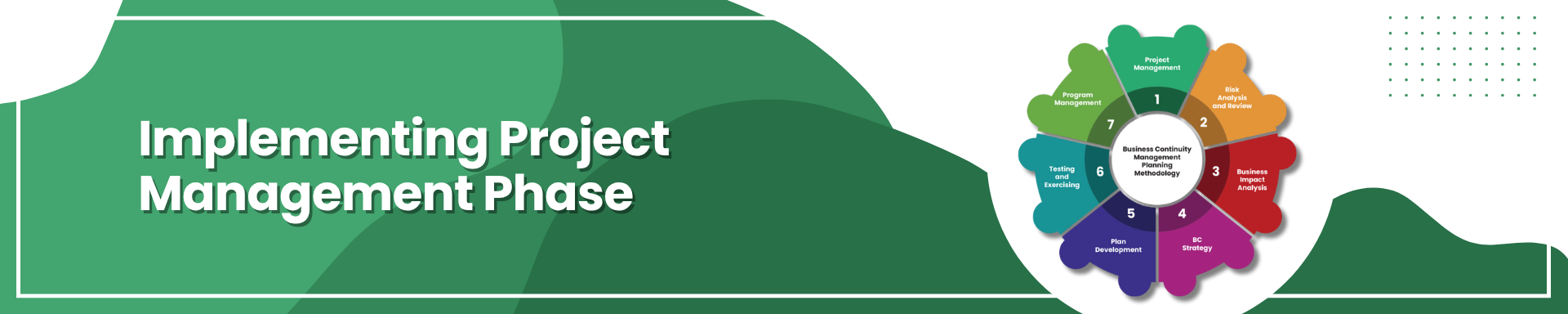
Chapter 1 introduced the seven-phase planning methodology. This chapter covers the first phase and the ISO 22301 expectations for leadership, planning and the resources it supports. It explains what the phase must produce and gives examples relating to SAESL, an engine maintenance, repair and overhaul (MRO) organisation described on its [website](https://www.saesl.com.sg).
[](https://cta-redirect.hubspot.com/cta/redirect/3893111/7789ece9-0b11-4cae-9f32-d34d7eb1688a)
[Moh Heng Goh](https://blog.bcm-institute.org/bcm-v2/author/moh-heng-goh) Nov 14, 2026
## Introduction
A business continuity management (BCM) programme can fail before any plan is written, simply because nobody agreed who is responsible, what is in scope or when the work finishes. The Project Management (PM) phase prevents that. It gives Singapore Aero Engine Services Private Limited (SAESL) a clear structure for the work that follows.
[](https://cta-redirect.hubspot.com/cta/redirect/3893111/c9d0ea0f-9f66-4232-97e2-6be3fe001e05)
[](https://cta-redirect.hubspot.com/cta/redirect/3893111/f3c50f04-ebe4-4e72-a7cf-10ee0040d496)
[](https://cta-redirect.hubspot.com/cta/redirect/3893111/37371db8-20ba-4d3c-b0d7-bfbb491334c2)Chapter 1 introduced the seven-phase planning methodology. This chapter covers the first phase and the ISO 22301 expectations for leadership, planning, and resources it supports. It explains what the phase must produce and gives examples relating to SAESL, an engine maintenance, repair and overhaul (MRO) organisation described on its [website](https://www.saesl.com.sg).
## Purpose of the Project Management Phase
The phase has one purpose: to establish the BCM project so that the other six phases can run in an orderly way. It answers five questions. What is in scope? Who sponsors and who does the work? What will be delivered, and by when? How will progress be reported? What could stop the project?
ISO 22301 expects top management to show leadership and commitment, and to provide resources. The project phase is where this becomes visible. A signed project charter and a named sponsor are the evidence that management has committed to the programme.
## Defining Scope and Objectives
The BCM team starts with scope. SAESL's operations include engine overhaul, component repair, an in-house engine test facility and support services such as engineering services and on-wing support. For example, SAESL might decide that the first project cycle covers all of these activities and the corporate functions that support them, but excludes any customer-owned premises.
The team then states objectives that can be checked. Three examples of useful wording are:
- complete the business impact analysis for all 25 critical business functions by an agreed date;
- approve a business continuity plan for every business unit by an agreed date;
- hold at least one exercise for the most time-sensitive functions in the first year.
These objectives should link back to the BCM goals and objectives set in eBook 1, *Understanding Your Organisation for Singapore Aero Engine Services Private Limited*. All dates and targets here are illustrative until SAESL's leadership confirms them.
## Sponsor, Steering Committee and Project Team
Every BCM project needs three layers of responsibility.
- **Executive sponsor:** a member of senior management who owns the outcome, removes obstacles and approves the budget. For example, SAESL might appoint a senior executive from operations, because most critical functions sit there.
- **Steering committee:** senior representatives from engineering, quality, supply chain, information technology, human resources and finance. They review progress, resolve priority conflicts, and approve key deliverables.
- **Project team:** the BCM coordinator and the business unit BCM coordinators who do the day-to-day work and who will later write and maintain the plans.
A short responsibility matrix, often called a RACI chart, records who is Responsible, Accountable, Consulted and Informed for each deliverable. It removes doubt about who approves the BIA or who signs off a plan.
## Planning the Work
The project plan breaks the work into tasks, owners and dates for each of the later phases. SAESL operates around customer commitments and engine turnaround times, so the plan should avoid asking the same people for workshops during peak overhaul periods. For example, the BCM coordinator might schedule BIA workshops for the engine overhaul function around the shop's production plan.
The plan should also include time for review and correction. Business units often find that their first answers to a BIA are incomplete. A plan that allows only one pass will either miss its dates or accept weak results.
## Managing Project Risks and Communication
The project itself faces risks, and it is worth listing them early. Typical ones include limited availability among key staff, unclear ownership of shared functions, inconsistent use of templates, and loss of momentum after the first workshops. For each risk, the team notes an owner and a response.
Communication needs the same care. The project team might issue a short monthly update to the steering committee and a briefing to all business unit heads at the start of each phase. Reports should say what has been done, what is late and what decision is needed. Where a decision is outstanding, the report should name who has to make it.
## Resources, Budget and Standards
The project also needs resources. The sponsor should confirm how much time the business unit coordinators can spend on BCM, since most will have full-time operational jobs. For example, SAESL might agree that each coordinator reserves a fixed number of hours a month during the first year, and that this time is recognised in their objectives.
The team should settle its working standards at the start. These include the BCM policy that frames the programme, templates for the BIA questionnaire and plans, rating scales for risk and impact, and the terms the team will use. Agreeing them once saves repeated debate later, and gives a consistent record that can be shown to an auditor.
Finally, the project should define how it will be closed. A BCM project does not end when the first plans are written, because the programme continues under Chapter 8. The project plan should therefore say when the project hands over to routine programme management, and who accepts that hand-over.
## Requirements Specific to SAESL
SAESL's approvals from aviation authorities, including the Civil Aviation Authority of Singapore (CAAS), depend on documented control of quality and safety. The BCM project should therefore follow the same document control rules as the rest of the organisation. Charters, plans and exercise reports should carry version numbers, approval dates and owners. This lets SAESL show an auditor how the programme was governed.
The project should also align with the safety management system (SMS) that CAAS expects of approved maintenance organisations. For example, SAESL might include its SMS manager on the steering committee so that continuity risks and safety risks are not managed in isolation.
## Summary Table
**Table 2: Project Management Phase for Business Continuity Management Planning Methodology for Singapore Aero Engine Services Private Limited**
| **Deliverable** | **Content** | **Illustrative SAESL example** | **Approver** |
| --- | --- | --- | --- |
| Project charter | Scope, objectives, sponsor and authority | Covers overhaul, repair, test and support | Executive sponsor |
| Responsibility matrix | Roles for each deliverable | BCM coordinator leads, unit heads accountable | Steering committee |
| Project plan | Tasks, owners and dates | BIA workshops avoid peak overhaul periods | Steering committee |
| Project risk list | Risks to the project and responses | Key staff availability | BCM coordinator |
| Communication plan | Reports and briefings | Monthly steering update | Executive sponsor |
All SAESL-specific entries are illustrative and must be confirmed by SAESL.
## [](https://cta-redirect.hubspot.com/cta/redirect/3893111/b5945536-415f-4c64-9e05-c7b4d4f26c76)
## Conclusion
The project management phase gives SAESL a defined scope, named leaders and a realistic plan. These conditions let the remaining phases run without constant renegotiation. Treating the BCM programme like any other regulated project, with controlled documents and clear approvals, suits an organisation that already works to aviation quality standards.
The next chapter turns to the second phase, risk analysis and review, where SAESL identifies and assesses the threats it faces.
**Continue reading:** Chapter 3, *Risk Analysis and Review Phase for Business Continuity Management Planning Methodology for Singapore Aero Engine Services Private Limited*, shows how SAESL identifies, assesses and treats the risks that could disrupt its operations.
| Building Resilient Operations: Implementing Business Continuity Management at SAESL | | | | |
| --- | --- | --- | --- | --- |
| **eBook 2: Implementing Business Continuity Management** | | | | |
| **C1** | **C2** | **C3** | **C4** | **C5** |
| [](https://cta-redirect.hubspot.com/cta/redirect/3893111/5293770c-bccd-4cd7-ad66-f9b98acec36d) | [](https://cta-redirect.hubspot.com/cta/redirect/3893111/37371db8-20ba-4d3c-b0d7-bfbb491334c2) | [](https://cta-redirect.hubspot.com/cta/redirect/3893111/4c7ba3f8-467b-4cf6-bb15-08d57681de85) | [](https://cta-redirect.hubspot.com/cta/redirect/3893111/4af9a280-d158-4276-b5e9-76b765cc21cb) | [](https://cta-redirect.hubspot.com/cta/redirect/3893111/6be24b63-6244-407f-87cd-411083ce616e) |
| **C6** | **C7** | **C8** | **C9** | **C10** |
| [](https://cta-redirect.hubspot.com/cta/redirect/3893111/0ff5e2e1-09fb-4a8b-86d8-affab470e534) | [](https://cta-redirect.hubspot.com/cta/redirect/3893111/8d72106d-fbed-4c4f-9fd1-14070e628e97) | [](https://cta-redirect.hubspot.com/cta/redirect/3893111/d7dff66c-b830-46aa-bb7e-2d2fdf67a4df) | [](https://cta-redirect.hubspot.com/cta/redirect/3893111/9e98b285-f794-4c23-832a-de0d02e15c19) | [](https://cta-redirect.hubspot.com/cta/redirect/3893111/508f7ad5-755e-4c26-963a-c3e3754893d3) |
| | | | | |
---
## **Comments**

---

---

---

---


All rights reserved. Copyright 2026
```json
{
"@context" : "https://schema.org",
"@type" : "BlogPosting",
"author" : {
"@type" : "Person",
"name" : "Moh Heng Goh",
"url" : "https://blog.bcm-institute.org/bcm-v2/author/moh-heng-goh"
},
"dateModified" : "2026-11-14T10:24:15.497Z",
"datePublished" : "2026-11-14T10:08:23.000Z",
"headline" : "[BCM] [SAESL] [E2] [C2] Project Management Phase for Business Continuity Management Planning Methodology for Singapore Aero Engine Services Private Limited",
"mainEntityOfPage" : {
"@id" : "https://blog.bcm-institute.org/bcm-v2/project-management-phase-for-business-continuity-management-planning-methodology-for-singapore-aero-engine-services-private-limited",
"@type" : "WebPage"
},
"publisher" : {
"@type" : "Organization",
"logo" : {
"@type" : "ImageObject",
"url" : "https://blog.bcm-institute.org/hubfs/BCMI%20Logo.png"
},
"name" : "BCMI Pte Ltd"
}
}
```