---
title: "[BCM] [EGH] [E3] [BIA] [P3] CBF [1] Emergency Department Services"
description: "EGH impact over time for CBF-1: scores from 4 hours to 60 days, with RTO, MTPD and vulnerable periods for 12 emergency department Sub-CBFs under ISO 22301."
---
.
[](http://www.bcm-institute.org/)
- [Home](https://www.bcm-institute.org/)
- [About Us](https://www.bcm-institute.org/about-us-3/)
- [A President’s Perspective](https://www.bcm-institute.org/about-us/a-presidents-perspective/)
- [Our History](https://www.bcm-institute.org/about-us/our-history/)
- [Our Advisory Council](https://www.bcm-institute.org/about-us/our-advisory-council/)
- [Customers’ Testimonials](https://www.bcm-institute.org/about-us/customers-testimonials/)
- [Credential Verification](https://www.bcm-institute.org/about-us/credential-verification/)
- [Courses](https://blog.bcm-institute.org/blog/course-fees-for-blended-learning-courses-master-catalog)
- [ISO 22301 Business Continuity Management System Audit](https://blog.bcm-institute.org/audit/business-continuity-management-audit-courses)
- [ISO 22301 Business Continuity Management](https://blog.bcm-institute.org/bcm/business-continuity-management-courses)
- [Crisis Communication](https://blog.bcm-institute.org/crisis-communication/crisis-communication-courses)
- [Crisis Management](https://blog.bcm-institute.org/en/crisis-management/courses)
- [IT Disaster Recovery](https://blog.bcm-institute.org/it-disaster-recovery/courses)
- [Operational Resilience](https://blog.bcm-institute.org/operational-resilience/courses)
- [Operational Resilience Audit](https://blog.bcm-institute.org/operational-resilience-audit/courses)
- [Certification](https://blog.bcm-institute.org/certification/types-of-certifications-offered)
- [ISO 22301 BCMS Audit Certification](https://blog.bcm-institute.org/certification/business-continuity-management-audit-certification)
- [ISO22301 Business Continuity Management Certification](https://blog.bcm-institute.org/bcm/business-continuity-management-certification)
- [Crisis Communication Certification](https://blog.bcm-institute.org/crisis-communication/crisis-communication-certification)
- [Crisis Management Certification](https://blog.bcm-institute.org/en/crisis-management/crisis-management-certification)
- [IT Disaster Recovery Planning Certification](https://blog.bcm-institute.org/it-disaster-recovery/it-disaster-recovery-certification)
- [Operational Resilience Certification](https://blog.bcm-institute.org/operational-resilience/operational-resilience-certification)
- [Operational Resilience Audit Certification](https://blog.bcm-institute.org/operational-resilience-audit)
- [Seminars](https://blog.bcm-institute.org/meet-the-expert/mte-webinar-mainpage)
- [Store](https://www.bcm-institute.org/store-2/)
- [Contact Us](http://www.bcm-institute.org/about-us/contact-us/)
-
-
###### Keeping Care Running: Managing and Implementing Business Continuity Management at Eastern General Hospital

# \[BCM\] \[EGH\] \[E3\] \[BIA\] \[P3\] CBF \[1\] Emergency Department Services
[](https://cta-redirect.hubspot.com/cta/redirect/3893111/dfa53785-5be1-4117-a1bc-43e40cdb42e8)
Chapter 4 estimated the impact of disrupting each Sub-Critical Business Function (Sub-CBF) of CBF-1 Emergency Department Services at Eastern General Hospital (EGH) for one fixed period of seven days. Real disruptions do not stop at seven days. This chapter shows how the impact grows as a disruption continues, from 4 hours to 60 days, and uses that growth to set recovery targets.
[](https://cta-redirect.hubspot.com/cta/redirect/3893111/bc131ed6-ca92-4253-8940-2f98dad34599)
[Moh Heng Goh](https://blog.bcm-institute.org/bcm-v2/author/moh-heng-goh) Nov 18, 2026
## [](https://cta-redirect.hubspot.com/cta/redirect/3893111/c5748bd7-2a18-4a78-8cc9-7dcc65204af9)
## [](https://cta-redirect.hubspot.com/cta/redirect/3893111/326c85d5-f1af-4a99-9f0e-0072cfcad36a)
## [](https://cta-redirect.hubspot.com/cta/redirect/3893111/bc131ed6-ca92-4253-8940-2f98dad34599)
## Introduction
Chapter 4 estimated the impact of disrupting each Sub-Critical Business Function (Sub-CBF) of CBF-1 Emergency Department Services at Eastern General Hospital (EGH) for one fixed period of seven days. Real disruptions do not stop at seven days. This chapter shows how the impact grows as a disruption continues, from 4 hours to 60 days, and uses that growth to set recovery targets.
Impact rises over time because consequences add up. One delayed patient is an inconvenience. Many delayed patients create clinical risk, complaints and pressure on staff. A long stoppage raises questions about licensing, staffing and public trust. Looking at impact over time shows when each process crosses from tolerable to unacceptable, which is the information needed for recovery priorities under ISO 22301 clause 8.2.2.
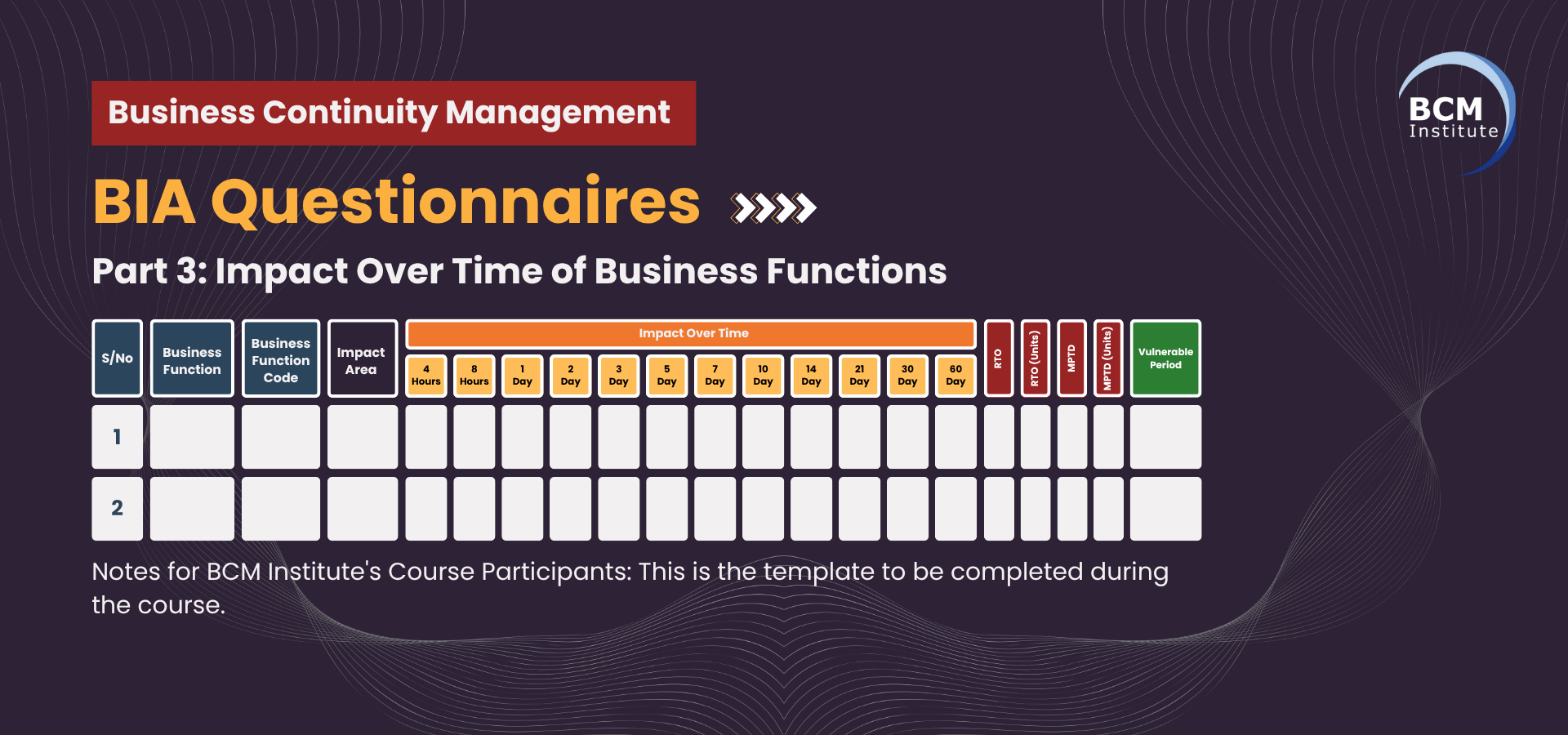
Three terms come from the table. The **recovery time objective (RTO)** is the target time by which a Sub-CBF is restored, at its minimum level, before impact becomes unacceptable. The **maximum tolerable period of disruption (MTPD)** is the longest disruption the hospital can accept before the viability of the Critical Business Function (CBF) is seriously threatened. It is always longer than the RTO. The **vulnerable period** is a time when disruption would do the most harm.
Scores run from 1 (very low), 2 (low), 3 (moderate) and 4 (high) to 5 (very high). Scores rise or stay level over time. For each Sub-CBF, the MTPD is set at or before the point at which impact first reaches 5. All scores and targets are illustrative planning assumptions, and vulnerable periods are described as conditions, not calendar dates.
## How the Targets Were Set
1. **Score the impact:** use the dominant impact area and score each interval from 1 to 5.
2. **Set the MTPD:** choose a point no later than the first score of 5.
3. **Set the RTO:** choose a target well inside the MTPD, leaving time for a recovery strategy to work.
4. **Describe the vulnerable period:** name the conditions in which a disruption would do the most harm.
## Impact Over Time Table
**Table 6: Impact Over Time of Business Functions for CBF-1 Emergency Department Services**
| **Sub-CBF Code** | **Sub-Critical Business Function** | **Highest-Impact Area** | **4 Hours** | **8 Hours** | **1 Day** | **2 Days** | **3 Days** | **5 Days** | **7 Days** | **10 Days** | **14 Days** | **21 Days** | **30 Days** | **60 Days** | **Recovery Time Objective (RTO)** | **Maximum Tolerable Period of Disruption (MTPD)** | **Vulnerable Period** |
| --- | --- | --- | --- | --- | --- | --- | --- | --- | --- | --- | --- | --- | --- | --- | --- | --- | --- |
| **CBF-1.1** | **Ambulance Arrival and Pre-hospital Handover** | **Patient safety** | **3** | **4** | **5** | **5** | **5** | **5** | **5** | **5** | **5** | **5** | **5** | **5** | **30 minutes** | **8 hours** | **Evening and weekend peaks, major public events and any period of road or rail disruption that increases ambulance traffic.** |
| **CBF-1.2** | **Triage and Registration** | **Patient safety** | **4** | **5** | **5** | **5** | **5** | **5** | **5** | **5** | **5** | **5** | **5** | **5** | **15 minutes** | **4 hours** | **Evening peak, Monday mornings, public holidays and the first days of an infectious disease outbreak.** |
| **CBF-1.3** | **Resuscitation and Life-Saving Intervention** | **Patient safety** | **5** | **5** | **5** | **5** | **5** | **5** | **5** | **5** | **5** | **5** | **5** | **5** | **5 minutes** | **1 hour** | **Every hour of every day, with the highest exposure at night when senior staffing is thinnest.** |
| **CBF-1.4** | **Emergency Assessment and Treatment** | **Patient safety** | **3** | **4** | **5** | **5** | **5** | **5** | **5** | **5** | **5** | **5** | **5** | **5** | **1 hour** | **8 hours** | **Weekday evenings, weekends, school holidays and winter-season respiratory illness peaks.** |
| **CBF-1.5** | **Emergency Diagnostic Requesting and Results Review** | **Operational** | **2** | **3** | **4** | **5** | **5** | **5** | **5** | **5** | **5** | **5** | **5** | **5** | **2 hours** | **1 day** | **Night shifts, when fewer imaging and laboratory staff are on site, and periods of high trauma or stroke activity.** |
| **CBF-1.6** | **Emergency Medication Administration** | **Patient safety** | **3** | **4** | **5** | **5** | **5** | **5** | **5** | **5** | **5** | **5** | **5** | **5** | **1 hour** | **8 hours** | **Shift changes, night hours and periods of high admissions, when medication errors are most likely.** |
| **CBF-1.7** | **Infection Screening and Isolation** | **Regulatory** | **2** | **3** | **3** | **4** | **4** | **5** | **5** | **5** | **5** | **5** | **5** | **5** | **4 hours** | **3 days** | **Local or regional outbreaks of respiratory or gastrointestinal illness, and the weeks after returning travellers arrive.** |
| **CBF-1.8** | **Emergency Observation and Short-Stay Care** | **Patient safety** | **2** | **3** | **4** | **4** | **5** | **5** | **5** | **5** | **5** | **5** | **5** | **5** | **4 hours** | **2 days** | **Evenings and nights, when observation spaces are full and nursing cover is thinner.** |
| **CBF-1.9** | **Patient Disposition, Transfer and Family Communication** | **Operational** | **2** | **3** | **3** | **4** | **4** | **5** | **5** | **5** | **5** | **5** | **5** | **5** | **8 hours** | **3 days** | **Mondays, the days after public holidays and winter-season peaks, when ward beds are scarce.** |
| **CBF-1.10** | **Surge and Mass Casualty Response** | **Operational** | **3** | **4** | **4** | **5** | **5** | **5** | **5** | **5** | **5** | **5** | **5** | **5** | **2 hours** | **1 day** | **Large public events, mass transport accidents, severe weather and the early weeks of an infectious disease outbreak.** |
| **CBF-1.11** | **Patient Identification and Clinical Documentation** | **Legal** | **2** | **3** | **4** | **4** | **5** | **5** | **5** | **5** | **5** | **5** | **5** | **5** | **4 hours** | **2 days** | **Periods of heavy registration, system upgrades and migrations, and any time unidentified patients arrive in numbers.** |
| **CBF-1.12** | **Emergency Staff Deployment and Shift Handover** | **Human resources** | **3** | **4** | **4** | **5** | **5** | **5** | **5** | **5** | **5** | **5** | **5** | **5** | **2 hours** | **1 day** | **Shift changes, public holidays, school holiday leave peaks and periods of widespread staff illness.** |
Scores: 1 = very low, 2 = low, 3 = moderate, 4 = high, 5 = very high. All values are illustrative. Five of the 12 Sub-CBFs have an RTO of one hour or less, two already score 4 or higher at 4 hours, and eight have an MTPD of one day or less.
## Reading the Results
Two patterns deserve attention. First, several Sub-CBFs begin at a score of 3 or 4 after only four hours. Staff, equipment and records cannot be recovered slowly, and the hospital should assume that no outside help will arrive in that time. Second, the gap between RTO and MTPD is deliberately wide for supporting processes such as disposition and records. That gap gives management time to choose a response, but it is not a licence to wait.
The vulnerable periods show that risk is not even. Evening peaks, shift changes, public holidays and outbreak weeks recur across many rows, so a single set of preparations, such as extra cover on those shifts and a rehearsed surge plan, protects several Sub-CBFs at once.
## [](https://cta-redirect.hubspot.com/cta/redirect/3893111/987f8ca5-0ba4-4281-be57-5221186733d0)
The table shows that the Sub-CBFs fall into three groups. The first group, which includes resuscitation and triage, reaches high impact within hours and needs targets measured in minutes. The second group, including treatment, medication and staffing, reaches very high impact within one to two days. The third group, including infection screening, disposition and records, can tolerate several days but still cannot be left unmanaged.
This analysis supports recovery priorities by showing which Sub-CBFs must be restored first. RTO and MTPD guide strategy: a five-minute RTO needs equipment and people already in place, whereas an eight-hour RTO can rely on manual workarounds and reciprocal arrangements. Vulnerable periods influence contingency planning, because staff cover, stock and exercises can be concentrated in the weeks and shifts of greatest risk.
Together these results contribute to resilience by making sure effort follows risk, and by giving the board a clear basis for accepting or reducing exposure. EGH should validate each score with the process owner and check that each RTO can be achieved with the resources available, before the targets become commitments. Chapter 6 turns next to the information technology (IT) systems that each Sub-CBF needs.
**Continue reading:** Chapter 6, *Supporting IT Systems and Applications for CBF-1*, identifies the systems and equipment each Sub-CBF depends on and sets recovery point and system recovery objectives.
[](https://cta-redirect.hubspot.com/cta/redirect/3893111/dfa53785-5be1-4117-a1bc-43e40cdb42e8)
| **eBook 3: Starting Your BCM Implementation** | | | | | | |
| --- | --- | --- | --- | --- | --- | --- |
| **MBCO** | **P&S** | **RAR T1** | **RAR T2** | **RAR T3** | **BCS T1** | **CBF** |
| [](https://cta-redirect.hubspot.com/cta/redirect/3893111/ea740ff8-0ea0-42c1-9f11-c24b8cd087a3) | [](https://cta-redirect.hubspot.com/cta/redirect/3893111/9104f712-e344-470e-b809-048054cfad24) | [](https://cta-redirect.hubspot.com/cta/redirect/3893111/fd22acee-e88b-4762-a90b-b6d289932a34) | [](https://cta-redirect.hubspot.com/cta/redirect/3893111/2235e2bd-1f0b-4111-9a41-270facd16917) | [](https://cta-redirect.hubspot.com/cta/redirect/3893111/63305687-a213-481b-ac6b-e0734a26b5b4) | [](https://cta-redirect.hubspot.com/cta/redirect/3893111/0a841fb1-e607-4172-ac9b-3de7f1de2978) | [](https://cta-redirect.hubspot.com/cta/redirect/3893111/cb4749ae-a696-4d2c-b505-28e05a8f4091) |
| **CBF-1 Emergency Department Services** | | | | | | |
| **DP** | **BIAQ P1** | **BIAQ P2** | **BIAQ P3** | **BIAQ P4** | **BIAQ P5** | **BIAQ P6** |
| [](https://cta-redirect.hubspot.com/cta/redirect/3893111/b89e5054-cf71-456e-b996-89da5973a55d) | [](https://cta-redirect.hubspot.com/cta/redirect/3893111/7550701a-f590-4ad0-8d3a-8cc50936525b) | [](https://cta-redirect.hubspot.com/cta/redirect/3893111/273cb818-0eb2-49df-b102-6f4ef4804ba1) | [](https://cta-redirect.hubspot.com/cta/redirect/3893111/c04c91f1-307a-47f5-a95d-5dc15f6d0ed4) | [](https://cta-redirect.hubspot.com/cta/redirect/3893111/e2fd4705-2cd7-4607-98a2-66476557b5fd) | [](https://cta-redirect.hubspot.com/cta/redirect/3893111/71a03cb6-3afb-4a79-b8c1-0de352046ceb) | [](https://cta-redirect.hubspot.com/cta/redirect/3893111/4b2de4a4-0f67-4cd4-9b47-3d59daedf32d) |
| | | **BCS T2** | **BCS T3** | **PD** | | |
| | | [](https://cta-redirect.hubspot.com/cta/redirect/3893111/9b0acf47-9cc8-4695-82e5-84ddcdfd980e) | [](https://cta-redirect.hubspot.com/cta/redirect/3893111/b275e253-db79-4f6c-a536-6dd24d0c073b) | [](https://cta-redirect.hubspot.com/cta/redirect/3893111/570141dc-2948-45fb-a58c-54f279601234) | | |
---
## **Comments**

---

---

---

---


All rights reserved. Copyright 2026
```json
{
"@context" : "https://schema.org",
"@type" : "BlogPosting",
"author" : {
"@type" : "Person",
"name" : "Moh Heng Goh",
"url" : "https://blog.bcm-institute.org/bcm-v2/author/moh-heng-goh"
},
"dateModified" : "2026-11-18T08:27:50.072Z",
"datePublished" : "2026-11-18T08:27:29.000Z",
"headline" : "[BCM] [EGH] [E3] [BIA] [P3] CBF [1] Emergency Department Services",
"mainEntityOfPage" : {
"@id" : "https://blog.bcm-institute.org/bcm-v2/chapter-4-impact-over-time-of-business-functions-for-cbf-1",
"@type" : "WebPage"
},
"publisher" : {
"@type" : "Organization",
"logo" : {
"@type" : "ImageObject",
"url" : "https://blog.bcm-institute.org/hubfs/BCMI%20Logo.png"
},
"name" : "BCMI Pte Ltd"
}
}
```