---
title: "[BCM] [EGH] [E3] [BIA] [P2] [CBF] [2] Critical Care"
description: "EGH impact area assessment for CBF-2: main impact area, illustrative seven-day loss and BU MBCO effect for 12 critical care Sub-CBFs under ISO 22301."
---
.
[](http://www.bcm-institute.org/)
- [Home](https://www.bcm-institute.org/)
- [About Us](https://www.bcm-institute.org/about-us-3/)
- [A President’s Perspective](https://www.bcm-institute.org/about-us/a-presidents-perspective/)
- [Our History](https://www.bcm-institute.org/about-us/our-history/)
- [Our Advisory Council](https://www.bcm-institute.org/about-us/our-advisory-council/)
- [Customers’ Testimonials](https://www.bcm-institute.org/about-us/customers-testimonials/)
- [Credential Verification](https://www.bcm-institute.org/about-us/credential-verification/)
- [Courses](https://blog.bcm-institute.org/blog/course-fees-for-blended-learning-courses-master-catalog)
- [ISO 22301 Business Continuity Management System Audit](https://blog.bcm-institute.org/audit/business-continuity-management-audit-courses)
- [ISO 22301 Business Continuity Management](https://blog.bcm-institute.org/bcm/business-continuity-management-courses)
- [Crisis Communication](https://blog.bcm-institute.org/crisis-communication/crisis-communication-courses)
- [Crisis Management](https://blog.bcm-institute.org/en/crisis-management/courses)
- [IT Disaster Recovery](https://blog.bcm-institute.org/it-disaster-recovery/courses)
- [Operational Resilience](https://blog.bcm-institute.org/operational-resilience/courses)
- [Operational Resilience Audit](https://blog.bcm-institute.org/operational-resilience-audit/courses)
- [Certification](https://blog.bcm-institute.org/certification/types-of-certifications-offered)
- [ISO 22301 BCMS Audit Certification](https://blog.bcm-institute.org/certification/business-continuity-management-audit-certification)
- [ISO22301 Business Continuity Management Certification](https://blog.bcm-institute.org/bcm/business-continuity-management-certification)
- [Crisis Communication Certification](https://blog.bcm-institute.org/crisis-communication/crisis-communication-certification)
- [Crisis Management Certification](https://blog.bcm-institute.org/en/crisis-management/crisis-management-certification)
- [IT Disaster Recovery Planning Certification](https://blog.bcm-institute.org/it-disaster-recovery/it-disaster-recovery-certification)
- [Operational Resilience Certification](https://blog.bcm-institute.org/operational-resilience/operational-resilience-certification)
- [Operational Resilience Audit Certification](https://blog.bcm-institute.org/operational-resilience-audit)
- [Seminars](https://blog.bcm-institute.org/meet-the-expert/mte-webinar-mainpage)
- [Store](https://www.bcm-institute.org/store-2/)
- [Contact Us](http://www.bcm-institute.org/about-us/contact-us/)
-
-
###### Keeping Care Running: Managing and Implementing Business Continuity Management at Eastern General Hospital

# \[BCM\] \[EGH\] \[E3\] \[BIA\] \[P2\] \[CBF\] \[2\] Critical Care
[](https://cta-redirect.hubspot.com/cta/redirect/3893111/dfa53785-5be1-4117-a1bc-43e40cdb42e8)
Chapter 2 set a minimum business continuity objective (MBCO) for each of the 12 Sub-Critical Business Functions (Sub-CBFs) of CBF-2 Critical Care (Intensive Care and High Dependency) at Eastern General Hospital (EGH). This chapter asks what happens if one of those objectives can no longer be met. It estimates the main impact area, an indicative financial loss over a fixed period, and the effect on the business unit MBCO (BU MBCO).
The purpose of evaluating impact in a business impact analysis (BIA) is to turn a general worry into a comparable measure. A manager who says that a failure would be “serious” cannot be compared with another who says the same. A manager who says that a failure would cost about S$100,000 over a week and stop continuous monitoring can be compared and ranked.
### [](https://cta-redirect.hubspot.com/cta/redirect/3893111/182e67c2-aa89-4b0b-b3e9-144293680ea4)
[Moh Heng Goh](https://blog.bcm-institute.org/bcm-v2/author/moh-heng-goh) Nov 19, 2026
#### [](https://cta-redirect.hubspot.com/cta/redirect/3893111/c5748bd7-2a18-4a78-8cc9-7dcc65204af9)
## [](https://cta-redirect.hubspot.com/cta/redirect/3893111/6f3def45-6e82-4ee5-9e44-fc3946ad2398)
### [](https://cta-redirect.hubspot.com/cta/redirect/3893111/182e67c2-aa89-4b0b-b3e9-144293680ea4)
## Introduction
Chapter 2 set a minimum business continuity objective (MBCO) for each of the 12 Sub-Critical Business Functions (Sub-CBFs) of CBF-2 Critical Care (Intensive Care and High Dependency) at Eastern General Hospital (EGH). This chapter asks what happens if one of those objectives can no longer be met. It estimates the main impact area, an indicative financial loss over a fixed period, and the effect on the business unit MBCO (BU MBCO).
The purpose of evaluating impact in a business impact analysis (BIA) is to turn a general worry into a comparable measure. A manager who says that a failure would be “serious” cannot be compared with another who says the same. A manager who says that a failure would cost about S$100,000 over a week and stop continuous monitoring can be compared and ranked.
Impact areas are analysed separately because the same event harms different things. A failed ventilator is mainly a patient safety problem, a failed renal supplier is mainly a financial and clinical problem, and a gap in identity records is mainly a legal problem. Looking at one dominant area per Sub-CBF shows what kind of protection each one needs. The results then support recovery priorities, recovery strategies and Business Continuity Planning, as ISO 22301 clause 8.2.2 expects.
## How the Estimates Were Made
Each row uses the same method. It chooses the most significant impact area for the Sub-CBF, estimates a financial loss for a disruption of seven days using a stated formula, and describes the MBCO that would no longer be achievable.
- **Impact area:** the most significant of patient safety, financial, regulatory, operational, legal, reputation or human resources.
- **Financial loss:** an indicative planning value in Singapore dollars (S$), built from the stated formula. It is not an accounting figure.
- **Affected MBCO:** the part of the Chapter 2 objective that could no longer be met.
- **Business impact:** how the loss affects the safe service level.
All volumes, unit costs and loss values are illustrative assumptions for EGH to validate. The hospital has not published activity or financial data. Where a Sub-CBF puts life at risk, the financial figure understates the true importance, and the patient safety rating should lead the decision.
## Impact Area Table
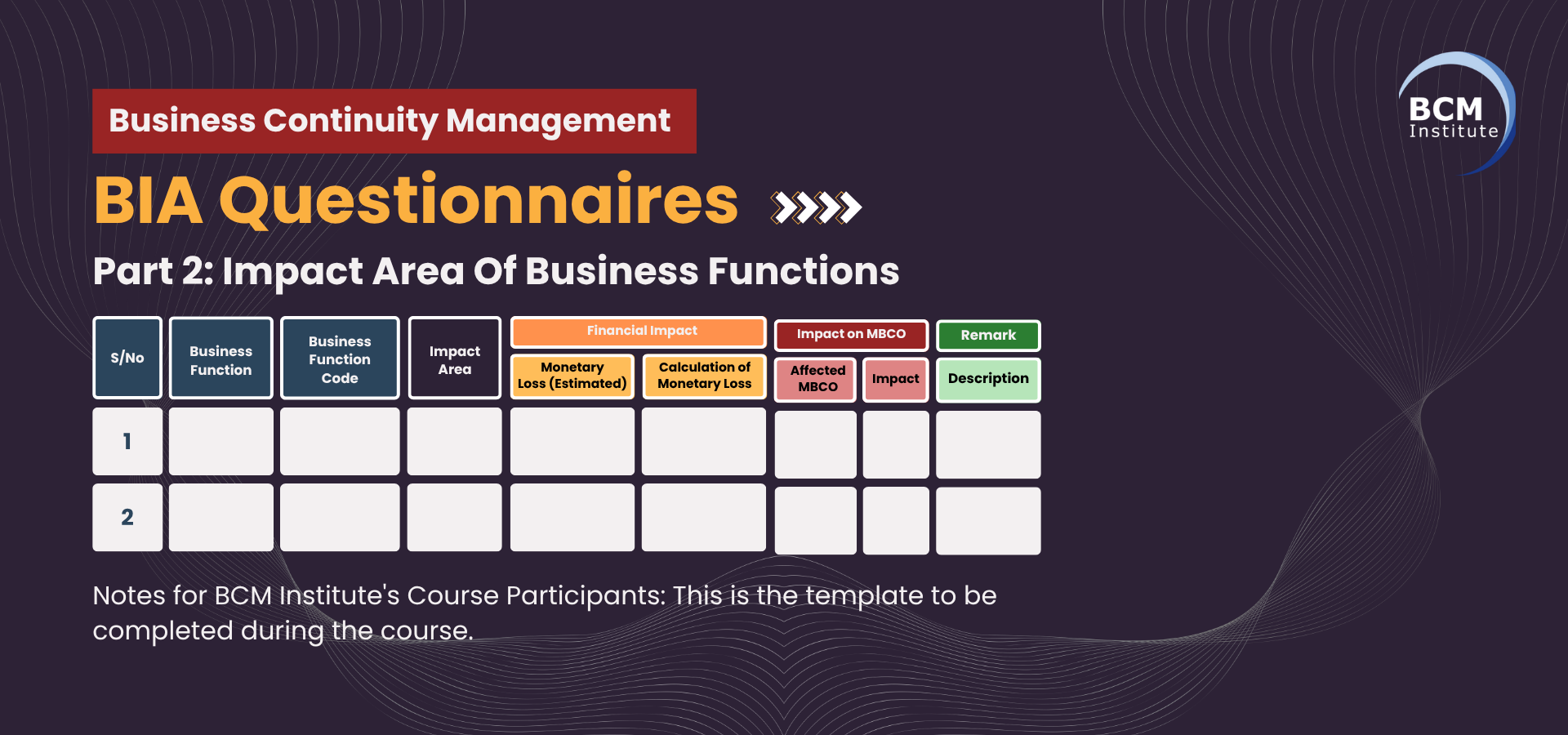
**Table 3: Impact Area of Business Functions for CBF-2 Critical Care (Intensive Care and High Dependency)**
| **Sub-CBF Code** | **Sub-Critical Business Function** | **Impact Area** | **Financial Impact – Monetary Loss (Estimated)** | **Financial Impact – Calculation Formula** | **Impact on BU MBCO – Affected MBCO** | **Impact on BU MBCO – Business Impact** | **Remarks / Description** |
| --- | --- | --- | --- | --- | --- | --- | --- |
| **CBF-2.1** | **Critical Care Admission, Triage and Bed Allocation** | **Operational** | **S$50,400** | **patients delayed or boarded outside critical care per day (6) × extra cost per boarded patient-day, including staff and monitoring (S$1,200) × days (7) = S$50,400** | **Review of referrals within 30 minutes, and one bed kept clear for an emergency.** | **Referrals queue in the emergency department and wards, no bed is kept for an emergency, and sick patients wait without critical care.** | **Waiting patients occupy emergency and ward spaces, harm rises with each hour, and the flow of the whole hospital slows.** |
| **CBF-2.2** | **Continuous Physiological Monitoring and Escalation** | **Patient safety** | **S$100,000** | **serious adverse events from missed deterioration (4) × average cost per event, including treatment and review (S$25,000) = S$100,000** | **Continuous monitoring with alarms acted on within one minute.** | **Deterioration goes unseen, alarms are missed, and nurses must rely on manual checks at a ratio they cannot sustain.** | **A patient who deteriorates unseen can die within minutes, and regulators and families expect a clear account of the failure.** |
| **CBF-2.3** | **Mechanical Ventilation and Airway Management** | **Patient safety** | **S$185,000** | **\[ventilated patients needing manual support or emergency transfer per day (10) × extra nursing and transfer cost per patient (S$1,500) × days (7)\] + \[expected serious adverse events (2) × average cost per event (S$40,000)\] = S$185,000** | **Uninterrupted ventilation with a backup device at each bed.** | **Ventilation depends on bag squeezing by hand, backup devices run out, and patients cannot be kept safe for long.** | **Loss of ventilation causes brain injury or death within minutes, so the financial figure understates the true importance.** |
| **CBF-2.4** | **Haemodynamic and Organ Support** | **Patient safety** | **S$120,000** | **serious adverse events from unstable blood pressure (3) × average cost per event (S$40,000) = S$120,000** | **Target blood pressure held for patients on vasoactive infusions.** | **Pressure falls, infusions stop or run at the wrong rate, and patients in shock lose organ perfusion.** | **Organ damage and death can follow a short interruption, and the pumps and lines are single points of failure.** |
| **CBF-2.5** | **Renal Replacement Therapy** | **Financial** | **S$57,800** | **\[dialysis patients deferred or transferred per day (6) × cost per deferred or transferred session (S$900) × days (7)\] + \[emergency hire of dialysis machines and filters (S$20,000)\] = S$57,800** | **Renal replacement for patients with life-threatening complications within 4 hours.** | **Fluid overload and high potassium cannot be treated on site, and patients wait for transfer or intermittent dialysis.** | **Cost rises through transfer and hire, and clinical risk rises quickly for the patients at the edge of safety.** |
| **CBF-2.6** | **Critical Care Medication and Infusion Management** | **Patient safety** | **S$60,000** | **expected medication-related harm events (4) × average cost per event (S$15,000) = S$60,000** | **Time-critical infusions and sedation without interruption, double-checked and recorded.** | **Doses are late, missed or duplicated, allergy checks are weaker, and pump settings are not verified.** | **Direct harm to patients follows, and poor records create legal and regulatory exposure.** |
| **CBF-2.7** | **Bedside Nursing Care and Infection Prevention Bundles** | **Operational** | **S$54,000** | **additional device-associated infections (3) × average cost per infection (S$18,000) = S$54,000** | **Nursing care and infection bundles at the minimum ratio of 1:1 ICU and 1:2 HD.** | **Bundles lapse, pressure injuries and line infections rise, and nurses cannot meet the ratio.** | **Infections prolong stay and may harm other patients, and lapses show up weeks later.** |
| **CBF-2.8** | **Critical Care Diagnostics and Results Review** | **Operational** | **S$30,800** | **delayed diagnostic tests per day (80) × extra cost per delayed test, including repeats and longer stay (S$55) × days (7) = S$30,800** | **Blood gases and critical results within 30 minutes with phone call for critical values.** | **Treatment decisions wait for results, tests are repeated, and critical values reach nurses late.** | **Care slows for every patient and stays lengthen.** |
| **CBF-2.9** | **Critical Patient Transfer (Intrahospital and Interhospital)** | **Operational** | **S$73,500** | **delayed critical transfers per day (3) × cost per delayed transfer, including a blocked critical care bed-day (S$3,500) × days (7) = S$73,500** | **Transfer with a trained team, transport ventilator and monitor within 60 minutes for urgent cases.** | **Patients cannot reach imaging or theatre, or leave for other hospitals, and beds stay blocked.** | **Delay in a time-critical scan or operation harms patients, and blocked beds stop new admissions.** |
| **CBF-2.10** | **Family Communication, Consent and End-of-Life Support** | **Reputation** | **S$74,000** | **\[complaint handling and communication recovery (S$60,000)\] + \[extra liaison hours per day (40) × cost per hour (S$50) × days (7)\] = S$74,000** | **Daily update by a named senior clinician, with consent and end-of-life discussions documented.** | **Families receive no news, consent is not documented, and end-of-life decisions are made without support.** | **Trust falls quickly in a setting where families are already distressed, and complaints and claims follow.** |
| **CBF-2.11** | **Patient Identification and Critical Care Documentation** | **Legal** | **S$35,600** | **\[records needing reconstruction per day (40) × cost per reconstructed record (S$20) × days (7)\] + \[legal review of record gaps (S$30,000)\] = S$35,600** | **Two-identifier checks and a full paper record reconciled within 24 hours.** | **Patients are misidentified, entries are lost, and blood products or drugs may reach the wrong person.** | **Wrong-patient errors, complaints and legal claims are likely, and the record for review is weakened.** |
| **CBF-2.12** | **Critical Care Staff Deployment, Surge and Escalation** | **Human resources** | **S$112,000** | **overtime and agency hours per day (200) × cost per hour (S$80) × days (7) = S$112,000** | **Named leaders each shift, minimum safe staffing and a structured handover.** | **Beds are understaffed, surge steps are late, and handover is incomplete.** | **Safe staffing is the base for every other Sub-CBF, and sustained overload raises errors and staff loss.** |
All values are illustrative planning assumptions for a seven-day disruption of one Sub-CBF at a time. The three largest estimates are Mechanical Ventilation and Airway Management (S$185,000), Haemodynamic and Organ Support (S$120,000) and Critical Care Staff Deployment, Surge and Escalation (S$112,000). The total of all 12 rows is S$953,100, but the rows should not be added together in practice, because one event rarely disrupts all 12 at once.
## [](https://cta-redirect.hubspot.com/cta/redirect/3893111/76188041-e1c9-43d9-8efa-e550f46ad04d)
Impact assessment turns the Sub-CBF list into a set of comparable risks. It shows which processes cause the greatest harm when they fail, in what form that harm appears, and which part of the minimum service level is lost. For EGH, patient safety is the dominant area for the processes closest to the bedside, while operational, legal and workforce areas dominate the supporting ones.
Financial estimates help management decide how much to spend on protection. A control that costs S$50,000 a year and prevents a loss of S$1 million is easy to justify, but a control that costs more than the loss it prevents needs another reason, such as patient safety or the law. Because the figures are estimates, the ranking matters more than the exact number.
Impact analysis also shapes the next steps. It influences the recovery time objectives (RTOs), the order of recovery, the choice of strategy and the content of the Business Continuity Plan. A Sub-CBF with a high patient safety impact will receive a short RTO and a strong strategy, while one with a mainly financial impact may accept a longer recovery. Understanding impact areas builds resilience by directing effort to where harm is greatest. EGH should validate every estimate with the process owner, and finance should confirm the unit costs.
**Continue reading:** Chapter 4, *Impact Over Time of Business Functions for CBF-2*, shows how the impact grows over time and sets recovery time objectives and maximum tolerable periods of disruption.
---
## **Comments**

---

---

---

---


All rights reserved. Copyright 2026
```json
{
"@context" : "https://schema.org",
"@type" : "BlogPosting",
"author" : {
"@type" : "Person",
"name" : "Moh Heng Goh",
"url" : "https://blog.bcm-institute.org/bcm-v2/author/moh-heng-goh"
},
"dateModified" : "2026-11-19T04:49:19.784Z",
"datePublished" : "2026-11-19T04:49:09.000Z",
"headline" : "[BCM] [EGH] [E3] [BIA] [P2] [CBF] [2] Critical Care",
"mainEntityOfPage" : {
"@id" : "https://blog.bcm-institute.org/bcm-v2/chapter-3-impact-area-of-business-functions-for-cbf-2",
"@type" : "WebPage"
},
"publisher" : {
"@type" : "Organization",
"logo" : {
"@type" : "ImageObject",
"url" : "https://blog.bcm-institute.org/hubfs/BCMI%20Logo.png"
},
"name" : "BCMI Pte Ltd"
}
}
```