---
title: "[BCM] [SAESL] [E2] [C4] Business Impact Analysis Phase for Business Continuity Management Planning Methodology for Singapore Aero Engine Services Private Limited"
description: The business impact analysis phase for SAESL, with illustrative tiers, RTOs and MTPDs for 25 critical business functions, in line with ISO 22301.
---
.
[](http://www.bcm-institute.org/)
- [Home](https://www.bcm-institute.org/)
- [About Us](https://www.bcm-institute.org/about-us-3/)
- [A President’s Perspective](https://www.bcm-institute.org/about-us/a-presidents-perspective/)
- [Our History](https://www.bcm-institute.org/about-us/our-history/)
- [Our Advisory Council](https://www.bcm-institute.org/about-us/our-advisory-council/)
- [Customers’ Testimonials](https://www.bcm-institute.org/about-us/customers-testimonials/)
- [Credential Verification](https://www.bcm-institute.org/about-us/credential-verification/)
- [Courses](https://blog.bcm-institute.org/blog/course-fees-for-blended-learning-courses-master-catalog)
- [ISO 22301 Business Continuity Management System Audit](https://blog.bcm-institute.org/audit/business-continuity-management-audit-courses)
- [ISO 22301 Business Continuity Management](https://blog.bcm-institute.org/bcm/business-continuity-management-courses)
- [Crisis Communication](https://blog.bcm-institute.org/crisis-communication/crisis-communication-courses)
- [Crisis Management](https://blog.bcm-institute.org/en/crisis-management/courses)
- [IT Disaster Recovery](https://blog.bcm-institute.org/it-disaster-recovery/courses)
- [Operational Resilience](https://blog.bcm-institute.org/operational-resilience/courses)
- [Operational Resilience Audit](https://blog.bcm-institute.org/operational-resilience-audit/courses)
- [Certification](https://blog.bcm-institute.org/certification/types-of-certifications-offered)
- [ISO 22301 BCMS Audit Certification](https://blog.bcm-institute.org/certification/business-continuity-management-audit-certification)
- [ISO22301 Business Continuity Management Certification](https://blog.bcm-institute.org/bcm/business-continuity-management-certification)
- [Crisis Communication Certification](https://blog.bcm-institute.org/crisis-communication/crisis-communication-certification)
- [Crisis Management Certification](https://blog.bcm-institute.org/en/crisis-management/crisis-management-certification)
- [IT Disaster Recovery Planning Certification](https://blog.bcm-institute.org/it-disaster-recovery/it-disaster-recovery-certification)
- [Operational Resilience Certification](https://blog.bcm-institute.org/operational-resilience/operational-resilience-certification)
- [Operational Resilience Audit Certification](https://blog.bcm-institute.org/operational-resilience-audit)
- [Seminars](https://blog.bcm-institute.org/meet-the-expert/mte-webinar-mainpage)
- [Store](https://www.bcm-institute.org/store-2/)
- [Contact Us](http://www.bcm-institute.org/about-us/contact-us/)
-
-
###### Building Resilient Operations: Implementing Business Continuity Management at SAESL

# \[BCM\] \[SAESL\] \[E2\] \[C4\] Business Impact Analysis Phase for Business Continuity Management Planning Methodology for Singapore Aero Engine Services Private Limited
[](https://cta-redirect.hubspot.com/cta/redirect/3893111/c9d0ea0f-9f66-4232-97e2-6be3fe001e05)
Chapter 3 identified and rated the risks that could disrupt SAESL. The BIA asks a different question: whatever the cause, what happens to each critical business function if it stops? This chapter covers the third phase of the planning methodology and the ISO 22301 requirement for a business impact analysis. It uses the 25 critical business functions (CBFs) that SAESL has defined, each with a code from CBF-01 to CBF-25.
[](https://cta-redirect.hubspot.com/cta/redirect/3893111/7789ece9-0b11-4cae-9f32-d34d7eb1688a)
[Moh Heng Goh](https://blog.bcm-institute.org/bcm-v2/author/moh-heng-goh) Nov 14, 2026
## Introduction
A business continuity plan cannot protect everything equally. Singapore Aero Engine Services Private Limited (SAESL) must decide which functions need to resume first, how quickly, and at what minimum service level. The Business Impact Analysis (BIA) phase gives the evidence for those decisions.
[](https://cta-redirect.hubspot.com/cta/redirect/3893111/c9d0ea0f-9f66-4232-97e2-6be3fe001e05)
[](https://cta-redirect.hubspot.com/cta/redirect/3893111/6b386b1f-455a-4825-b4ba-4200e0c5fd7e)
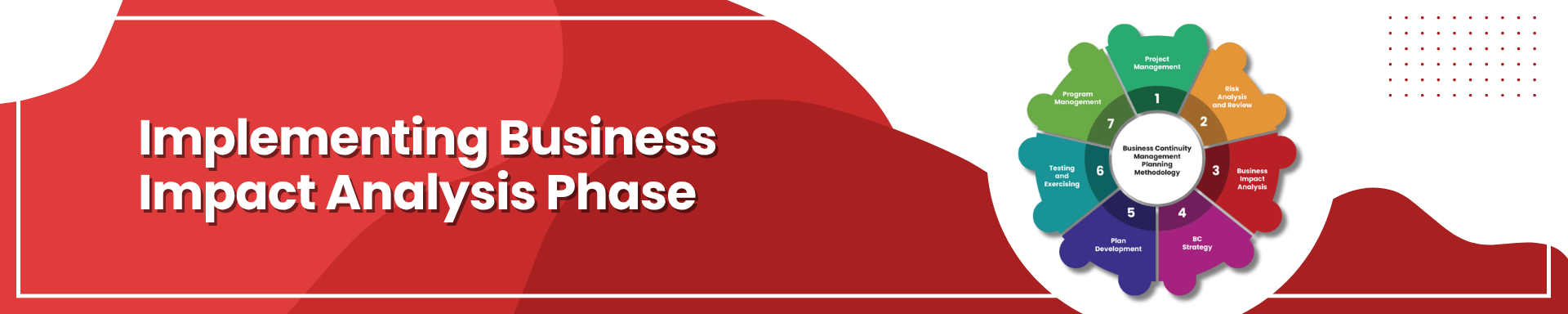
[](https://cta-redirect.hubspot.com/cta/redirect/3893111/4af9a280-d158-4276-b5e9-76b765cc21cb)Chapter 3 identified and rated the risks that could disrupt SAESL. The BIA asks a different question: whatever the cause, what happens to each critical business function if it stops? This chapter covers the third phase of the planning methodology and the ISO 22301 requirement for a business impact analysis. It uses the 25 critical business functions (CBFs) that SAESL has defined, each with a code from CBF-01 to CBF-25.
## Purpose of the Business Impact Analysis
The BIA measures how the impact of a disruption grows over time. A short outage in a corporate function may pass unnoticed. A short outage in the test facility may delay several engines. The analysis puts numbers and priorities on these differences, so that recovery effort and money go to the right place.
The BIA is not a risk assessment. The risk phase looks at causes and their likelihood. The BIA looks at consequences and time. Together, the two support the strategies in Chapter 5.
## What the BIA Measures
For each CBF, the BIA records the following measures.
- **Impact over time:** how the effect on customers, safety, regulatory standing, finances and reputation increases hour by hour and day by day.
- **Maximum tolerable period of disruption (MTPD):** the point beyond which the impact becomes unacceptable.
- **Recovery time objective (RTO):** the target time to resume the function, always shorter than the MTPD.
- **Minimum business continuity objective (MBCO):** the minimum level of service that is acceptable while the function is recovering.
- **Recovery point objective (RPO):** how much recent data the function can afford to lose.
- **Dependencies:** the people, premises, systems, suppliers and other functions that the CBF needs.
Dependencies matter as much as the times. A function with a modest RTO may rely on another function with a stricter one, and the stricter time then applies to both.
## How SAESL Conducts the BIA
The BCM coordinator issues a standard questionnaire and runs a workshop with each business unit. Staff who run the function, not only their managers, should attend, because they know its true dependencies. The team then reviews all the answers together to remove inconsistencies and to challenge answers that appear too cautious or too relaxed.
For example, SAESL might hold the first workshops for the CBFs closest to the engine, such as engine overhaul operations, inspection, and assembly and testing, and then move to the supporting functions. The results go to the steering committee for approval, so that the priorities have management's authority behind them.
## Requirements Specific to SAESL
Three features of SAESL's work shape its BIA.
**Regulatory deadlines.** SAESL's approvals from the Civil Aviation Authority of Singapore (CAAS) and other authorities depend on quality control, records and reporting. Under the CAAS rules for maintenance organisations, a condition that could seriously hazard an aircraft must be reported to the authority and to the type certificate holder within three days of identification (SAR-145.60). The BIA should therefore treat the functions that detect, investigate and report such conditions as time-sensitive, even though they are not on the shop floor.
**Long production cycles.** An overhaul takes weeks. A short stoppage in one work centre can often be absorbed. This means the MTPD for operational functions may be measured in days, while the MTPD for functions that protect safety, security or data may be measured in hours.
**Shared dependencies.** Almost every CBF depends on information technology, engineering records and facilities. The BIA should clearly record these shared dependencies, because they often set the real recovery order.
## Reading the Illustrative Results
The table below lists all 25 CBFs with an illustrative priority tier, RTO and MTPD. The tiers are:
- **Tier 1:** RTO of four hours to one day. These functions protect people, systems, security, and crisis management.
- **Tier 2:** RTO of one to two days. These functions produce, certify, and deliver the engines and their records.
- **Tier 3:** RTO of three days. These are support functions that can wait briefly.
- **Tier 4:** RTO of seven days. These are functions with long tolerance periods.
These figures are examples to show how the BIA works. They are not SAESL's actual results. The BIA workshops will produce the real values, and the steering committee will approve them.
## Summary Table
**Table 4: Business Impact Analysis Phase for Business Continuity Management Planning Methodology for Singapore Aero Engine Services Private Limited**
| **CBF code** | **Critical business function** | **Tier** | **RTO** | **MTPD** | **Main dependency** |
| --- | --- | --- | --- | --- | --- |
| **CBF-01** | **Engine Maintenance, Repair and Overhaul (MRO) Operations** | **2** | **2 days** | **7 days** | **Skilled staff, parts, facilities** |
| **CBF-02** | **Engine Inspection and Technical Evaluation** | **2** | **2 days** | **7 days** | **Inspection equipment, inspectors** |
| **CBF-03** | **Engine Assembly, Testing and Certification** | **2** | **2 days** | **7 days** | **Test facility, certifying staff** |
| **CBF-04** | **Engineering Support and Technical Services** | **3** | **3 days** | **10 days** | **Engineering records, specialists** |
| **CBF-05** | **Quality Assurance and Aviation Compliance** | **2** | **1 day** | **5 days** | **Quality system, records** |
| **CBF-06** | **Safety Management System (SMS)** | **1** | **1 day** | **3 days** | **Reporting channels, records** |
| **CBF-07** | **Regulatory Liaison and Certification Management** | **2** | **2 days** | **7 days** | **Approval documents, authority contacts** |
| **CBF-08** | **Supply Chain and Spare Parts Management** | **2** | **2 days** | **7 days** | **Suppliers, planning systems** |
| **CBF-09** | **Warehouse and Inventory Management** | **3** | **3 days** | **10 days** | **Storage facility, inventory system** |
| **CBF-10** | **Procurement and Vendor Management** | **3** | **3 days** | **10 days** | **Vendor records, finance systems** |
| **CBF-11** | **Information Technology Services** | **1** | **4 hours** | **2 days** | **Data centre, network, vendors** |
| **CBF-12** | **Engineering Information and Document Management** | **2** | **1 day** | **5 days** | **Document systems, backups** |
| **CBF-13** | **Cybersecurity Operations** | **1** | **4 hours** | **1 day** | **Monitoring tools, specialists** |
| **CBF-14** | **Customer Programme Management** | **2** | **1 day** | **5 days** | **Customer contacts, status data** |
| **CBF-15** | **Logistics and Transportation Coordination** | **3** | **3 days** | **10 days** | **Carriers, customs documents** |
| **CBF-16** | **Human Resource Management** | **3** | **3 days** | **10 days** | **Staff records, payroll system** |
| **CBF-17** | **Training and Competency Management** | **4** | **7 days** | **21 days** | **Training records, trainers** |
| **CBF-18** | **Finance and Corporate Services** | **3** | **3 days** | **14 days** | **Finance system, banks** |
| **CBF-19** | **Legal, Risk and Corporate Governance** | **3** | **3 days** | **14 days** | **Contracts, advisers** |
| **CBF-20** | **Business Continuity and Crisis Management** | **1** | **4 hours** | **1 day** | **Crisis team, communication tools** |
| **CBF-21** | **Corporate Communications and Stakeholder Management** | **2** | **1 day** | **3 days** | **Contact lists, channels** |
| **CBF-22** | **Facilities and Infrastructure Management** | **1** | **1 day** | **3 days** | **Power, utilities, contractors** |
| **CBF-23** | **Environmental and Sustainability Management** | **4** | **7 days** | **21 days** | **Monitoring data, permits** |
| **CBF-24** | **Security Management** | **1** | **4 hours** | **1 day** | **Access systems, guards** |
| **CBF-25** | **Executive Leadership and Strategic Management** | **1** | **4 hours** | **1 day** | **Succession, decision channels** |
All tiers, RTOs and MTPDs are illustrative and must be confirmed by SAESL's BIA workshops and approved by its leadership.
## [](https://cta-redirect.hubspot.com/cta/redirect/3893111/b5945536-415f-4c64-9e05-c7b4d4f26c76)
## Conclusion
The BIA gives SAESL an ordered view of its 25 critical business functions, with times and dependencies that can be tested. It shows, for example, that the functions that protect information, security and crisis response need the fastest recovery, even though the shop floor is the visible centre of the business. Keeping the shared dependencies in view prevents plans that look good on paper but cannot be carried out.
The next chapter uses these results to choose strategies to protect and recover each function.
## Sources
- [CAAS: SAR-145 (Amendment 18)](https://www.caas.gov.sg/docs/default-source/docs---srg/sar-145-(amdm-18).pdf)
**Continue reading:** Chapter 5, *Business Continuity Strategy Phase for Business Continuity Management Planning Methodology for Singapore Aero Engine Services Private Limited*, shows how SAESL chooses mitigation, prevention and recovery measures for each critical business function.
| Building Resilient Operations: Implementing Business Continuity Management at SAESL | | | | |
| --- | --- | --- | --- | --- |
| **eBook 2: Implementing Business Continuity Management** | | | | |
| **C1** | **C2** | **C3** | **C4** | **C5** |
| [](https://cta-redirect.hubspot.com/cta/redirect/3893111/5293770c-bccd-4cd7-ad66-f9b98acec36d) | [](https://cta-redirect.hubspot.com/cta/redirect/3893111/37371db8-20ba-4d3c-b0d7-bfbb491334c2) | [](https://cta-redirect.hubspot.com/cta/redirect/3893111/4c7ba3f8-467b-4cf6-bb15-08d57681de85) | [](https://cta-redirect.hubspot.com/cta/redirect/3893111/4af9a280-d158-4276-b5e9-76b765cc21cb) | [](https://cta-redirect.hubspot.com/cta/redirect/3893111/6be24b63-6244-407f-87cd-411083ce616e) |
| **C6** | **C7** | **C8** | **C9** | **C10** |
| [](https://cta-redirect.hubspot.com/cta/redirect/3893111/0ff5e2e1-09fb-4a8b-86d8-affab470e534) | [](https://cta-redirect.hubspot.com/cta/redirect/3893111/8d72106d-fbed-4c4f-9fd1-14070e628e97) | [](https://cta-redirect.hubspot.com/cta/redirect/3893111/d7dff66c-b830-46aa-bb7e-2d2fdf67a4df) | [](https://cta-redirect.hubspot.com/cta/redirect/3893111/9e98b285-f794-4c23-832a-de0d02e15c19) | [](https://cta-redirect.hubspot.com/cta/redirect/3893111/508f7ad5-755e-4c26-963a-c3e3754893d3) |
| | | | | |
---
## **Comments**

---

---

---

---


All rights reserved. Copyright 2026
```json
{
"@context" : "https://schema.org",
"@type" : "BlogPosting",
"author" : {
"@type" : "Person",
"name" : "Moh Heng Goh",
"url" : "https://blog.bcm-institute.org/bcm-v2/author/moh-heng-goh"
},
"dateModified" : "2026-11-14T10:25:18.430Z",
"datePublished" : "2026-11-14T10:18:01.000Z",
"headline" : "[BCM] [SAESL] [E2] [C4] Business Impact Analysis Phase for Business Continuity Management Planning Methodology for Singapore Aero Engine Services Private Limited",
"mainEntityOfPage" : {
"@id" : "https://blog.bcm-institute.org/bcm-v2/business-impact-analysis-phase-for-business-continuity-management-planning-methodology-for-singapore-aero-engine-services-private-limited",
"@type" : "WebPage"
},
"publisher" : {
"@type" : "Organization",
"logo" : {
"@type" : "ImageObject",
"url" : "https://blog.bcm-institute.org/hubfs/BCMI%20Logo.png"
},
"name" : "BCMI Pte Ltd"
}
}
```