---
title: "[BCM] [SAESL] [E2] [C5] Business Continuity Strategy Phase for Business Continuity Management Planning Methodology for Singapore Aero Engine Services Private Limited"
description: "Business continuity strategies for SAESL's 25 critical business functions: prevention, mitigation and recovery measures in text and table form, per ISO 22301."
---
.
[](http://www.bcm-institute.org/)
- [Home](https://www.bcm-institute.org/)
- [About Us](https://www.bcm-institute.org/about-us-3/)
- [A President’s Perspective](https://www.bcm-institute.org/about-us/a-presidents-perspective/)
- [Our History](https://www.bcm-institute.org/about-us/our-history/)
- [Our Advisory Council](https://www.bcm-institute.org/about-us/our-advisory-council/)
- [Customers’ Testimonials](https://www.bcm-institute.org/about-us/customers-testimonials/)
- [Credential Verification](https://www.bcm-institute.org/about-us/credential-verification/)
- [Courses](https://blog.bcm-institute.org/blog/course-fees-for-blended-learning-courses-master-catalog)
- [ISO 22301 Business Continuity Management System Audit](https://blog.bcm-institute.org/audit/business-continuity-management-audit-courses)
- [ISO 22301 Business Continuity Management](https://blog.bcm-institute.org/bcm/business-continuity-management-courses)
- [Crisis Communication](https://blog.bcm-institute.org/crisis-communication/crisis-communication-courses)
- [Crisis Management](https://blog.bcm-institute.org/en/crisis-management/courses)
- [IT Disaster Recovery](https://blog.bcm-institute.org/it-disaster-recovery/courses)
- [Operational Resilience](https://blog.bcm-institute.org/operational-resilience/courses)
- [Operational Resilience Audit](https://blog.bcm-institute.org/operational-resilience-audit/courses)
- [Certification](https://blog.bcm-institute.org/certification/types-of-certifications-offered)
- [ISO 22301 BCMS Audit Certification](https://blog.bcm-institute.org/certification/business-continuity-management-audit-certification)
- [ISO22301 Business Continuity Management Certification](https://blog.bcm-institute.org/bcm/business-continuity-management-certification)
- [Crisis Communication Certification](https://blog.bcm-institute.org/crisis-communication/crisis-communication-certification)
- [Crisis Management Certification](https://blog.bcm-institute.org/en/crisis-management/crisis-management-certification)
- [IT Disaster Recovery Planning Certification](https://blog.bcm-institute.org/it-disaster-recovery/it-disaster-recovery-certification)
- [Operational Resilience Certification](https://blog.bcm-institute.org/operational-resilience/operational-resilience-certification)
- [Operational Resilience Audit Certification](https://blog.bcm-institute.org/operational-resilience-audit)
- [Seminars](https://blog.bcm-institute.org/meet-the-expert/mte-webinar-mainpage)
- [Store](https://www.bcm-institute.org/store-2/)
- [Contact Us](http://www.bcm-institute.org/about-us/contact-us/)
-
-
###### Building Resilient Operations: Implementing Business Continuity Management at SAESL

# \[BCM\] \[SAESL\] \[E2\] \[C5\] Business Continuity Strategy Phase for Business Continuity Management Planning Methodology for Singapore Aero Engine Services Private Limited
[](https://cta-redirect.hubspot.com/cta/redirect/3893111/c9d0ea0f-9f66-4232-97e2-6be3fe001e05)
This chapter covers the fourth phase of the planning methodology and the ISO 22301 requirement to determine and select business continuity strategies and solutions. The strategies encompass prevention, mitigation and recovery measures for SAESL's 25 CBFs. The chapter presents them first in text, then in a table. All examples are illustrative until SAESL confirms them.
[](https://cta-redirect.hubspot.com/cta/redirect/3893111/7789ece9-0b11-4cae-9f32-d34d7eb1688a)
[Moh Heng Goh](https://blog.bcm-institute.org/bcm-v2/author/moh-heng-goh) Nov 14, 2026
## Introduction
The business impact analysis in Chapter 4 told Singapore Aero Engine Services Private Limited (SAESL) which of its critical business functions (CBFs) must recover first and how quickly. The Business Continuity Strategy (BCS) phase answers the next question: how will SAESL actually meet those recovery times?
[](https://cta-redirect.hubspot.com/cta/redirect/3893111/c9d0ea0f-9f66-4232-97e2-6be3fe001e05)
[](https://cta-redirect.hubspot.com/cta/redirect/3893111/66c784de-297c-4446-90c9-4611204cbb14)
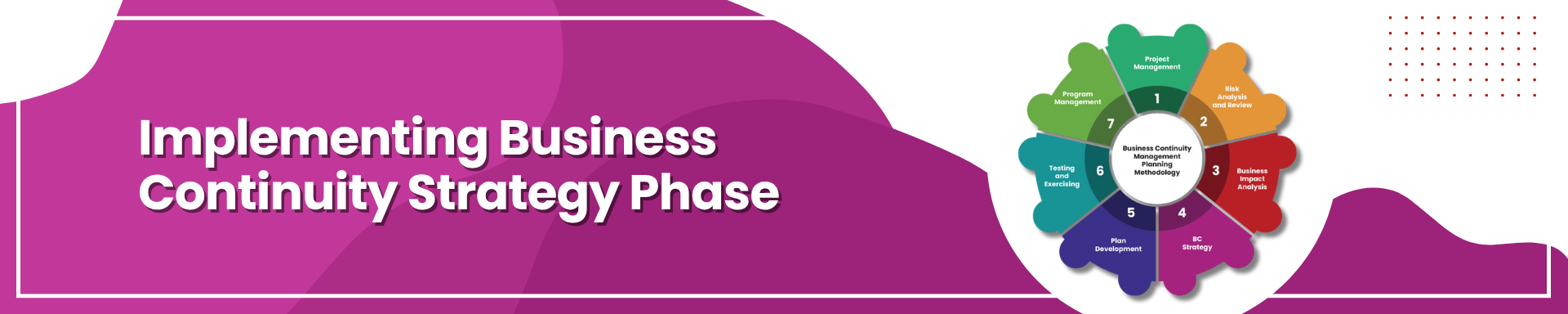
[](https://cta-redirect.hubspot.com/cta/redirect/3893111/6be24b63-6244-407f-87cd-411083ce616e)This chapter covers the fourth phase of the planning methodology and the ISO 22301 requirement to determine and select business continuity strategies and solutions. The strategies encompass prevention, mitigation and recovery measures for SAESL's 25 CBFs. The chapter presents them first in text, then in a table. All examples are illustrative until SAESL confirms them.
## What a Business Continuity Strategy Is
A strategy is a chosen approach to protect a function and to restore it within its recovery time objective (RTO). It is not yet a detailed procedure. Chapter 6 turns the strategies into written plans.
Three types of measures work together.
- **Prevention:** reduces the chance of a disruption, for example by maintaining equipment or controlling access.
- **Mitigation:** reduces the impact if a disruption happens, for example by holding spare capacity or alternative suppliers.
- **Recovery:** restores the function after a disruption, for example by moving work to another site or switching to backup systems.
## Choosing Strategies
The BCM team selects a strategy for each CBF by comparing options against the BIA results and the risk register. A good strategy meets the RTO, uses the minimum business continuity objective (MBCO) as its target service level, and costs less than the impact it avoids. For every CBF, the team considers five kinds of resources: people, premises, technology, suppliers and information.
The steering committee approves the final choices. This matters because strategies often require budget, and some depend on agreements with customers, suppliers, or the engine manufacturer.
## Business Continuity Strategies for SAESL's Critical Business Functions: In Text
SAESL has 25 CBFs. To keep strategies practical, the team might group them by the kind of resource they depend on. The groups below follow the CBF codes from Chapter 4.
### Engine operations (CBF-01, CBF-02, CBF-03)
These functions depend on skilled people, specialised equipment and the test facility. For prevention, SAESL might apply planned maintenance to critical equipment and keep staff cross-training up to date. For mitigation, it might hold critical spares for key tools and organise work cells so that jobs can move between them. For recovery, it might agree in advance how work scopes are re-planned, and which engines take priority, when a work centre or the test facility is unavailable. This addresses risks R2 and R6 from Chapter 3.
### Quality, safety and regulatory functions (CBF-05, CBF-06, CBF-07)
These functions protect SAESL's approvals. For prevention, SAESL might keep master copies of approval documents and procedures in more than one controlled location. For mitigation, it might name deputies authorised to act in certifying and quality roles. For recovery, it might prepare a protocol for quickly contacting the Civil Aviation Authority of Singapore (CAAS) and other authorities, so reporting duties are met even when normal channels are down. This addresses R5.
### Supply and logistics functions (CBF-08, CBF-09, CBF-10, CBF-15)
These depend on suppliers, stock and transport. To prevent this, SAESL might monitor supplier health and delivery performance. For mitigation, it might hold safety stock of long-lead parts and, where the engine manufacturer allows, qualify more than one source. For recovery, it might pre-agree alternative carriers and priority freight routes. This addresses R1, R8 and R9.
### Technology and information functions (CBF-11, CBF-12, CBF-13)
These carry the shared dependencies noted in Chapter 4. For prevention, SAESL might apply access controls, patching and continuous monitoring. For mitigation, it might replicate data and keep backups that an attacker cannot alter. For recovery, it might document and test the order in which systems are restored, with engineering records first. This addresses R3 and R4.
### Customer, communication and leadership functions (CBF-14, CBF-20, CBF-21, CBF-25)
These manage relationships and decisions during a crisis. For prevention, SAESL might maintain current contact lists and clear delegations of authority. For mitigation, it might prepare holding statements for customers and authorities. For recovery, it might set up an alternative location and a reliable channel for the crisis team. This helps with every risk, because every serious disruption needs decisions and communication.
### Corporate and site support functions (CBF-04, CBF-16, CBF-17, CBF-18, CBF-19, CBF-22, CBF-23, CBF-24)
These include human resources, finance, legal, facilities, environmental and security functions. For prevention, SAESL might keep site systems such as power, fire protection and access control under planned maintenance. For mitigation, it might arrange remote working for office-based staff and agree emergency contractor support. For recovery, it might document manual workarounds for payroll, payments and access control. This addresses R6, R7 and R10.
## Testing Strategies for Cost and Practicality
Before the steering committee approves a strategy, the BCM team should test it against four questions. Does it meet the RTO and MBCO from the BIA? Does it reduce a risk that matters in the register? Is the cost proportionate to the impact avoided? Can it be sustained over time, or will it decay once the project ends?
Some strategies depend on third parties, such as a second supplier, a carrier or a data centre provider. For these, SAESL should seek written confirmation of what the third party will provide and when. A verbal promise of help in an emergency is not a strategy. For example, SAESL might include recovery commitments in the agreements it renews, and record them in the programme file so that they are reviewed with the plans.
## Requirements Specific to SAESL
Two points set SAESL apart. First, any alternative way of working must still meet the conditions of its approvals. A recovery strategy that moves work to another site or supplier is acceptable only if the approval holder and the relevant authorities accept it. The team should check this before a strategy is approved, not during an incident. Second, SAESL's customers own the engines it works on, so strategies must also protect customer property and the traceability of every part.
## Summary Table
**Table 5: Business Continuity Strategy Phase for Business Continuity Management Planning Methodology for Singapore Aero Engine Services Private Limited**
| **Group** | **CBFs** | **Prevention** | **Mitigation** | **Recovery** |
| --- | --- | --- | --- | --- |
| **Engine operations** | CBF-01, 02, 03 | Planned maintenance, cross-training | Spare tooling, flexible work cells | Re-plan work scopes and priorities |
| **Quality, safety and regulatory** | CBF-05, 06, 07 | Controlled copies of key documents | Named deputies for certifying roles | Authority contact protocol |
| **Supply and logistics** | CBF-08, 09, 10, 15 | Supplier monitoring | Safety stock, second sources | Alternative carriers |
| **Technology and information** | CBF-11, 12, 13 | Access control, monitoring | Replication, protected backups | Ordered system restoration |
| **Customer, communication, leadership** | CBF-14, 20, 21, 25 | Current contact lists | Prepared statements | Alternative crisis location |
| **Corporate and site support** | CBF-04, 16, 17, 18, 19, 22, 23, 24 | Maintained site systems | Remote working, contractors | Manual workarounds |
All SAESL-specific entries are illustrative and must be confirmed by SAESL.
## [](https://cta-redirect.hubspot.com/cta/redirect/3893111/b5945536-415f-4c64-9e05-c7b4d4f26c76)
## Conclusion
The strategy phase turns the BIA into decisions. By grouping the 25 CBFs and choosing prevention, mitigation and recovery measures for each group, SAESL can show how it will meet its recovery times and where it still needs agreement or investment. The most important check is that every strategy keeps SAESL within the conditions of its approvals.
The next chapter explains how SAESL records these strategies in written business continuity plans.
**Continue reading:** Chapter 6, *Business Continuity Plan Development Phase for Business Continuity Management Planning Methodology for Singapore Aero Engine Services Private Limited*, shows how SAESL builds and validates its business continuity plans.
| Building Resilient Operations: Implementing Business Continuity Management at SAESL | | | | |
| --- | --- | --- | --- | --- |
| **eBook 2: Implementing Business Continuity Management** | | | | |
| **C1** | **C2** | **C3** | **C4** | **C5** |
| [](https://cta-redirect.hubspot.com/cta/redirect/3893111/5293770c-bccd-4cd7-ad66-f9b98acec36d) | [](https://cta-redirect.hubspot.com/cta/redirect/3893111/37371db8-20ba-4d3c-b0d7-bfbb491334c2) | [](https://cta-redirect.hubspot.com/cta/redirect/3893111/4c7ba3f8-467b-4cf6-bb15-08d57681de85) | [](https://cta-redirect.hubspot.com/cta/redirect/3893111/4af9a280-d158-4276-b5e9-76b765cc21cb) | [](https://cta-redirect.hubspot.com/cta/redirect/3893111/6be24b63-6244-407f-87cd-411083ce616e) |
| **C6** | **C7** | **C8** | **C9** | **C10** |
| [](https://cta-redirect.hubspot.com/cta/redirect/3893111/0ff5e2e1-09fb-4a8b-86d8-affab470e534) | [](https://cta-redirect.hubspot.com/cta/redirect/3893111/8d72106d-fbed-4c4f-9fd1-14070e628e97) | [](https://cta-redirect.hubspot.com/cta/redirect/3893111/d7dff66c-b830-46aa-bb7e-2d2fdf67a4df) | [](https://cta-redirect.hubspot.com/cta/redirect/3893111/9e98b285-f794-4c23-832a-de0d02e15c19) | [](https://cta-redirect.hubspot.com/cta/redirect/3893111/508f7ad5-755e-4c26-963a-c3e3754893d3) |
| | | | | |
---
## **Comments**

---

---

---

---


All rights reserved. Copyright 2026
```json
{
"@context" : "https://schema.org",
"@type" : "BlogPosting",
"author" : {
"@type" : "Person",
"name" : "Moh Heng Goh",
"url" : "https://blog.bcm-institute.org/bcm-v2/author/moh-heng-goh"
},
"dateModified" : "2026-11-14T10:23:18.860Z",
"datePublished" : "2026-11-14T10:23:18.000Z",
"headline" : "[BCM] [SAESL] [E2] [C5] Business Continuity Strategy Phase for Business Continuity Management Planning Methodology for Singapore Aero Engine Services Private Limited",
"mainEntityOfPage" : {
"@id" : "https://blog.bcm-institute.org/bcm-v2/business-continuity-strategy-phase-for-business-continuity-management-planning-methodology-for-singapore-aero-engine-services-private-limited",
"@type" : "WebPage"
},
"publisher" : {
"@type" : "Organization",
"logo" : {
"@type" : "ImageObject",
"url" : "https://blog.bcm-institute.org/hubfs/BCMI%20Logo.png"
},
"name" : "BCMI Pte Ltd"
}
}
```