---
title: Business Continuity Management Planning Methodology for Singapore Aero Engine Services Private Limited
description: A seven-phase business continuity planning methodology for SAESL, protecting airworthiness approvals and engine overhaul operations in line with ISO 22301.
---
.
[](http://www.bcm-institute.org/)
- [Home](https://www.bcm-institute.org/)
- [About Us](https://www.bcm-institute.org/about-us-3/)
- [A President’s Perspective](https://www.bcm-institute.org/about-us/a-presidents-perspective/)
- [Our History](https://www.bcm-institute.org/about-us/our-history/)
- [Our Advisory Council](https://www.bcm-institute.org/about-us/our-advisory-council/)
- [Customers’ Testimonials](https://www.bcm-institute.org/about-us/customers-testimonials/)
- [Credential Verification](https://www.bcm-institute.org/about-us/credential-verification/)
- [Courses](https://blog.bcm-institute.org/blog/course-fees-for-blended-learning-courses-master-catalog)
- [ISO 22301 Business Continuity Management System Audit](https://blog.bcm-institute.org/audit/business-continuity-management-audit-courses)
- [ISO 22301 Business Continuity Management](https://blog.bcm-institute.org/bcm/business-continuity-management-courses)
- [Crisis Communication](https://blog.bcm-institute.org/crisis-communication/crisis-communication-courses)
- [Crisis Management](https://blog.bcm-institute.org/en/crisis-management/courses)
- [IT Disaster Recovery](https://blog.bcm-institute.org/it-disaster-recovery/courses)
- [Operational Resilience](https://blog.bcm-institute.org/operational-resilience/courses)
- [Operational Resilience Audit](https://blog.bcm-institute.org/operational-resilience-audit/courses)
- [Certification](https://blog.bcm-institute.org/certification/types-of-certifications-offered)
- [ISO 22301 BCMS Audit Certification](https://blog.bcm-institute.org/certification/business-continuity-management-audit-certification)
- [ISO22301 Business Continuity Management Certification](https://blog.bcm-institute.org/bcm/business-continuity-management-certification)
- [Crisis Communication Certification](https://blog.bcm-institute.org/crisis-communication/crisis-communication-certification)
- [Crisis Management Certification](https://blog.bcm-institute.org/en/crisis-management/crisis-management-certification)
- [IT Disaster Recovery Planning Certification](https://blog.bcm-institute.org/it-disaster-recovery/it-disaster-recovery-certification)
- [Operational Resilience Certification](https://blog.bcm-institute.org/operational-resilience/operational-resilience-certification)
- [Operational Resilience Audit Certification](https://blog.bcm-institute.org/operational-resilience-audit)
- [Seminars](https://blog.bcm-institute.org/meet-the-expert/mte-webinar-mainpage)
- [Store](https://www.bcm-institute.org/store-2/)
- [Contact Us](http://www.bcm-institute.org/about-us/contact-us/)
-
-
###### Building Resilient Operations: Implementing Business Continuity Management at SAESL

# \[BCM\] \[SAESL\] \[E2\] \[C1\] Business Continuity Management Planning Methodology for Singapore Aero Engine Services Private Limited
[](https://cta-redirect.hubspot.com/cta/redirect/3893111/c9d0ea0f-9f66-4232-97e2-6be3fe001e05)
This is the first chapter of *Implementing Business Continuity Management for Singapore Aero Engine Services Private Limited*, the second eBook in the *Building Resilient Operations series: Implementing Business Continuity Management at SAESL*. It supports the planning requirements of ISO 22301, the international standard for business continuity management systems (BCMS). It sets out the seven-phase methodology that the remaining chapters of the eBook follow, one phase at a time.
[](https://cta-redirect.hubspot.com/cta/redirect/3893111/7789ece9-0b11-4cae-9f32-d34d7eb1688a)
[Moh Heng Goh](https://blog.bcm-institute.org/bcm-v2/author/moh-heng-goh) Nov 14, 2026
## Introduction
Singapore Aero Engine Services Private Limited (SAESL) overhauls and repairs Rolls-Royce Trent engines for airlines on six continents. Every engine in its facility represents a customer's aircraft that is waiting to fly again. A disruption that stops the shop floor, the test facility or the supply of parts therefore affects customers within days, not months.
[](https://cta-redirect.hubspot.com/cta/redirect/3893111/c9d0ea0f-9f66-4232-97e2-6be3fe001e05)
[](https://cta-redirect.hubspot.com/cta/redirect/3893111/68f13ffe-b808-44ec-9a28-7304d89f5889)
[](https://cta-redirect.hubspot.com/cta/redirect/3893111/5293770c-bccd-4cd7-ad66-f9b98acec36d)This is the first chapter of *Implementing Business Continuity Management for Singapore Aero Engine Services Private Limited*, the second eBook in the *Building Resilient Operations series: Implementing Business Continuity Management at SAESL*. It supports the planning requirements of ISO 22301, the international standard for business continuity management systems (BCMS). It sets out the seven-phase methodology that the remaining chapters of the eBook follow, one phase at a time.
## Why SAESL Needs a Planning Methodology
Business continuity management (BCM) is a discipline, and a discipline needs a repeatable method. Without one, each business unit plans in its own way, uses its own terms and produces plans that cannot be compared or combined. ISO 22301 expects the organisation to understand itself, analyse impacts and risks, choose solutions, document plans and prove that they work. A planning methodology turns those expectations into a sequence of work that people can follow.
The eBook that precedes this one, *Understanding Your Organisation for Singapore Aero Engine Services Private Limited*, built the foundation: goals, objectives, assumptions, the BCM team, the operating environment and the critical business functions. This eBook uses that foundation to carry out the planning. For example, SAESL might use the critical business functions agreed in eBook 1 as the scope for every phase described below.
## The Seven Phases
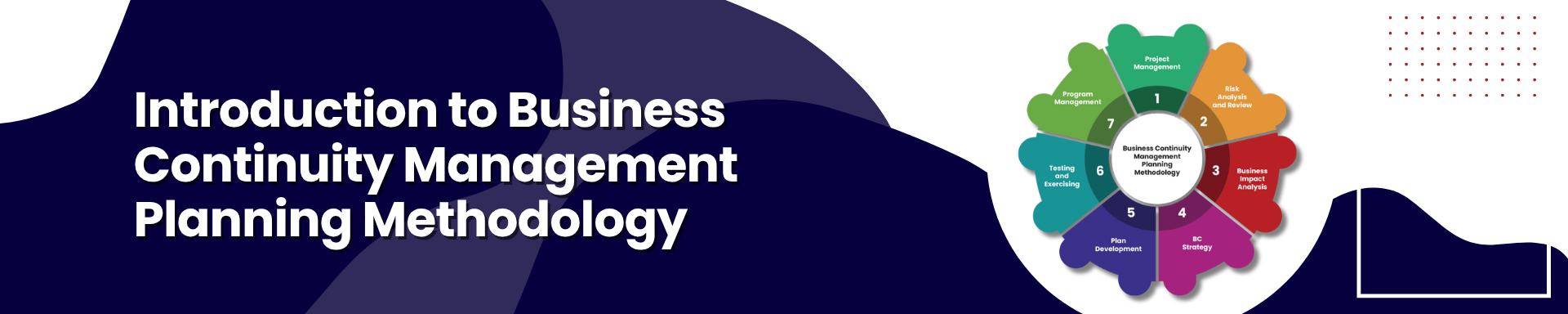
The methodology has seven phases. The first six form a planning cycle. The seventh keeps the whole system alive after the first plans are written.
1. **Project Management (PM):** set up the BCM project, with its scope, sponsor, team, schedule and reporting lines.
2. **Risk Analysis and Review (RAR):** identify the threats that could disrupt SAESL, assess them and decide which need controls.
3. **Business Impact Analysis (BIA):** measure what a disruption would cost each critical business function over time, and set recovery priorities.
4. **Business Continuity Strategy (BCS):** choose how each function will be protected and recovered, within the time and cost the BIA supports.
5. **Plan Development (PD):** write the business continuity (BC) plans that put the chosen strategies into action.
6. **Testing and Exercising (TE):** check that the plans work and that people know their roles.
7. **Program Management (PgM):** maintain, review and improve the BCM programme as SAESL changes.
The order matters. The risk analysis and the BIA inform the strategies. The strategies shape the plans. The exercises show where the plans fall short. Programme management then feeds those lessons back into the earlier phases.
## How the Phases Connect
The phases are not a one-way line. Results from one phase change the work in another. A BIA may reveal that a function depends on a supplier that the risk analysis never considered. An exercise may show that a recovery time chosen in the strategy phase cannot be met. When this happens, SAESL returns to the earlier phase, corrects the finding and updates the affected documents.
Each phase also produces a defined output that the next phase uses. The project plan scopes the risk work. The risk register and the BIA together support the strategy decisions. The strategy paper sets the content of the plans. The exercise reports feed the programme review. Keeping these hand-offs explicit helps the BCM team show an auditor, a customer or a regulator how a given plan came to exist.
## A Specific Requirement for SAESL: Protecting Its Approvals
SAESL holds airworthiness approvals from 13 authorities, including the Civil Aviation Authority of Singapore (CAAS), the Civil Aviation Authority of China (CAAC), the Federal Aviation Administration (FAA) and the European Union Aviation Safety Agency (EASA). These approvals allow SAESL to release engines and components to service. If SAESL could not show that it still met its approval conditions after a disruption, its customers could not use the engines it released.
The methodology therefore includes one requirement particular to SAESL: **continuity of compliance**. Each phase should ask what a disruption would do to SAESL's ability to maintain its approvals, keep its quality records and demonstrate airworthiness control. For example, SAESL might treat the loss of engineering records, or of the people who certify work, as a disruption in its own right, even when the shop floor is unaffected.
CAAS requires approved maintenance organisations to operate a safety management system (SMS) suited to their size and complexity, under paragraph SAR-145.64 of its Singapore Airworthiness Requirements for maintenance organisations (Amendment 18, 25 June 2021 \[verify\]). The BCM programme does not replace the SMS. It complements it. The SMS manages safety risk in normal operations, and BCM keeps those operations, and the evidence for them, available when something goes wrong. Chapter 3 returns to this link.
Further detail about SAESL's services and approvals is available on the [SAESL website](https://www.saesl.com.sg).
## Applying the Methodology at SAESL
Three practical points follow for the BCM team.
- **One scope, set once:** the BCM coordinator agrees the scope in Phase 1 and every later phase uses it. This stops each business unit from drawing its own boundary.
- **One vocabulary:** the team defines terms such as maximum tolerable period of disruption (MTPD), recovery time objective (RTO) and minimum business continuity objective (MBCO) once, in the project phase. Every business unit then uses them consistently.
- **One evidence trail:** each phase leaves a record that can be shown to an auditor or to an aviation authority. This is the same discipline that SAESL already applies to maintenance records.
The BCM team should also expect to run the phases at different speeds in different business units. Engine overhaul may reach the strategy phase while a support function is still completing its BIA. This is acceptable, provided every unit uses the same templates and the BCM coordinator tracks progress against the project plan.
## Summary Table
**Table 1: Business Continuity Management Planning Methodology for Singapore Aero Engine Services Private Limited**
| **Phase** | **Purpose** | **Main output** | **Illustrative SAESL focus** |
| --- | --- | --- | --- |
| **1. Project Management (PM)** | **Organise the work** | **Project plan and charter** | **Scope across all business units** |
| **2. Risk Analysis and Review (RAR)** | **Understand threats** | **Risk register** | **Parts supply, test facility, cyber and records** |
| **3. Business Impact Analysis (BIA)** | **Set recovery priorities** | **Impact ratings, MTPD and RTO** | **Engine overhaul, certification and customer delivery** |
| **4. Business Continuity Strategy (BCS)** | **Choose solutions** | **Strategy paper** | **Alternative suppliers and workarounds** |
| **5. Plan Development (PD)** | **Document the response** | **BC plans** | **Plans owned by each business unit** |
| **6. Testing and Exercising (TE)** | **Prove the plans** | **Exercise reports** | **Call tests and walkthroughs first** |
| **7. Program Management (PgM)** | **Sustain and improve** | **Review and improvement log** | **Annual review and change triggers** |
All SAESL-specific entries in this table are illustrative and must be confirmed by SAESL.
## [](https://cta-redirect.hubspot.com/cta/redirect/3893111/b5945536-415f-4c64-9e05-c7b4d4f26c76)
## Conclusion
SAESL needs a planning methodology because its customers, approvals and engines depend on continuous, well-documented operations. The seven phases give the BCM team a clear route from project start-up to a maintained programme, and they let SAESL show how each plan was produced. The requirement to protect continuity of compliance should run through every phase.
The next chapter looks at the first phase, project management, and how SAESL can organise the work.
## Sources
- [SAESL: Quality and approvals](https://www.saesl.com.sg/about-us/quality/)
- [CAAS: SAR-145 (Amendment 18)](https://www.caas.gov.sg/docs/default-source/docs---srg/sar-145-(amdm-18).pdf)
- [ISO: ISO 22301:2019, Security and resilience, Business continuity management systems](https://www.iso.org/standard/75106.html)
**Continue reading:** Chapter 2, *Project Management Phase for Business Continuity Management Planning Methodology for Singapore Aero Engine Services Private Limited*, shows how SAESL scopes, staffs and governs its BCM project.
| Building Resilient Operations: Implementing Business Continuity Management at SAESL | | | | |
| --- | --- | --- | --- | --- |
| **eBook 2: Implementing Business Continuity Management** | | | | |
| **C1** | **C2** | **C3** | **C4** | **C5** |
| [](https://cta-redirect.hubspot.com/cta/redirect/3893111/5293770c-bccd-4cd7-ad66-f9b98acec36d) | [](https://cta-redirect.hubspot.com/cta/redirect/3893111/37371db8-20ba-4d3c-b0d7-bfbb491334c2) | [](https://cta-redirect.hubspot.com/cta/redirect/3893111/4c7ba3f8-467b-4cf6-bb15-08d57681de85) | [](https://cta-redirect.hubspot.com/cta/redirect/3893111/4af9a280-d158-4276-b5e9-76b765cc21cb) | [](https://cta-redirect.hubspot.com/cta/redirect/3893111/6be24b63-6244-407f-87cd-411083ce616e) |
| **C6** | **C7** | **C8** | **C9** | **C10** |
| [](https://cta-redirect.hubspot.com/cta/redirect/3893111/0ff5e2e1-09fb-4a8b-86d8-affab470e534) | [](https://cta-redirect.hubspot.com/cta/redirect/3893111/8d72106d-fbed-4c4f-9fd1-14070e628e97) | [](https://cta-redirect.hubspot.com/cta/redirect/3893111/d7dff66c-b830-46aa-bb7e-2d2fdf67a4df) | [](https://cta-redirect.hubspot.com/cta/redirect/3893111/9e98b285-f794-4c23-832a-de0d02e15c19) | [](https://cta-redirect.hubspot.com/cta/redirect/3893111/508f7ad5-755e-4c26-963a-c3e3754893d3) |
| | | | | |
---
## **Comments**

---

---

---

---


All rights reserved. Copyright 2026
```json
{
"@context" : "https://schema.org",
"@type" : "BlogPosting",
"author" : {
"@type" : "Person",
"name" : "Moh Heng Goh",
"url" : "https://blog.bcm-institute.org/bcm-v2/author/moh-heng-goh"
},
"dateModified" : "2026-11-14T09:20:03.313Z",
"datePublished" : "2026-11-14T09:20:03.000Z",
"headline" : "Business Continuity Management Planning Methodology for Singapore Aero Engine Services Private Limited",
"mainEntityOfPage" : {
"@id" : "https://blog.bcm-institute.org/bcm-v2/business-continuity-management-planning-methodology-for-singapore-aero-engine-services-private-limited",
"@type" : "WebPage"
},
"publisher" : {
"@type" : "Organization",
"logo" : {
"@type" : "ImageObject",
"url" : "https://blog.bcm-institute.org/hubfs/BCMI%20Logo.png"
},
"name" : "BCMI Pte Ltd"
}
}
```