---
title: "[BCM] [EGH] [E2] [C9] Summary for Business Continuity Management Planning Methodology for Eastern General Hospital"
description: Chapter 9 summarises the EGH seven-phase ISO 22301 BCM methodology, carrying forward codes and tiers, with pitfalls, roles, first steps and items to confirm.
---
.
[](http://www.bcm-institute.org/)
- [Home](https://www.bcm-institute.org/)
- [About Us](https://www.bcm-institute.org/about-us-3/)
- [A President’s Perspective](https://www.bcm-institute.org/about-us/a-presidents-perspective/)
- [Our History](https://www.bcm-institute.org/about-us/our-history/)
- [Our Advisory Council](https://www.bcm-institute.org/about-us/our-advisory-council/)
- [Customers’ Testimonials](https://www.bcm-institute.org/about-us/customers-testimonials/)
- [Credential Verification](https://www.bcm-institute.org/about-us/credential-verification/)
- [Courses](https://blog.bcm-institute.org/blog/course-fees-for-blended-learning-courses-master-catalog)
- [ISO 22301 Business Continuity Management System Audit](https://blog.bcm-institute.org/audit/business-continuity-management-audit-courses)
- [ISO 22301 Business Continuity Management](https://blog.bcm-institute.org/bcm/business-continuity-management-courses)
- [Crisis Communication](https://blog.bcm-institute.org/crisis-communication/crisis-communication-courses)
- [Crisis Management](https://blog.bcm-institute.org/en/crisis-management/courses)
- [IT Disaster Recovery](https://blog.bcm-institute.org/it-disaster-recovery/courses)
- [Operational Resilience](https://blog.bcm-institute.org/operational-resilience/courses)
- [Operational Resilience Audit](https://blog.bcm-institute.org/operational-resilience-audit/courses)
- [Certification](https://blog.bcm-institute.org/certification/types-of-certifications-offered)
- [ISO 22301 BCMS Audit Certification](https://blog.bcm-institute.org/certification/business-continuity-management-audit-certification)
- [ISO22301 Business Continuity Management Certification](https://blog.bcm-institute.org/bcm/business-continuity-management-certification)
- [Crisis Communication Certification](https://blog.bcm-institute.org/crisis-communication/crisis-communication-certification)
- [Crisis Management Certification](https://blog.bcm-institute.org/en/crisis-management/crisis-management-certification)
- [IT Disaster Recovery Planning Certification](https://blog.bcm-institute.org/it-disaster-recovery/it-disaster-recovery-certification)
- [Operational Resilience Certification](https://blog.bcm-institute.org/operational-resilience/operational-resilience-certification)
- [Operational Resilience Audit Certification](https://blog.bcm-institute.org/operational-resilience-audit)
- [Seminars](https://blog.bcm-institute.org/meet-the-expert/mte-webinar-mainpage)
- [Store](https://www.bcm-institute.org/store-2/)
- [Contact Us](http://www.bcm-institute.org/about-us/contact-us/)
-
-
###### Keeping Care Running: Managing and Implementing Business Continuity Management at Eastern General Hospital

# \[BCM\] \[EGH\] \[E2\] \[C9\] Summary for Business Continuity Management Planning Methodology for Eastern General Hospital
Lorem ipsum dolor sit amet, consectetuer adipiscing elit, sed diam nonummy nibh euismod tincidunt ut laoreet dolore magna aliquam erat volutpat.
[Moh Heng Goh](https://blog.bcm-institute.org/bcm-v2/author/moh-heng-goh) Nov 17, 2026
#### [](https://cta-redirect.hubspot.com/cta/redirect/3893111/c5748bd7-2a18-4a78-8cc9-7dcc65204af9)
## [](https://cta-redirect.hubspot.com/cta/redirect/3893111/ed46e362-3b5a-4a67-95cd-d0df7fae8af4)
## Introduction
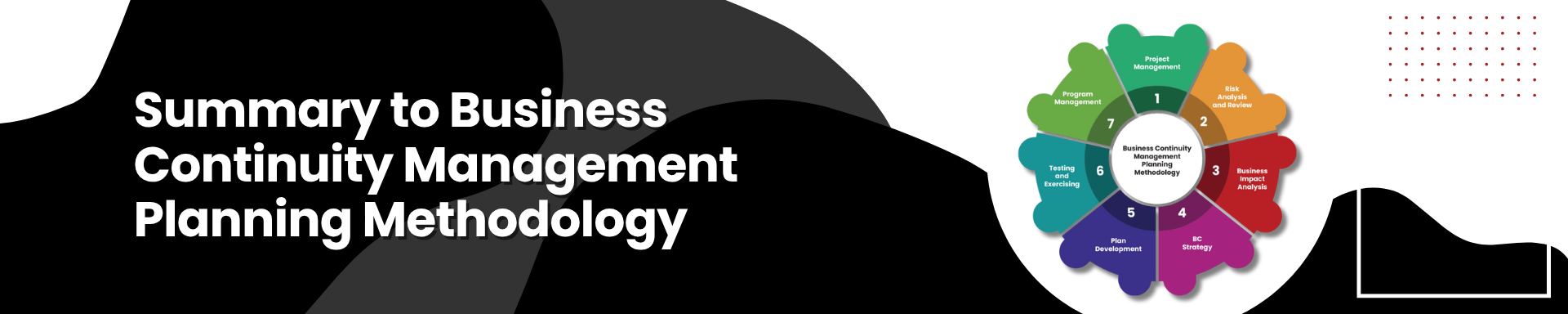
This chapter closes the body of eBook 2, *Implementing Business Continuity Management for Eastern General Hospital*. It revisits each of the seven phases in order, cites the chapter that covers it, and carries forward the codes, tiers and counts defined earlier so that the whole eBook reads as one picture. It then shows how the phases work together, which common pitfalls the methodology prevents, who does what, an illustrative first-steps plan, and what Eastern General Hospital (EGH) must confirm before relying on the examples.
The methodology meets the planning requirements of ISO 22301 and is written for the [](https://cta-redirect.hubspot.com/cta/redirect/3893111/0829428d-9f00-473a-8c9e-f138e9c32798)BCM coordinators who will implement it. EGH is described on its [official website](https://www.egh.com.sg/) as an upcoming acute hospital of about 1,000 beds in Bedok North, part of the SingHealth group, due to begin serving patients virtually in 2026 with the physical campus due in 2029 to 2030. Because the hospital is still being built, every internal detail in this eBook, including owners, systems, scores, tiers and recovery times, is illustrative.
## The Seven Phases Revisited
### 1. Project Management (PM), Chapter 2
The first phase sets scope and objectives, names a sponsor, forms a steering committee and project team with a responsibility matrix, plans the work, manages project risks and communication, and prepares the handover to routine programme management. For EGH, the steering committee includes design and commissioning leads, which reflects the pre-opening lens introduced in Chapter 1: continuity needs to be designed into a building before it is occupied. The phase hands an approved charter, a team and a work plan to the next phase.
### 2. Risk Analysis and Review (RAR), Chapter 3
The second phase works in four steps: identifying risks, assessing them, mitigating them and reviewing them continuously. The illustrative register holds ten risks, R1 to R10: extended power failure (R1), cyberattack on clinical systems (R2), infectious disease outbreak (R3), fire or smoke in a clinical building (R4), flooding or loss of water supply (R5), medical gas or critical equipment failure (R6), supplier or logistics failure (R7), staff shortage (R8), mass casualty or demand surge (R9), and network or telecommunications outage affecting virtual and home care (R10). Each is scored from 1 to 25 as likelihood multiplied by impact. In the illustrative scoring, seven risks fall in the High band (R1, R3, R4, R5, R6, R8 and R9), one in the Extreme band (R2) and two in the Medium band (R7 and R10). The phase hands a ranked register and a set of controls to the BIA.
### 3. Business Impact Analysis (BIA), Chapter 4
The third phase measures impact over time and sets the maximum tolerable period of disruption (MTPD), recovery time objective (RTO), minimum business continuity objective (MBCO), recovery point objective (RPO) and dependencies for each critical business function (CBF). EGH supplied sixteen CBFs, coded CBF-1 to CBF-16. In the illustrative ranking, ten are Tier 1 with an RTO of four hours or less (CBF-1, CBF-2, CBF-3, CBF-4, CBF-5, CBF-6, CBF-10, CBF-11, CBF-12 and CBF-16), five are Tier 2 with an RTO of up to 24 hours (CBF-7, CBF-9, CBF-13, CBF-14 and CBF-15), and one is Tier 3 with an RTO of up to 72 hours (CBF-8). The shortest illustrative RTO is one hour, set for the emergency department (CBF-1), critical care (CBF-4), facilities and building systems (CBF-11) and security and crisis communications (CBF-16). The phase hands the ranked functions and recovery targets to the strategy phase.
### 4. Business Continuity Strategy (BCS), Chapter 5
The fourth phase chooses prevention, mitigation and recovery measures for the sixteen functions, grouped into six resource groups: S1 people, S2 premises and utilities, S3 technology and data, S4 medical equipment and clinical supplies, S5 suppliers and partners, and S6 information and communications. Each group is linked to risk codes, and strategies are tested for cost and practicality. Strategies for shared dependencies, above all power, information systems and staff, are chosen once and protect many functions. The phase hands agreed strategies to plan development.
### 5. Plan Development (PD), Chapter 6
The fifth phase has three stages: deciding how the plan is organised (the plan template and the recovery organisation), holding a writing workshop after which each business unit BCM coordinator completes the template, and finalising plan production through validation by coordinators and heads of business units. The chapter gives an illustrative outline for critical care (CBF-4). The phase hands validated plans to the testing phase.
### 6. Testing and Exercising (TE), Chapter 7
The sixth phase uses initial tests (component tests, call notification tests and walkthroughs) and advanced tests (integrated, simulation and live tests). The chapter also reports the regulatory search: no specific requirement on exercising continuity or emergency plans was found in the MOH licence conditions and pages that could be read, the nearest provision being a condition on regular review of emergency department policies, and the regulations themselves could be read only in part. The phase hands exercise reports and corrective actions to programme management.
### 7. Program Management (PgM), Chapter 8
The seventh phase covers governance and ownership, scheduled review, change triggers, lessons from events, awareness and training, performance measures, audit, management review and an annual calendar. It returns the programme to the start of the cycle, since each review refreshes the risk register and the BIA.
## How the Phases Work Together
The phases form a loop and not a straight line. The chain from risk to recovery can be followed with one example. R1, extended power failure, is rated High in Chapter 3.
The BIA in Chapter 4 shows that critical care (CBF-4) has an RTO of one hour and depends on power, gases and ventilators. The strategies in Chapter 5 place the response in group S2, with duplicate feeds and tested changeover, and in group S4, with reserve gases and spare equipment. The plan in Chapter 6 gives the nurse in charge a checklist for the first hour.
The exercise in Chapter 7 tests the generator changeover as a component test and the critical care response as a walkthrough. The programme in Chapter 8 schedules the next test, records the lessons and refreshes the risk score. If the exercise reveals that changeover takes longer than an hour, the loop returns to strategy or to the RTO itself.
A second example starts from the risk with the highest score. R2, cyberattack on clinical systems, is rated Extreme in the illustrative register. The BIA shows that clinical information systems and digital platforms (CBF-12) have a Tier 1 RTO of four hours, and that pharmacy and medication management (CBF-6), diagnostic imaging and laboratory services (CBF-5) and virtual and home-based care (CBF-7) all depend on them. This is why CBF-12 attracts early attention: a single weakness there reaches many other functions. Strategy group S3 supplies segmented networks, offline backups and written downtime procedures, and group S6 supplies the notification and holding statements needed to keep staff, patients and families informed. The plan for each affected unit includes downtime forms and a check on which orders were placed before the outage. An integrated test in Chapter 7 brings the units together to see whether paper procedures hold for several hours, and the programme in Chapter 8 records any gap and sets a date for a repeat test.
The codes make this tracing possible. Because every chapter uses the same identifiers, a coordinator can start from any risk, function or strategy group and follow the links in either direction. A reader who meets CBF-6 in a plan, for example, can find its tier and recovery time in Chapter 4, the strategies that protect it in groups S3, S4 and S5 in Chapter 5, and the exercises that touch it in Chapter 7. EGH should keep these codes stable as the programme grows and add any new codes in sequence rather than renumber existing ones.
The pre-opening lens connects the phases in another way. Because EGH plans to open in stages, each phase is run more than once, first for the virtual service and then for each physical service. Early rounds rely on assumptions that should be marked and tested once real activity exists.
## Common Pitfalls the Methodology Prevents
| **Pitfall** | **How it shows up in a hospital** | **How the methodology prevents it** |
| --- | --- | --- |
| **Planning without authority** | **Units ignore requests for time** | **A sponsor and steering committee in PM** |
| **Guessing the threats** | **Money spent on unlikely events** | **A scored register in RAR** |
| **Treating all functions alike** | **Equal effort on outpatient scheduling and critical care** | **Tiers and recovery times from the BIA** |
| **Strategy that misses the target** | **An eight-hour fix for a one-hour function** | **Testing options against RTO in BCS** |
| **Plans nobody can use** | **Long documents with outdated contacts** | **A short template, workshop and validation in PD** |
| **Untested plans** | **First failure occurs in a real event** | **A graded series of exercises in TE** |
| **Decay after the project** | **Plans out of date within a year** | **Ownership, triggers and a calendar in PgM** |
## Roles at a Glance
| **Role** | **Main responsibilities** |
| --- | --- |
| **Sponsor** | **Owns the outcome, approves the charter and plans, secures resources** |
| **Steering committee, later BCM steering group** | **Directs the work, accepts outputs of each phase, reviews performance** |
| **Organisation BCM coordinator** | **Manages the project and then the programme; maintains master documents** |
| **Business unit BCM coordinators** | **Run the BIA for their unit, write and keep plans, support exercises** |
| **Heads of business units** | **Validate plans, release staff for workshops and exercises** |
| **Specialists (risk, facilities, information technology, infection prevention)** | **Advise on risks and strategies, own technical tests** |
| **Recovery organisation** | **Runs the response at strategic, tactical and operational levels** |
| **Internal audit** | **Gives independent assurance on the programme** |
## Illustrative First-Steps Plan
The plan below shows how EGH might begin. Periods and owners are examples. The plan assumes a start while the hospital is still being built, so early steps focus on design and on the virtual service.
1. **Weeks 1 to 4: confirm the foundation.** Appoint the sponsor and organisation BCM coordinator, confirm scope, approve the charter, form the steering committee and name business unit coordinators. Check what SingHealth already provides in policy, templates and incident arrangements.
2. **Weeks 3 to 8: understand the risks.** Hold risk workshops, adopt or adapt a scoring scale, and draft the register of R1 to R10, tagged by opening stage.
3. **Weeks 6 to 12: run the first BIA.** Start with virtual and home-based care (CBF-7), the digital platforms (CBF-12) and the Tier 1 functions planned for the first physical stages. Confirm the sixteen functions, tiers, recovery times and dependencies.
4. **Weeks 10 to 16: raise design requirements.** Send resilience needs for power, water, medical gases and network paths to the design and commissioning leads before layouts are fixed.
5. **Weeks 12 to 20: choose strategies.** Evaluate options in the six resource groups, starting with shared dependencies, and obtain steering committee decisions.
6. **Weeks 16 to 26: write plans.** Agree the template and recovery organisation, hold the writing workshop, and validate the first plans, starting with Tier 1 functions.
7. **Weeks 24 to 30: test the first plans.** Run component tests and a call notification test, then a walkthrough for the virtual service.
8. **Weeks 28 to 32: hand over.** Present the handover pack, confirm programme ownership, set the calendar and schedule the first management review.
## What EGH Must Confirm Before Relying on the Examples
This eBook is a method with worked examples, not a record of EGH's actual arrangements. Before the examples are used, EGH should confirm the following.
- **Current status and timeline.** The opening dates and stages in this eBook come from the hospital's website pages, one of which was last updated in June 2025. EGH should confirm what is now live and what is planned.
- **The list of critical business functions.** The sixteen functions were supplied for this eBook. EGH should confirm that the list is complete, add specialties once they are decided, and check the codes.
- **All figures.** Risk scores, tiers, recovery times, maximum tolerable periods, frequencies, roles and dates are illustrative. Each needs confirmation by the people who own the function.
- **Licensing status and conditions.** The website does not state EGH's licence status. EGH should confirm the licence conditions that apply and read them in full, including the effective dates, which were not stated in the text read for this eBook.
- **Exercising requirements.** The full text of the Healthcare Services (General) Regulations 2021 and the Healthcare Services (Acute Hospital Service) Regulations 2023 could not be read in full for this eBook. EGH should ask the Ministry of Health whether any requirement on emergency or continuity planning or exercising applies, and check group-level requirements from SingHealth **\[verify\]**.
- **Relocation and approvals.** Strategies that move a service to another area may need approval under licensing arrangements, which should be checked before the strategy is relied on **\[verify\]**.
- **Group arrangements.** EGH should find out which policies, contracts, data services and incident procedures are held at SingHealth level, and how they affect strategies.
- **The campus interface.** EGH should agree the transfer protocol with Eastern Community Hospital, which is run by SingHealth Community Hospitals.
- **Standards.** The text of ISO 22301 was not opened for this eBook. EGH should check the current edition and any Singapore adoption before citing clauses **\[verify\]**.
## Summary Table
| Phase | Chapter | Key output | Carried-forward codes and counts |
| --- | --- | --- | --- |
| **Project Management (PM)** | **2** | **Charter, team, work plan, handover pack** | **Sponsor, steering committee, coordinators** |
| **Risk Analysis and Review (RAR)** | **3** | **Scored risk register** | **R1 to R10; 7 High, 1 Extreme, 2 Medium** |
| **Business Impact Analysis (BIA)** | **4** | **Ranked functions, RTO, MTPD, dependencies** | **CBF-1 to CBF-16; 10 Tier 1, 5 Tier 2, 1 Tier 3** |
| **Business Continuity Strategy (BCS)** | **5** | **Strategies by resource group** | **S1 to S6, six groups** |
| **Plan Development (PD)** | **6** | **Validated plans; critical care outline** | **Three stages** |
| **Testing and Exercising (TE)** | **7** | **Exercise reports, corrective actions** | **Three initial and three advanced test types** |
| **Program Management (PgM)** | **8** | **Calendar, measures, audit and review** | **Annual cycle with quarterly reporting** |
## [](https://cta-redirect.hubspot.com/cta/redirect/3893111/297a5452-5a0d-4b73-9778-093a77c00efb)
The seven phases give EGH a complete and repeatable way to keep care running when something goes wrong. Each phase hands a defined output to the next, the codes R1 to R10, CBF-1 to CBF-16 and S1 to S6 tie the chapters together, and the programme phase closes the loop. The pre-opening lens means the work can begin now, while the hospital is still being designed and commissioned, which is when continuity measures are cheapest to include. Before the examples are relied on, EGH should confirm the items listed above, and replace every illustrative figure with its own. Eastern General Hospital's own pages and the Ministry of Health's published licence conditions are the right starting points for that checking.
## Sources
- [Eastern General Hospital, official website](https://www.egh.com.sg/) and [Hospital Overview](https://www.egh.com.sg/about-egh/hospital-overview/).
- [MOH, Licence Conditions on Acute Hospital Service Licensees, version 1.0](https://isomer-user-content.by.gov.sg/7/778fe29b-fbad-4918-ad2c-67162f04a991/LCs%20on%20Acute%20Hospital%20Service%20Licensees_1.0.pdf).
- [HCSA, Summary of requirements for licensees](https://www.hcsa.gov.sg/about-us/2-summary-of-requirements/).
**Continue reading:** the back cover, which summarises the eBook and points to the next steps for BCM coordinators and to eBook 3, *Starting Your Business Continuity Management Implementation for Eastern General Hospital*.
| Keeping Care Running: Managing and Implementing Business Continuity Management at Eastern General Hospital | | | | |
| --- | --- | --- | --- | --- |
| **eBook 2: Implementing Business Continuity Management** | | | | |
| **C1** | **C2** | **C3** | **C4** | **C5** |
| [](https://cta-redirect.hubspot.com/cta/redirect/3893111/ae929f9f-d9ce-4159-89d6-7e4e808e302e) | [](https://cta-redirect.hubspot.com/cta/redirect/3893111/31402f15-220b-47f2-96bd-c1c0b99f601b) | [](https://cta-redirect.hubspot.com/cta/redirect/3893111/47b1732f-7d2d-4b7f-9e2c-1bb9f5eb37e9) | [](https://cta-redirect.hubspot.com/cta/redirect/3893111/354c4374-6f93-47df-8e52-f9cae94c431c) | [](https://cta-redirect.hubspot.com/cta/redirect/3893111/883a28c8-785a-42c1-bec1-ab356f5dfe62) |
| **C6** | **C7** | **C8** | **C9** | **C10** |
| [](https://cta-redirect.hubspot.com/cta/redirect/3893111/c706799d-aeab-4a5e-89c0-3aa51b17707c) | [](https://cta-redirect.hubspot.com/cta/redirect/3893111/4bebd8de-6b61-4578-b24a-3ceb6a11cd05) | [](https://cta-redirect.hubspot.com/cta/redirect/3893111/d7d1ea36-1913-4593-8189-04e6d1b116d7) | [](https://cta-redirect.hubspot.com/cta/redirect/3893111/0829428d-9f00-473a-8c9e-f138e9c32798) | [](https://cta-redirect.hubspot.com/cta/redirect/3893111/a8ed064d-96cf-41d5-b4d9-c2ef1f77a7a6) |
| | | | | |
---
## **Comments**

---

---

---

---


All rights reserved. Copyright 2026
```json
{
"@context" : "https://schema.org",
"@type" : "BlogPosting",
"author" : {
"@type" : "Person",
"name" : "Moh Heng Goh",
"url" : "https://blog.bcm-institute.org/bcm-v2/author/moh-heng-goh"
},
"dateModified" : "2026-11-17T07:05:32.859Z",
"datePublished" : "2026-11-17T06:44:14.000Z",
"headline" : "[BCM] [EGH] [E2] [C9] Summary for Business Continuity Management Planning Methodology for Eastern General Hospital",
"mainEntityOfPage" : {
"@id" : "https://blog.bcm-institute.org/bcm-v2/bcm-egh-e2-c9-summary-for-business-continuity-management-planning-methodology-for-eastern-general-hospital",
"@type" : "WebPage"
},
"publisher" : {
"@type" : "Organization",
"logo" : {
"@type" : "ImageObject",
"url" : "https://blog.bcm-institute.org/hubfs/BCMI%20Logo.png"
},
"name" : "BCMI Pte Ltd"
}
}
```