---
title: "[BCM] [EGH] [E2] [C6] Business Continuity Plan Development Phase for Business Continuity Management Planning Methodology for Eastern General Hospital"
description: "Chapter 6 explains Plan Development for EGH under ISO 22301: plan template, recovery organisation, writing workshop, validation and a critical care outline."
---
.
[](http://www.bcm-institute.org/)
- [Home](https://www.bcm-institute.org/)
- [About Us](https://www.bcm-institute.org/about-us-3/)
- [A President’s Perspective](https://www.bcm-institute.org/about-us/a-presidents-perspective/)
- [Our History](https://www.bcm-institute.org/about-us/our-history/)
- [Our Advisory Council](https://www.bcm-institute.org/about-us/our-advisory-council/)
- [Customers’ Testimonials](https://www.bcm-institute.org/about-us/customers-testimonials/)
- [Credential Verification](https://www.bcm-institute.org/about-us/credential-verification/)
- [Courses](https://blog.bcm-institute.org/blog/course-fees-for-blended-learning-courses-master-catalog)
- [ISO 22301 Business Continuity Management System Audit](https://blog.bcm-institute.org/audit/business-continuity-management-audit-courses)
- [ISO 22301 Business Continuity Management](https://blog.bcm-institute.org/bcm/business-continuity-management-courses)
- [Crisis Communication](https://blog.bcm-institute.org/crisis-communication/crisis-communication-courses)
- [Crisis Management](https://blog.bcm-institute.org/en/crisis-management/courses)
- [IT Disaster Recovery](https://blog.bcm-institute.org/it-disaster-recovery/courses)
- [Operational Resilience](https://blog.bcm-institute.org/operational-resilience/courses)
- [Operational Resilience Audit](https://blog.bcm-institute.org/operational-resilience-audit/courses)
- [Certification](https://blog.bcm-institute.org/certification/types-of-certifications-offered)
- [ISO 22301 BCMS Audit Certification](https://blog.bcm-institute.org/certification/business-continuity-management-audit-certification)
- [ISO22301 Business Continuity Management Certification](https://blog.bcm-institute.org/bcm/business-continuity-management-certification)
- [Crisis Communication Certification](https://blog.bcm-institute.org/crisis-communication/crisis-communication-certification)
- [Crisis Management Certification](https://blog.bcm-institute.org/en/crisis-management/crisis-management-certification)
- [IT Disaster Recovery Planning Certification](https://blog.bcm-institute.org/it-disaster-recovery/it-disaster-recovery-certification)
- [Operational Resilience Certification](https://blog.bcm-institute.org/operational-resilience/operational-resilience-certification)
- [Operational Resilience Audit Certification](https://blog.bcm-institute.org/operational-resilience-audit)
- [Seminars](https://blog.bcm-institute.org/meet-the-expert/mte-webinar-mainpage)
- [Store](https://www.bcm-institute.org/store-2/)
- [Contact Us](http://www.bcm-institute.org/about-us/contact-us/)
-
-
###### Keeping Care Running: Managing and Implementing Business Continuity Management at Eastern General Hospital

# \[BCM\] \[EGH\] \[E2\] \[C6\] Business Continuity Plan Development Phase for Business Continuity Management Planning Methodology for Eastern General Hospital
[](https://cta-redirect.hubspot.com/cta/redirect/3893111/dfa53785-5be1-4117-a1bc-43e40cdb42e8)
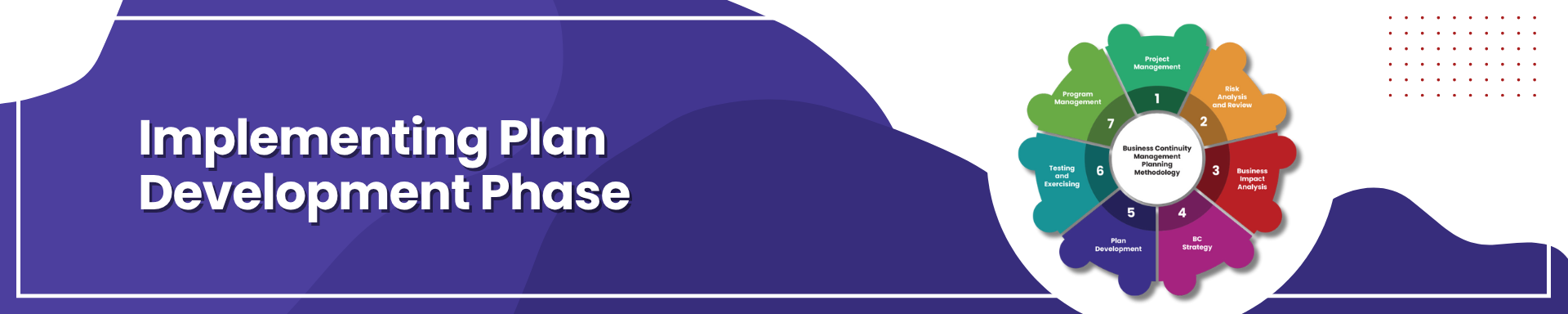
The fifth phase, Plan Development (PD), turns strategies into written business continuity plans that staff can follow under pressure. At Eastern General Hospital (EGH), the readers of these plans will be nurses, doctors, engineers and managers who may be tired, short of staff and working without normal systems. A plan that is long, vague or difficult to find fails them at the moment it is needed.
[Moh Heng Goh](https://blog.bcm-institute.org/bcm-v2/author/moh-heng-goh) Nov 17, 2026
#### [](https://cta-redirect.hubspot.com/cta/redirect/3893111/c5748bd7-2a18-4a78-8cc9-7dcc65204af9)
## [](https://cta-redirect.hubspot.com/cta/redirect/3893111/a8d5e9c1-7cf9-4dc1-b2b5-d07c5b8544f3)
## Introduction
The fifth phase, Plan Development (PD), turns strategies into written business continuity plans that staff can follow under pressure. At Eastern General Hospital (EGH), the readers of these plans will be nurses, doctors, engineers and managers who may be tired, short of staff and working without normal systems. A plan that is long, vague or difficult to find fails them at the moment it is needed.
This chapter answers the question: what does plan development entail? It describes three stages, gives an illustrative plan outline for one function, and sets out requirements specific to EGH. As elsewhere, names, numbers and structures are illustrative and must be confirmed by EGH.[](https://cta-redirect.hubspot.com/cta/redirect/3893111/c706799d-aeab-4a5e-89c0-3aa51b17707c)
## What Does Plan Development Entail?
Plan development has three stages. Each produces a defined output and ends with a decision to move on.
### Stage 1: Decide How the Plan Is Organised
Before anyone writes, the team decides what a plan looks like and who acts in it. This stage has two tasks.
**Design the plan template.** A single template, used by every unit, makes plans easy to read, compare and maintain. It should be short enough to use during an incident, which usually means action cards of one or two pages for each role, backed by a short reference section. A useful template contains:
- the purpose, scope and the function covered, with its code (for example CBF-4);
- the activation criteria, which say what events or thresholds trigger the plan and who may activate it;
- the recovery organisation, with names, roles, deputies and contact methods;
- immediate actions for the first hour, in checklist form;
- recovery procedures linked to the strategies in Chapter 5, including the minimum business continuity objective;
- resources needed, such as equipment, supplies, systems and space, and where to find them;
- communication lists and message templates;
- records to keep, so that decisions can be reviewed later;
- the stand-down criteria and the return to normal operation; and
- the version, owner, approval date and next review date.
**Determine the recovery organisation.** The recovery organisation is the group of people who run the response. A common design has three levels: a strategic level that decides priorities and speaks to regulators and the SingHealth group, a tactical level that co-ordinates clinical and support functions, and operational teams in each unit. Roles should be defined by position, not by name, and each should have at least one deputy. The organisation should link with the hospital's existing emergency and incident arrangements rather than create a parallel structure.
### Stage 2: Hold the Writing Workshop
A plan writing workshop guides the plan writers through the template. It is run by the organisation BCM coordinator or a trained facilitator and attended by the business unit BCM coordinators and, where useful, heads of unit. A good workshop does four things.
1. It explains how the BIA results and strategies translate into plan content, so that writers know their targets.
2. It works through one completed example, so that writers see what level of detail is expected.
3. It gives each coordinator time to draft the first sections with help available.
4. It agrees a deadline for first drafts and a way to ask questions.
After the workshop, each business unit BCM coordinator completes the plan template for the function or functions in the unit. The coordinator consults the people who actually do the work, since they know which steps are realistic. For clinical areas, this includes the nurse manager and a senior clinician.
### Stage 3: Finalise Plan Production
The final stage checks that the plans are complete and usable. Business unit BCM coordinators and heads of business units validate the content for completeness and coverage. Validation asks the following questions:
- Does the plan cover every strategy chosen for the function, and the risks relevant to it?
- Do its recovery times match those in the BIA?
- Are the dependencies on other functions acknowledged, and do the plans of those functions agree?
- Are roles filled, deputies named and contact details correct?
- Can an unfamiliar reader follow it?
The organisation BCM coordinator then reviews the plans together, looking for gaps and conflicts between units, and the sponsor or steering committee approves them. Approved plans are issued through a controlled repository, and printed copies of action cards are placed where staff will look for them. Version control matters: a staff member who uses an old contact list during an incident may lose valuable time.
## Illustrative Plan Outline: Critical Care (CBF-4)
Critical care is a Tier 1 function with an illustrative RTO of one hour and MTPD of two hours. The outline below shows how its plan might look. All details are examples for EGH to adapt.
- **Purpose and scope:** maintain life support for critically ill patients during loss of power, gases, monitoring, staff or space.
- **Linked risks:** R1 extended power failure, R6 medical gas or critical equipment failure, R4 fire or smoke, R8 staff shortage and R3 infectious disease outbreak.
- **Activation:** the nurse in charge activates the plan when power moves to backup supply for more than a set period, when gas pressure alarms sound, when staffing falls below a safe level, or when evacuation is ordered.
- **Recovery organisation:** the critical care consultant on duty leads clinically, the nurse in charge co-ordinates the unit, a facilities duty engineer reports on utilities, and a liaison links to the hospital command team.
- **First-hour actions:** check each ventilated patient, switch to manual ventilation where needed, connect reserve gas cylinders, move to battery or backup monitors, record the time of each action, and report status to the command team.
- **Recovery procedures:** prioritise patients for scarce equipment using agreed clinical criteria, request staff from the redeployment roster, and prepare a safe transfer of patients to another unit if conditions cannot be restored.
- **Resources:** reserve gas cylinders, manual resuscitation bags, spare monitors, battery packs, printed observation charts and downtime forms, each with a stated location.
- **Communication:** a call list for the on-call team, a message template for families and a line to the command team.
- **Stand-down:** the consultant and the duty engineer confirm that supply and equipment are stable, and the team records lessons.
## Requirements Specific to EGH
- **Plans for each opening stage.** EGH's website states that the hospital will begin serving patients virtually in 2026, with the physical campus due in 2029 to 2030. Plans should be written first for virtual and home-based care (CBF-7) and the digital platforms that support it (CBF-12), and then for physical services as they are commissioned. Each plan should state the stage it covers.
- **Alignment with licence conditions.** MOH licence conditions for acute hospital licensees include conditions on the emergency department service, intensive care, patient transport and the prevention of transmission of blood-borne viruses and pathogenic bacteria. Plans for the related functions should refer to the relevant conditions and be checked against them by the people responsible for compliance.
- **Shared campus plans.** The plan for patient flow and transfer (CBF-13) must be agreed with Eastern Community Hospital, which is run by SingHealth Community Hospitals. Both parties should sign the transfer protocol.
- **Group links.** If SingHealth has group-level incident procedures, plans should name the contact points and the triggers for notifying the group.
## Summary Table
| **Stage** | **Main tasks** | **Led by** | **Output** |
| --- | --- | --- | --- |
| **1 Decide how the plan is organised** | **Design the plan template; define the recovery organisation** | **Organisation BCM coordinator** | **Approved template and recovery organisation chart** |
| **2 Hold the writing workshop** | **Guide writers; unit coordinators complete the template** | **Facilitator and business unit BCM coordinators** | **First drafts of all plans** |
| **3 Finalise plan production** | **Validate for completeness and coverage; approve; issue** | **Business unit coordinators and heads of business units** | **Validated, controlled plans** |
## [](https://cta-redirect.hubspot.com/cta/redirect/3893111/297a5452-5a0d-4b73-9778-093a77c00efb)
Plan development is where earlier analysis becomes something a nurse or engineer can use at three in the morning. Three stages, a common template, a clear recovery organisation, a workshop and a validation step help EGH to produce plans of consistent quality. The critical care outline shows how risks R1, R3, R4, R6 and R8 and the targets from the BIA appear in one plan. The next phase tests whether such plans work.
## Sources
- [MOH, Licence Conditions on Acute Hospital Service Licensees, version 1.0](https://isomer-user-content.by.gov.sg/7/778fe29b-fbad-4918-ad2c-67162f04a991/LCs%20on%20Acute%20Hospital%20Service%20Licensees_1.0.pdf), section headings.
- [Eastern General Hospital, Hospital Overview](https://www.egh.com.sg/about-egh/hospital-overview/).
**Continue reading:** Chapter 7, *Testing and Exercising Phase for Business Continuity Management Planning Methodology for Eastern General Hospital*, which describes the types of exercise and what MOH and the law of Singapore say about exercising plans.
| Keeping Care Running: Managing and Implementing Business Continuity Management at Eastern General Hospital | | | | |
| --- | --- | --- | --- | --- |
| **eBook 2: Implementing Business Continuity Management** | | | | |
| **C1** | **C2** | **C3** | **C4** | **C5** |
| [](https://cta-redirect.hubspot.com/cta/redirect/3893111/ae929f9f-d9ce-4159-89d6-7e4e808e302e) | [](https://cta-redirect.hubspot.com/cta/redirect/3893111/31402f15-220b-47f2-96bd-c1c0b99f601b) | [](https://cta-redirect.hubspot.com/cta/redirect/3893111/47b1732f-7d2d-4b7f-9e2c-1bb9f5eb37e9) | [](https://cta-redirect.hubspot.com/cta/redirect/3893111/354c4374-6f93-47df-8e52-f9cae94c431c) | [](https://cta-redirect.hubspot.com/cta/redirect/3893111/883a28c8-785a-42c1-bec1-ab356f5dfe62) |
| **C6** | **C7** | **C8** | **C9** | **C10** |
| [](https://cta-redirect.hubspot.com/cta/redirect/3893111/c706799d-aeab-4a5e-89c0-3aa51b17707c) | [](https://cta-redirect.hubspot.com/cta/redirect/3893111/4bebd8de-6b61-4578-b24a-3ceb6a11cd05) | [](https://cta-redirect.hubspot.com/cta/redirect/3893111/d7d1ea36-1913-4593-8189-04e6d1b116d7) | [](https://cta-redirect.hubspot.com/cta/redirect/3893111/0829428d-9f00-473a-8c9e-f138e9c32798) | [](https://cta-redirect.hubspot.com/cta/redirect/3893111/a8ed064d-96cf-41d5-b4d9-c2ef1f77a7a6) |
| | | | | |
---
## **Comments**

---

---

---

---


All rights reserved. Copyright 2026
```json
{
"@context" : "https://schema.org",
"@type" : "BlogPosting",
"author" : {
"@type" : "Person",
"name" : "Moh Heng Goh",
"url" : "https://blog.bcm-institute.org/bcm-v2/author/moh-heng-goh"
},
"dateModified" : "2026-11-17T06:27:20.069Z",
"datePublished" : "2026-11-17T05:20:39.000Z",
"headline" : "[BCM] [EGH] [E2] [C6] Business Continuity Plan Development Phase for Business Continuity Management Planning Methodology for Eastern General Hospital",
"mainEntityOfPage" : {
"@id" : "https://blog.bcm-institute.org/bcm-v2/bcm-egh-e2-c6-business-continuity-plan-development-phase-for-business-continuity-management-planning-methodology-for-eastern-general-hospital",
"@type" : "WebPage"
},
"publisher" : {
"@type" : "Organization",
"logo" : {
"@type" : "ImageObject",
"url" : "https://blog.bcm-institute.org/hubfs/BCMI%20Logo.png"
},
"name" : "BCMI Pte Ltd"
}
}
```