---
title: "[BCM] [EGH] [E2] [C5] Business Continuity Strategy Phase for Business Continuity Management Planning Methodology for Eastern General Hospital"
description: Chapter 5 sets out EGH business continuity strategies under ISO 22301, grouped into six resource groups and linked to risks R1 to R10 and CBF-1 to CBF-16.
---
.
[](http://www.bcm-institute.org/)
- [Home](https://www.bcm-institute.org/)
- [About Us](https://www.bcm-institute.org/about-us-3/)
- [A President’s Perspective](https://www.bcm-institute.org/about-us/a-presidents-perspective/)
- [Our History](https://www.bcm-institute.org/about-us/our-history/)
- [Our Advisory Council](https://www.bcm-institute.org/about-us/our-advisory-council/)
- [Customers’ Testimonials](https://www.bcm-institute.org/about-us/customers-testimonials/)
- [Credential Verification](https://www.bcm-institute.org/about-us/credential-verification/)
- [Courses](https://blog.bcm-institute.org/blog/course-fees-for-blended-learning-courses-master-catalog)
- [ISO 22301 Business Continuity Management System Audit](https://blog.bcm-institute.org/audit/business-continuity-management-audit-courses)
- [ISO 22301 Business Continuity Management](https://blog.bcm-institute.org/bcm/business-continuity-management-courses)
- [Crisis Communication](https://blog.bcm-institute.org/crisis-communication/crisis-communication-courses)
- [Crisis Management](https://blog.bcm-institute.org/en/crisis-management/courses)
- [IT Disaster Recovery](https://blog.bcm-institute.org/it-disaster-recovery/courses)
- [Operational Resilience](https://blog.bcm-institute.org/operational-resilience/courses)
- [Operational Resilience Audit](https://blog.bcm-institute.org/operational-resilience-audit/courses)
- [Certification](https://blog.bcm-institute.org/certification/types-of-certifications-offered)
- [ISO 22301 BCMS Audit Certification](https://blog.bcm-institute.org/certification/business-continuity-management-audit-certification)
- [ISO22301 Business Continuity Management Certification](https://blog.bcm-institute.org/bcm/business-continuity-management-certification)
- [Crisis Communication Certification](https://blog.bcm-institute.org/crisis-communication/crisis-communication-certification)
- [Crisis Management Certification](https://blog.bcm-institute.org/en/crisis-management/crisis-management-certification)
- [IT Disaster Recovery Planning Certification](https://blog.bcm-institute.org/it-disaster-recovery/it-disaster-recovery-certification)
- [Operational Resilience Certification](https://blog.bcm-institute.org/operational-resilience/operational-resilience-certification)
- [Operational Resilience Audit Certification](https://blog.bcm-institute.org/operational-resilience-audit)
- [Seminars](https://blog.bcm-institute.org/meet-the-expert/mte-webinar-mainpage)
- [Store](https://www.bcm-institute.org/store-2/)
- [Contact Us](http://www.bcm-institute.org/about-us/contact-us/)
-
-
###### Keeping Care Running: Managing and Implementing Business Continuity Management at Eastern General Hospital

# \[BCM\] \[EGH\] \[E2\] \[C5\] Business Continuity Strategy Phase for Business Continuity Management Planning Methodology for Eastern General Hospital
[](https://cta-redirect.hubspot.com/cta/redirect/3893111/dfa53785-5be1-4117-a1bc-43e40cdb42e8)The fourth phase, Business Continuity Strategy (BCS), decides how each critical business function will keep going, or recover within its recovery time objective, when a disruption occurs. The strategies encompass prevention, mitigation and recovery measures for the sixteen critical business functions (CBFs) defined in Chapter 4, and they respond to the ten risks, R1 to R10, in Chapter 3.
[Moh Heng Goh](https://blog.bcm-institute.org/bcm-v2/author/moh-heng-goh) Nov 17, 2026
#### [](https://cta-redirect.hubspot.com/cta/redirect/3893111/c5748bd7-2a18-4a78-8cc9-7dcc65204af9)
## [](https://cta-redirect.hubspot.com/cta/redirect/3893111/66c784de-297c-4446-90c9-4611204cbb14)
## Introduction
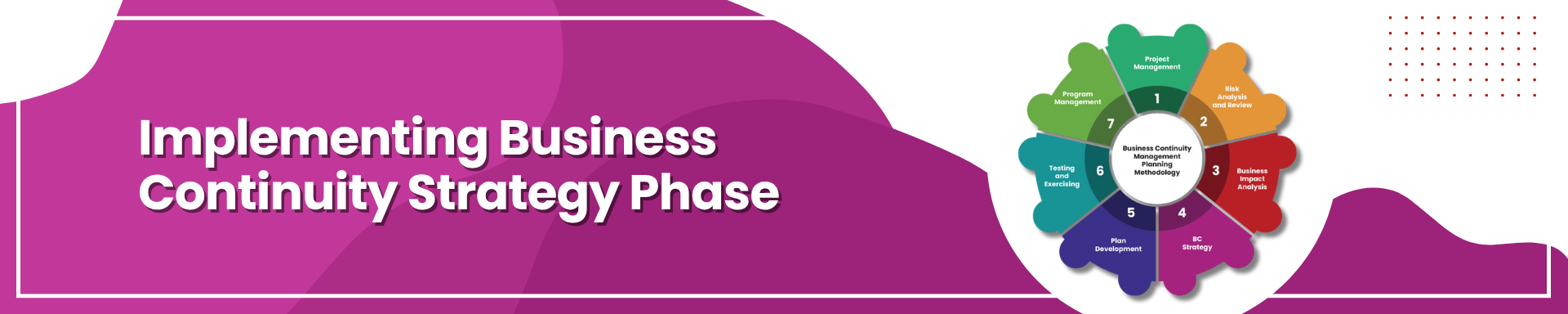
The fourth phase, Business Continuity Strategy (BCS), decides how each critical business function will keep going, or recover within its recovery time objective, when a disruption occurs. The strategies encompass prevention, mitigation and recovery measures for the sixteen critical business functions (CBFs) defined in Chapter 4, and they respond to the ten risks, R1 to R10, in Chapter 3.
This chapter presents Business Continuity Strategies for Eastern General Hospital (EGH) Critical Business Functions twice. The text groups them by the kind of resource each function depends on. The Summary Table then sets out the same strategies in one view. The chapter also explains how strategies are chosen and tested for cost and practicality, and what is particular to EGH. All strategies are illustrative options for EGH to evaluate, not decisions that it has made.
## Prevention, Mitigation and Recovery
Three kinds of measure work together. **Prevention** lowers the likelihood of a disruption, for example by maintaining equipment or restricting access to systems. **Mitigation** limits the effect while the disruption continues, for example by operating a function at a reduced level, the minimum business continuity objective. **Recovery** restores normal service, for example by moving to an alternative site or repairing a failed system. A strong strategy usually combines all three. Relying on recovery alone is expensive because the damage has already occurred, and relying on prevention alone leaves no answer when prevention fails.
## How Strategies Are Chosen and Tested
For each function, the team lists options, compares them against the recovery time objective (RTO) from the BIA, and tests them for cost and practicality. Four questions help:
1. **Does it meet the RTO?** An option that takes eight hours cannot protect a function with a two-hour target.
2. **What does it cost, and who pays?** Costs include set-up, running and testing. Larger costs go to the steering committee with the risk reduction they buy.
3. **Can it be done in practice?** The option should work with real staff, rosters, space and contracts. A plan that needs thirty trained staff is weak if only twelve are rostered at night.
4. **Can it be proved?** Each strategy should be testable through the exercises in Chapter 7. An untested strategy is a hope, not a control.
Where several functions share a dependency, the strategy should be chosen once for the shared resource. Power is the clearest case: a resilient power arrangement protects most Tier 1 functions at the same time, which is cheaper and more reliable than separate local measures.
## Strategies for Critical Business Functions by Resource Group
### S1 People (R8, R3, R9)
Functions most affected: CBF-1, CBF-2, CBF-3, CBF-4, CBF-10 and CBF-14. The main strategies are cross-training so that staff can cover neighbouring areas, a redeployment roster that names who moves where when numbers fall, a call-out process tested at different times of day, and arrangements for staff welfare such as rest areas, meals and transport during prolonged events. For outbreaks (R3), cohorting of staff and clear rules on fitness to work protect the workforce. For demand surges (R9), the plan should record how many staff can be released from elective work to emergency care, and how fast.
### S2 Premises and Utilities (R1, R4, R5)
Functions most affected: CBF-1, CBF-2, CBF-3, CBF-4, CBF-5, CBF-10 and CBF-11. Strategies include duplicate power feeds with generator capacity sized to the critical load, automatic changeover with scheduled on-load testing, fuel stocks and refuelling contracts, water storage for sterilisation and cooling, flood protection of plant rooms, and fire compartments with agreed evacuation routes. For a function that cannot be maintained in its home area, such as a ward made unusable by fire, the strategy should name an alternative area to which patients can be moved, with the clinical reason for the choice. Because EGH is still being designed, requests for resilient arrangements should reach the design team before layouts are fixed. This is the pre-opening lens from Chapter 1.
### S3 Technology and Data (R2, R10)
Functions most affected: CBF-5, CBF-6, CBF-7, CBF-12 and CBF-8. Strategies include segmented networks, offline and immutable backups, tested restoration of clinical systems against the recovery point objectives set in the BIA, secondary data centre capacity, and written downtime procedures that let clinicians keep working on paper when screens are lost. Downtime kits, with printed forms and medication charts, should sit in each clinical area and be checked regularly. For virtual and home-based care (CBF-7), the strategy should include a telephone fallback and a way to prioritise patients at greatest clinical risk when video links fail, which relates to R10.
### S4 Medical Equipment and Clinical Supplies (R6, R7)
Functions most affected: CBF-3, CBF-4, CBF-5, CBF-6 and CBF-9. Strategies include reserve oxygen and medical air supplies with manifold changeover, maintenance contracts with response times, spare critical equipment such as ventilators and infusion pumps, a reserve of sterile instrument sets, and minimum stock levels for resuscitation drugs and equipment. MOH licence conditions require licensees to keep adequate resuscitation drugs and equipment on site at all times, so these stock levels are a regulatory matter as well as a clinical one.
### S5 Suppliers and Partners (R7, R3, R9)
Functions most affected: CBF-6, CBF-9, CBF-13 and CBF-15. Strategies include dual sourcing for critical medicines and consumables, buffer stock set according to supplier lead times, continuity clauses and contact points in contracts, agreed delivery routes during disruption, and mutual aid arrangements with other hospitals. Patient flow and transfer (CBF-13) rely on Eastern Community Hospital, which is run by SingHealth Community Hospitals, so a written protocol should say who decides on transfers when either site is under strain.
### S6 Information and Communications (R2, R4, R9, R10)
Functions most affected: CBF-16 and all other CBFs for notification. Strategies include a mass notification tool with tested contact lists, a pre-agreed command structure, holding statements for patients, families, staff and the media, alternative communication channels such as radio or runners if phones fail, and a clear rule on who speaks to regulators and to the SingHealth group. Security arrangements, including access control during a crisis, belong in this group because they support safe movement and protect patients and staff.
## Requirements Specific to EGH
Strategies for a licensed hospital are shaped by approvals and contracts that limit alternative ways of working. Three points deserve attention.
- **Licensed premises and services.** MOH licence conditions for acute hospital licensees contain requirements about approved permanent premises and equipment, and about specified services such as emergency department and intensive care. Moving a service to an alternative area during an incident might need prior approval or notification. Whether and when this applies has not been confirmed and is marked **\[verify\]**; EGH should ask MOH before relying on any relocation strategy.
- **Group arrangements.** As part of the SingHealth group, EGH might use shared contracts, procurement or data services. These help, but they can also tie a strategy to a contract EGH does not control. The BCM team should find out which dependencies are held at group level and agree continuity terms with the group.
- **Staged opening.** Strategies must work at each stage. During the virtual-only stage, most of S3 and S6 apply, while S2 and S4 gain importance as physical services open. The strategy list should be revisited at each stage, with each stage-specific strategy marked as planned, in design or in place.
## Summary Table
| **Group** | **Functions most affected** | **Risks** | **Illustrative strategies** |
| --- | --- | --- | --- |
| **S1 People** | **CBF-1, 2, 3, 4, 10, 14** | **R8, R3, R9** | **Cross-training, redeployment roster, tested call-out, staff welfare** |
| **S2 Premises and utilities** | **CBF-1, 2, 3, 4, 5, 10, 11** | **R1, R4, R5** | **Duplicate power feeds, tested changeover, water storage, flood protection, alternative areas** |
| **S3 Technology and data** | **CBF-5, 6, 7, 8, 12** | **R2, R10** | **Segmentation, offline backups, secondary capacity, downtime procedures, telephone fallback** |
| **S4 Medical equipment and clinical supplies** | **CBF-3, 4, 5, 6, 9** | **R6, R7** | **Reserve gases, spare equipment, maintenance contracts, minimum stock** |
| **S5 Suppliers and partners** | **CBF-6, 9, 13, 15** | **R7, R3, R9** | **Dual sourcing, buffer stock, contract clauses, mutual aid, transfer protocol** |
| **S6 Information and communications** | **CBF-16 and all functions for notification** | **R2, R4, R9, R10** | **Mass notification, command structure, holding statements, alternative channels** |
## [](https://cta-redirect.hubspot.com/cta/redirect/3893111/297a5452-5a0d-4b73-9778-093a77c00efb)
The six resource groups give EGH a clear way to connect the risks in Chapter 3 and the targets in Chapter 4 to practical measures. Shared dependencies, above all power, information systems and people, deserve the first investment because they protect most Tier 1 functions at once. Strategies that depend on licensed premises or group contracts need early checking, and strategies for physical services should be raised with designers before layouts are fixed. The next chapter turns the chosen strategies into written plans.
## Sources
- [MOH, Licence Conditions on Acute Hospital Service Licensees, version 1.0](https://isomer-user-content.by.gov.sg/7/778fe29b-fbad-4918-ad2c-67162f04a991/LCs%20on%20Acute%20Hospital%20Service%20Licensees_1.0.pdf), for the section headings on approved premises, equipment and specified services.
- [MOH, Licence Conditions on Emergency Life Saving Measures, version 1.0](https://isomer-user-content.by.gov.sg/7/c9eb5682-75e3-4537-b017-93f6a6768eef/lcs-on-emergency-life-saving-measures_1-0.pdf), for the requirement to keep resuscitation drugs and equipment on site.
- [Eastern General Hospital, Hospital Overview](https://www.egh.com.sg/about-egh/hospital-overview/).
**Continue reading:** Chapter 6, *Business Continuity Plan Development Phase for Business Continuity Management Planning Methodology for Eastern General Hospital*, which explains how to organise the plan, run the writing workshop and validate the plans.
| Keeping Care Running: Managing and Implementing Business Continuity Management at Eastern General Hospital | | | | |
| --- | --- | --- | --- | --- |
| **eBook 2: Implementing Business Continuity Management** | | | | |
| **C1** | **C2** | **C3** | **C4** | **C5** |
| [](https://cta-redirect.hubspot.com/cta/redirect/3893111/ae929f9f-d9ce-4159-89d6-7e4e808e302e) | [](https://cta-redirect.hubspot.com/cta/redirect/3893111/31402f15-220b-47f2-96bd-c1c0b99f601b) | [](https://cta-redirect.hubspot.com/cta/redirect/3893111/47b1732f-7d2d-4b7f-9e2c-1bb9f5eb37e9) | [](https://cta-redirect.hubspot.com/cta/redirect/3893111/354c4374-6f93-47df-8e52-f9cae94c431c) | [](https://cta-redirect.hubspot.com/cta/redirect/3893111/883a28c8-785a-42c1-bec1-ab356f5dfe62) |
| **C6** | **C7** | **C8** | **C9** | **C10** |
| [](https://cta-redirect.hubspot.com/cta/redirect/3893111/c706799d-aeab-4a5e-89c0-3aa51b17707c) | [](https://cta-redirect.hubspot.com/cta/redirect/3893111/4bebd8de-6b61-4578-b24a-3ceb6a11cd05) | [](https://cta-redirect.hubspot.com/cta/redirect/3893111/d7d1ea36-1913-4593-8189-04e6d1b116d7) | [](https://cta-redirect.hubspot.com/cta/redirect/3893111/0829428d-9f00-473a-8c9e-f138e9c32798) | [](https://cta-redirect.hubspot.com/cta/redirect/3893111/a8ed064d-96cf-41d5-b4d9-c2ef1f77a7a6) |
| | | | | |
---
## **Comments**

---

---

---

---


All rights reserved. Copyright 2026
```json
{
"@context" : "https://schema.org",
"@type" : "BlogPosting",
"author" : {
"@type" : "Person",
"name" : "Moh Heng Goh",
"url" : "https://blog.bcm-institute.org/bcm-v2/author/moh-heng-goh"
},
"dateModified" : "2026-11-17T06:24:52.422Z",
"datePublished" : "2026-11-17T05:20:42.000Z",
"headline" : "[BCM] [EGH] [E2] [C5] Business Continuity Strategy Phase for Business Continuity Management Planning Methodology for Eastern General Hospital",
"mainEntityOfPage" : {
"@id" : "https://blog.bcm-institute.org/bcm-v2/bcm-egh-e2-c5-business-continuity-strategy-phase-for-business-continuity-management-planning-methodology-for-eastern-general-hospital",
"@type" : "WebPage"
},
"publisher" : {
"@type" : "Organization",
"logo" : {
"@type" : "ImageObject",
"url" : "https://blog.bcm-institute.org/hubfs/BCMI%20Logo.png"
},
"name" : "BCMI Pte Ltd"
}
}
```