---
title: "[BCM] [EGH] [E1] [C10] Identifying Critical Business Functions for Eastern General Hospital"
description: EGH's 16 preliminary critical business functions with dependencies, impacts and priorities, set against MOH licensing, cluster governance and ISO 22301.
---
.
[](http://www.bcm-institute.org/)
- [Home](https://www.bcm-institute.org/)
- [About Us](https://www.bcm-institute.org/about-us-3/)
- [A President’s Perspective](https://www.bcm-institute.org/about-us/a-presidents-perspective/)
- [Our History](https://www.bcm-institute.org/about-us/our-history/)
- [Our Advisory Council](https://www.bcm-institute.org/about-us/our-advisory-council/)
- [Customers’ Testimonials](https://www.bcm-institute.org/about-us/customers-testimonials/)
- [Credential Verification](https://www.bcm-institute.org/about-us/credential-verification/)
- [Courses](https://blog.bcm-institute.org/blog/course-fees-for-blended-learning-courses-master-catalog)
- [ISO 22301 Business Continuity Management System Audit](https://blog.bcm-institute.org/audit/business-continuity-management-audit-courses)
- [ISO 22301 Business Continuity Management](https://blog.bcm-institute.org/bcm/business-continuity-management-courses)
- [Crisis Communication](https://blog.bcm-institute.org/crisis-communication/crisis-communication-courses)
- [Crisis Management](https://blog.bcm-institute.org/en/crisis-management/courses)
- [IT Disaster Recovery](https://blog.bcm-institute.org/it-disaster-recovery/courses)
- [Operational Resilience](https://blog.bcm-institute.org/operational-resilience/courses)
- [Operational Resilience Audit](https://blog.bcm-institute.org/operational-resilience-audit/courses)
- [Certification](https://blog.bcm-institute.org/certification/types-of-certifications-offered)
- [ISO 22301 BCMS Audit Certification](https://blog.bcm-institute.org/certification/business-continuity-management-audit-certification)
- [ISO22301 Business Continuity Management Certification](https://blog.bcm-institute.org/bcm/business-continuity-management-certification)
- [Crisis Communication Certification](https://blog.bcm-institute.org/crisis-communication/crisis-communication-certification)
- [Crisis Management Certification](https://blog.bcm-institute.org/en/crisis-management/crisis-management-certification)
- [IT Disaster Recovery Planning Certification](https://blog.bcm-institute.org/it-disaster-recovery/it-disaster-recovery-certification)
- [Operational Resilience Certification](https://blog.bcm-institute.org/operational-resilience/operational-resilience-certification)
- [Operational Resilience Audit Certification](https://blog.bcm-institute.org/operational-resilience-audit)
- [Seminars](https://blog.bcm-institute.org/meet-the-expert/mte-webinar-mainpage)
- [Store](https://www.bcm-institute.org/store-2/)
- [Contact Us](http://www.bcm-institute.org/about-us/contact-us/)
-
-
###### Keeping Care Running: Managing and Implementing Business Continuity Management at Eastern General Hospital
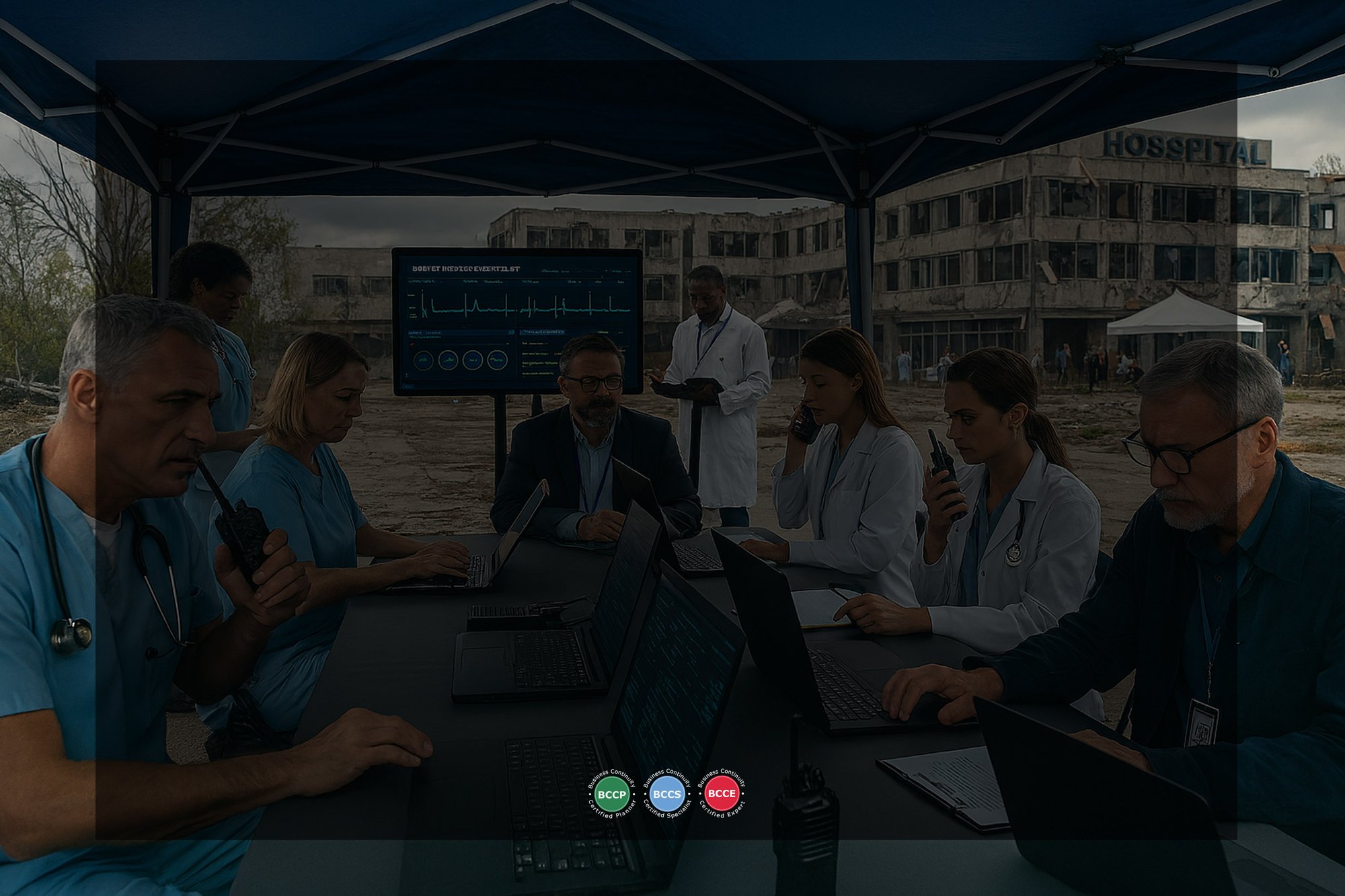
# \[BCM\] \[EGH\] \[E1\] \[C10\] Identifying Critical Business Functions for Eastern General Hospital
[](https://cta-redirect.hubspot.com/cta/redirect/3893111/dfa53785-5be1-4117-a1bc-43e40cdb42e8)
Business continuity management (BCM) keeps essential care running when something goes wrong.
This chapter is the tenth in *Understanding Your Organisation for Eastern General Hospital*, eBook 1 of the Keeping Care Running series*: Managing and Implementing Business Continuity Management at Eastern General Hospital*.
It introduces BCM to EGH's senior management, BCM coordinator and clinical and support department heads.
Later chapters and eBooks cover context analysis, business impact analysis (BIA), risk assessment, strategies, plans and exercises in depth.
This chapter introduces them and then identifies the critical business functions that the later work will test and confirm.
[](https://cta-redirect.hubspot.com/cta/redirect/3893111/fbb42012-8f64-401c-a56c-d84bdcfeee14)
[Moh Heng Goh](https://blog.bcm-institute.org/bcm-v2/author/moh-heng-goh) Nov 3, 2026
## **[](https://cta-redirect.hubspot.com/cta/redirect/3893111/dfa53785-5be1-4117-a1bc-43e40cdb42e8)eBook 1: Chapter 10**
**[](https://cta-redirect.hubspot.com/cta/redirect/3893111/fbb42012-8f64-401c-a56c-d84bdcfeee14)**
#### **Identifying Critical Business Functions for Eastern General Hospital**
## Introduction
People come to a hospital when they cannot wait.
A stroke patient, a woman in labour, a child with a high fever and a family waiting for news from theatre all expect Eastern General Hospital (EGH) to be ready, whatever else is happening.
Business continuity management (BCM) keeps the most important care going when something goes wrong.
This chapter is the tenth in *Understanding Your Organisation for Eastern General Hospital*, eBook 1 of the Keeping Care Running series*: Managing and Implementing Business Continuity Management at Eastern General Hospital*.
It introduces BCM to EGH's senior management, BCM coordinator and clinical and support department heads. Later chapters and eBooks cover context analysis, business impact analysis (BIA), risk assessment, strategies, plans and exercises in depth.
This chapter introduces them and then identifies the critical business functions that the later work will test and confirm.
After reading this chapter, a reader should be able to:
- explain what BCM and a business continuity management system (BCMS) are, and how BCM differs from emergency response;
- describe the regulatory, governance and voluntary standards that apply to EGH, and which of them are mandatory;
- map clauses 4 to 10 of ISO 22301:2019 to the Plan-Do-Check-Act cycle;
- recognise the 16 preliminary critical business functions proposed for EGH and the reasons for their priority;
- describe how common disruptions affect a hospital and how a response unfolds step by step; and
- identify the roles needed, from the governing body to shift staff.
## About Eastern General Hospital
EGH is a new acute hospital under SingHealth, being built in Bedok North next to Bedok North MRT station.
It plans to have about 1,000 acute care beds, and with the co-located Eastern Community Hospital (ECH), which will add about 400 community care beds, the EGH Campus will have about 1,400 beds.
The Ministry of Health (MOH) announced the project in 2020; groundbreaking took place on 20 April 2024; main construction began in 2025; and the campus is due to open progressively from 2029.
EGH's vision is to be a great hospital for the community and a great workplace for staff. Its mission is to provide excellent healthcare and promote healing, centred around the person.
It plans to deliver emergency, inpatient, and outpatient services across many specialities, supported by the One SingHealth centres for cancer, dental, heart, neuroscience, and eye care.
Several features shape EGH's continuity needs. The hospital is digitally enabled from the start, under a Smart Hospital Roadmap with three pillars: Smart Care, Smart Operations and Smart Infrastructure.
It already serves patients through SingHealth@Home and Virtual Professional Consultations, which extend care into homes and primary care clinics.
It is part of a cluster, so it shares services and can draw on other SingHealth institutions.
It is still under construction, so continuity can be designed in rather than added later. SingHealth has stated that campus spaces can be converted or scaled up quickly in an outbreak, and that areas can be closed off to limit pathogen spread.
The EGH Campus also includes the Healthcare Living Laboratory, a three-storey facility beside the site where the team mocks up hospital spaces and trials clinical and spatial prototypes. For continuity, this is a useful asset.
EGH can use it to test downtime procedures, patient flow, and evacuation routes before the real wards exist, and invite clinical teams to rehearse scenarios in realistic space.
EGH also operates in a community setting. It aims to help patients and residents lead healthier lives through community partnerships, including care delivered in patients' homes.
A disruption in eastern Singapore, such as a long power cut or a transport failure, could therefore affect both the hospital building and the patients who depend on its home-based services.
Anything about EGH's future internal set-up in this chapter is illustrative.
## What Business Continuity Management Is
BCM is a management process that identifies which activities an organisation must continue during a disruption, how quickly each must resume, and what resources it needs.
A BCMS is the set of policies, roles, plans, exercises and reviews that keeps this capability current. ISO 22301:2019 sets out the requirements for a BCMS, and ISO 22313:2020 provides guidance.
BCM differs from emergency response. Emergency response deals with the immediate event: evacuating a ward during a fire, activating a code for a mass-casualty arrival or isolating a contaminated room.
BCM begins with the question of what happens to care once the first hour has passed. Where will the displaced patients be treated, how will medicines be supplied, and which theatre lists can be postponed safely?
A hospital makes this distinction in practice every day.
A code team that responds to a cardiac arrest is emergency response. A plan that keeps the cardiac catheterisation service running when its imaging system has failed for three days is BCM.
Both are needed, and they must work together.
The incident commander leading the emergency response should already know which continuity plans will take over once the immediate danger has passed.
BCM also differs from clinical governance and from information technology disaster recovery.
Clinical governance protects quality and safety in normal operations. Disaster recovery restores systems. BCM brings these together and asks whether the whole service can continue.
**Table 10.3: Key ISO 22301 terms with examples at Eastern General Hospital**
| **Term** | **Meaning** | **Example at EGH (illustrative)** |
| --- | --- | --- |
| **Disruption** | **An event that interrupts the expected delivery of products or services** | **A power failure that affects theatres** |
| **Prioritised activity** | **An activity that must be done first during a disruption (also called a critical business function)** | **Emergency care (CBF-1)** |
| **Business impact analysis (BIA)** | **The process of analysing how disruption affects activities over time** | **Workshops with ward and theatre leads** |
| **Maximum tolerable period of disruption (MTPD)** | **The time after which an activity's loss becomes unacceptable** | **The agreed limit for losing critical care capacity** |
| **Recovery time objective (RTO)** | **The target time to resume an activity** | **The time to restore the electronic medical record, set within the MTPD** |
| **Minimum business continuity objective (MBCO)** | **The minimum level of service acceptable during a disruption** | **Emergency care at reduced capacity** |
| **Business continuity strategy** | **The approach chosen to protect and recover an activity** | **Manual downtime procedures plus a secondary data path** |
| **Business continuity plan** | **Documented procedures for responding and recovering** | **A theatre continuity plan** |
| **Exercise** | **A process to train, assess and improve a plan** | **A table-top exercise on a ransomware attack** |
## Regulatory and Governance Context
Three distinct groups shape EGH's continuity obligations. They must not be confused, because only one is legally mandatory.
### Regulators and Legislation
MOH is the primary regulator. It licenses healthcare services under the Healthcare Services Act 2020 (HCSA), with the Healthcare Services (General) Regulations 2021 and the Healthcare Services (Acute Hospital Service) Regulations 2023 setting detailed requirements.
Acute hospital service is a licensable service, so MOH applies to EGH once it provides that service.
MOH's notice of licence conditions, Circular 87/2023, lists conditions by title and does not itself set out business continuity rules. EGH should read the full licence conditions for any readiness or continuity duty.
Other agencies apply in specific areas. The Cyber Security Agency of Singapore administers the Cybersecurity Act 2018, which lists healthcare as a critical information infrastructure sector.
It applies to EGH only if EGH owns or operates infrastructure that has been designated \[verify\].
The Personal Data Protection Commission applies the Personal Data Protection Act 2012 to organisations that handle personal data, and it fined SingHealth after the 2018 cyber-attack \[verify application to EGH\].
The Singapore Civil Defence Force applies fire safety rules to buildings \[verify\].
### Governance Framework
No comply-or-explain governance code applies to EGH directly, because EGH is not a charity.
EGH is governed through the SingHealth public healthcare cluster under MOH oversight, and the exact arrangements should be confirmed with SingHealth \[verify\]. This chapter does not invent a code or policy.
### Voluntary Standards
ISO 22301:2019, with Amendment 1:2024, provides the requirements for a BCMS, and ISO 22313:2020 provides guidance. Both are voluntary.
They offer the basis for the BCMS and for any certification EGH chooses to pursue. Singapore has no national BCM policy for hospitals, so ISO 22301 also serves as a benchmark where MOH rules are silent.
Amendment 1:2024 adds climate action changes. In summary, organisations must determine whether climate change is a relevant issue when they consider their context (clause 4.1) and whether interested parties have climate-related requirements (clause 4.2).
For EGH, this means considering intense rainfall, heat and their effects on utilities, cooling and supply chains. It does not add new mandatory targets.
For each regulator, EGH should keep a short note stating whether it applies, what it requires and who in EGH owns the relationship.
This note prevents two common mistakes: assuming a requirement applies when it does not, and missing one that does.
Review it whenever EGH adds a new service, such as a new licensable service or a system that may be designated, and whenever legislation changes.
Where the position is unclear, EGH should ask the regulator or SingHealth's legal and compliance teams directly.
### A Worked Scenario: Ransomware at EGH
Suppose a ransomware attack encrypts EGH's clinical systems. The frameworks interact as follows, in a hypothetical sequence.
1. **Immediate response:** the incident team isolates affected systems and activates downtime procedures, which protect patients under the ISO 22301 plans.
2. **Cluster escalation:** EGH informs SingHealth, which may coordinate a wider response.
3. **Regulatory notifications:** if the systems are designated critical information infrastructure, the Cybersecurity Act requires incident reporting. If personal data is affected, the PDPA requires assessment and notification. MOH expects to be informed of events that affect patient safety or service delivery \[verify timing and thresholds\].
4. **Recovery:** the BCMS strategy restores systems in priority order against the agreed recovery time objectives.
5. **Learning:** the post-incident review feeds Clause 10 improvement actions.
## The Structure of ISO 22301
ISO 22301:2019 follows the Plan-Do-Check-Act cycle. Clauses 4 to 7 plan, clause 8 does, clause 9 checks and clause 10 acts. In other words, the clauses and their EGH examples are as follows.
The cycle is continuous. Findings from exercises and incidents in the check and act stages feed back into context, objectives and plans in the plan and do stages. A hospital that treats the cycle as a loop, and not a line, steadily improves.
One that treats it as a project to be finished soon finds its plans out of date. Amendment 1:2024 does not change this structure. It adds climate-related considerations to clauses 4.1 and 4.2.
### Plan: Clauses 4 to 7
**Clause 4, Context.** The organisation understands its environment, interested parties and scope. EGH might list MOH, SingHealth, patients and the main contractor as interested parties, and include climate change in its context register.
**Clause 5, Leadership.** Top management shows commitment, sets the policy and assigns roles. EGH's chief executive might chair the BCM steering committee.
**Clause 6, Planning.** The organisation addresses risks and opportunities to the BCMS and sets objectives. EGH might set an objective to complete a BIA for each department before its service opens.
**Clause 7, Support.** The organisation provides resources, competence, awareness, communication and documented information. EGH might train department representatives and deputies for incident roles.
### Do: Clause 8
**Clause 8, Operation.** The organisation carries out BIA and risk assessment (8.2), chooses strategies (8.3), builds plans (8.4) and runs exercises (8.5). EGH might develop a theatre continuity plan and test it with a downtime exercise.
### Check: Clause 9
**Clause 9, Performance evaluation.** The organisation monitors, audits and reviews the BCMS. EGH might report exercise results and open actions to its steering committee each quarter.
### Act: Clause 10
**Clause 10, Improvement.** The organisation corrects nonconformities and improves continually. EGH might track actions arising from every exercise and incident until they close.
**Table 10.1: Overview of Business Continuity Management for Eastern General Hospital**
| **BCM element** | **ISO 22301 clause** | **Purpose** | **Application at EGH** | **Governance or regulatory link** |
| --- | --- | --- | --- | --- |
| **Context and interested parties** | **4.1; 4.2** | **Understand the environment and expectations** | **Context register covering MOH, SingHealth, climate and construction** | **HCSA; Amendment 1:2024** |
| **Scope** | **4.3; 4.4** | **Define what the BCMS covers** | **Virtual care first, extended by campus phase** | **Licence scope \[verify\]** |
| **Leadership and policy** | **5.1; 5.2; 5.3** | **Commit and direct** | **Chief executive chairs a steering committee** | **Cluster governance \[verify\]** |
| **Objectives and planning** | **6.1; 6.2** | **Set measurable targets** | **BIA complete before each service opens** | **Good practice benchmark** |
| **Support** | **7.2; 7.3; 7.4; 7.5** | **Provide competence, awareness and communication** | **Training for incident roles and deputies** | **Staff safety duties** |
| **BIA and risk assessment** | **8.2.2; 8.2.3** | **Identify priorities and threats** | **Preliminary list of 16 critical business functions** | **Cybersecurity Act 2018; PDPA 2012 \[verify\]** |
| **Strategies and plans** | **8.3; 8.4** | **Protect and recover priorities** | **Downtime procedures, minimum stocks, outbreak plan** | **HCSA licence conditions \[verify\]** |
| **Exercises** | **8.5** | **Prove the capability** | **Table-top, functional and full exercises** | **MOH and SingHealth expectations \[verify\]** |
| **Evaluation and improvement** | **9; 10** | **Monitor and improve** | **Quarterly reporting, audit and action tracking** | **Good practice benchmark** |
## Indicative Critical Business Functions
ISO 22301 calls these activities "prioritised activities". This eBook uses the term "critical business function" (CBF) and codes each one for reference in later chapters. The list in Table 10.2 is preliminary.
It will be confirmed or changed through the BIA described in Chapter 8. Priorities are indicative only, and no recovery targets are stated at this stage.
**Table 10.2: Indicative Critical Business Functions (Prioritised Activities) for Eastern General Hospital**
| **Critical Business Function** | **What it involves** | **Key dependencies (people, premises, suppliers, IT, utilities)** | **Impact if disrupted** | **Indicative priority** |
| --- | --- | --- | --- | --- |
| **CBF-1 Emergency care** | **Triage, resuscitation and stabilisation of walk-in and ambulance patients** | **Emergency physicians and nurses; emergency department; imaging and laboratory; electronic records; power** | **Direct risk to life; loss of access to acute care in the east** | **High** |
| **CBF-2 Inpatient ward care** | **Nursing and medical care, medication rounds and discharge for admitted patients** | **Ward nurses and doctors; ward space; pharmacy; electronic records; oxygen and utilities** | **Patient harm; blocked admissions from emergency care** | **High** |
| **CBF-3 Operating theatre services** | **Emergency and elective surgery, anaesthesia and recovery** | **Surgical teams; theatres; sterile supplies; medical gases; ventilation; power** | **Delayed life-saving surgery; cancelled lists** | **High** |
| **CBF-4 Critical care** | **Intensive and high-dependency care for the most unwell patients** | **Critical care staff; specialised equipment; power; medical gases; supplies** | **Immediate risk to life** | **High** |
| **CBF-5 Diagnostic imaging and laboratory services** | **Scans, blood tests and pathology that guide treatment** | **Radiographers and laboratory scientists; equipment; reagents; network and records** | **Delayed diagnosis and treatment decisions** | **High** |
| **CBF-6 Pharmacy and medication management** | **Dispensing, medicine storage and medication safety** | **Pharmacists; stock; cold chain; suppliers; records** | **Medication errors; treatment interruptions** | **High** |
| **CBF-7 Virtual and home-based care** | **SingHealth@Home, Virtual Professional Consultations and remote monitoring** | **Virtual care teams; telehealth platform; telecommunications; monitoring devices** | **Unmonitored patients at home; return to hospital beds** | **Medium** |
| **CBF-8 Outpatient specialist care** | **Specialist clinics and day procedures** | **Clinicians; clinic spaces; appointment systems; records** | **Delayed non-urgent care; backlog** | **Medium** |
| **CBF-9 Clinical support supplies** | **Sterile services, blood products, medical gases and consumables** | **Sterile processing staff; equipment; suppliers; transport; utilities** | **Theatres and wards cannot operate safely** | **High** |
| **CBF-10 Infection prevention and outbreak response** | **Isolation, screening, zoning and surveillance** | **Infection prevention team; isolation capacity; protective equipment; surveillance data** | **Spread of infection; loss of capacity** | **High** |
| **CBF-11 Facilities, utilities and building systems** | **Power, water, cooling, ventilation, lifts and medical gas plant** | **Engineers; building management system; contractors; utilities; spare parts** | **Failure of nearly every clinical activity** | **High** |
| **CBF-12 Clinical information systems and digital platforms** | **Electronic records, imaging archives, scheduling and network services** | **Information technology staff; data centres; network; vendors; power** | **Loss of records and orders; unsafe care** | **High** |
| **CBF-13 Patient flow and transfer to community care** | **Bed management, discharge, and transfer to ECH and other settings** | **Bed managers; transfer teams; referral system; transport** | **Overcrowding; blocked beds** | **Medium** |
| **CBF-14 Workforce deployment and staff welfare** | **Rostering, redeployment, staff safety and support** | **Human resources; rostering system; transport; accommodation and meals** | **Unsafe staffing; staff burnout** | **High** |
| **CBF-15 Logistics, food, linen and waste services** | **Supply chain, patient meals, laundry and clinical waste** | **Logistics staff; vendors; storage; transport; utilities** | **Infection and welfare risks as supplies run out** | **Medium** |
| **CBF-16 Security, safety and crisis communications** | **Access control, fire safety, incident command and communications** | **Security staff; command centre; communication systems; spokespersons** | **Loss of control and public trust** | **Medium** |
### How to Read the List
The list mixes two kinds of function. Some deliver care directly, such as emergency care (CBF-1), operating theatre services (CBF-3) and critical care (CBF-4).
Others enable care, such as facilities, utilities and building systems (CBF-11) and clinical information systems and digital platforms (CBF-12).
Enabling functions often carry the highest dependency, because the failure of one can stop many care functions at once. For this reason, they are marked High even though patients never see them.
The indicative priority reflects likely harm to patients and speed of impact.
Functions marked Medium, such as virtual and home-based care (CBF-7) and outpatient specialist care (CBF-8), can usually tolerate a longer interruption or have alternatives, but they are not unimportant.
Virtual care, in particular, may rise in priority during an outbreak, as it can keep stable patients out of crowded wards. The BIA will test each of these judgements with clinical leads.
The list will also change as the campus opens. Functions such as ECH transfers and some specialist services will only become relevant when they exist.
EGH should therefore review the list at each phase, add new functions and retire any that no longer apply.
For ISO 22301 purposes, each function will eventually need an MTPD, an RTO, an MBCO and a recovery point objective (RPO) for its data.
This chapter does not state any of these because they must come from the BIA and clinical judgement, not from assumptions in a book.
## Disruption Scenarios
Disruptions rarely arrive as neat categories, but a simple classification helps teams plan. Table 10.4 shows eight types of disruption with an EGH example for each.
**Table 10.4: Disruption scenarios and effects for Eastern General Hospital**
| **Disruption** | **Typical effect** | **Example at EGH (illustrative)** |
| --- | --- | --- |
| **Loss of staff** | **Reduced capacity and unsafe rosters** | **A transport disruption keeps theatre nurses from the site** |
| **Loss of utilities** | **Failure of life-supporting equipment** | **A power failure outlasts backup generation in critical care** |
| **Loss of premises** | **Reduced beds and displaced services** | **A fire closes one ward block** |
| **Loss of suppliers** | **Shortage of medicines or sterile supplies** | **A supplier of surgical consumables stops deliveries** |
| **Loss of information technology** | **Loss of records, orders and results** | **Ransomware disables the electronic medical record** |
| **Health emergencies** | **Surge in demand and strain on infection control** | **An outbreak requires zoning and isolation** |
| **Climate events** | **Flooding, heat and damage to plant** | **Intense rainfall floods a plant room** |
| **Reputation** | **Loss of public trust and regulatory attention** | **A serious patient-safety event attracts media coverage** |
The scenarios show why continuity planning looks at causes and effects separately.
Different causes, such as a cyber-attack, a software fault or a flood in a data room, can produce the same effect: loss of information technology.
Planning for the effect lets EGH build one set of downtime procedures that works for all those causes, while the risk assessment in Chapter 9 deals with the causes individually. This approach keeps plans short and usable.
The scenarios also overlap. An outbreak can reduce staff numbers, increase demand and strain supplies simultaneously.
A flood can cut power, damage premises and stop deliveries. Exercises should therefore include combined scenarios, so that decision-makers practise setting priorities when several functions are under pressure at once.
### Step-by-Step Example: Loss of the Electronic Medical Record
The hypothetical example below shows how BCM supports a response.
1. **Detect and declare:** the information technology team detects an outage and the incident commander declares a disruption.
2. **Protect patients:** wards switch to paper downtime forms, and pharmacy uses printed medication lists held for this purpose.
3. **Prioritise:** CBF-1, CBF-3, CBF-4 and CBF-6 are restored first, because their loss carries the highest patient risk.
4. **Communicate:** the communications lead informs staff, patients and SingHealth, and MOH if required.
5. **Recover:** restore systems in priority order, and enter and check data from the downtime period.
6. **Review:** the team records lessons and updates plans.
## Benefits of BCM for Each Stakeholder Group
BCM benefits several groups at once. Patients and families gain safer care and fewer interrupted treatments.
Staff gain clear roles, safer working conditions and confidence that management has thought about disruption.
Senior management makes better decisions, faces fewer surprises, and has evidence for the board.
For patients, the benefit is easy to state: safer care when things go wrong. A patient on a home-monitoring programme knows that a clinician will call if the connection fails. A family waiting for a surgical list knows that the hospital has a plan if theatres lose power. Staff benefit in a different way.
When roles, authority, and fallback procedures are clear, staff can act without waiting for permission, reducing stress and error in difficult moments.
Senior management benefits from visibility. A BCMS provides a clear view of the most important services, the dependencies behind them and the weakest points.
This helps leaders decide where to spend limited money and what risks to accept.
The governing body benefits from evidence to support its oversight duties and a structure for challenge.
MOH and SingHealth gain a hospital that can show how it manages risk and responds to events. Suppliers and partners gain clearer expectations, and the community gains a hospital it can rely on.
For EGH specifically, early BCM also supports a smoother opening, since each service can be tested before patients arrive.
## Roles and Responsibilities
Chapter 6 describes the BCM team in detail. In summary, the roles run from the top of the organisation to the point of care.
- **Governing body or executive committee:** approves the policy, sets risk appetite and receives reports.
- **Chief executive:** chairs the steering committee and holds overall accountability.
- **Steering committee:** sets priorities and resolves conflicts between departments.
- **BCM coordinator:** runs the programme and supports departments.
- **Department heads:** own continuity for their area and approve BIA results.
- **Incident commander and leads:** direct the response during an incident.
- **Shift supervisors and staff:** follow the plans, raise alerts and apply downtime procedures.
Each role needs a written description with clear authority. For example, the incident commander should have the authority to cancel elective lists, redeploy staff and approve emergency spending up to a stated limit.
A department head should be able to invoke the department plan without waiting for approval from above. Without this clarity, valuable minutes are lost in debate. Roles should also be tested in exercises, since people often discover that a responsibility on paper does not match how the hospital really works.
Shift-level cover deserves particular attention. Hospitals operate every hour of every day, and most incidents begin outside office hours. EGH should ensure that each shift has someone who knows how to raise an alert, who to call and what to do in the first thirty minutes. A one-page card at each nurses' station and in each department can support this.
## Conclusion
BCM gives EGH a structured way to protect patients and services when normal operations are interrupted.
EGH operates in a layered setting: legal duties under the HCSA and related laws, a cluster governance setting and voluntary standards that provide the BCMS framework.
Sixteen preliminary critical business functions form the starting point for the BIA.
The key takeaways are these:
- BCM covers what happens after the first response, and it complements emergency response and clinical governance.
- ISO 22301 and ISO 22313 are voluntary, while the HCSA licence and related laws are mandatory.
- The 16 critical business functions in Table 10.2 are preliminary and will be confirmed through the BIA.
- EGH's stage of development lets it build continuity into design, commissioning and culture.
- Clear roles, from the governing body to shift staff, make plans real.
Chapter 11 summarises eBook 1 and prepares EGH for eBook 2.
## Sources
- [Eastern General Hospital](https://www.egh.com.sg)
- [Eastern General Hospital: Hospital overview](https://www.egh.com.sg/about-egh/hospital-overview/)
- [Eastern General Hospital: Who we are](https://www.egh.com.sg/about-egh/who-we-are/)
- [SingHealth: EGH Campus commences main construction (5 August 2025)](https://www.singhealth.com.sg/news/infrastructure/eastern-general-hospital-campus-commences-main-construction-and-)
- [SingHealth: EGH campus unveils Smart Hospital Roadmap (7 March 2026)](https://www.singhealth.com.sg/news/innovation/new-eastern-general-hospital--egh--campus-unveils-smart-hospital)
- [Ministry of Health: Healthcare services regulation and licensing](https://www.moh.gov.sg/others/health-regulation/healthcare-services-regulation-and-licensing/)
- [Ministry of Health: MOH Circular 87/2023, notice of issuance of licence conditions under the HCSA](https://isomer-user-content.by.gov.sg/7/bba2b02b-8340-4bae-bf41-046ed9676a03/moh-cir-87-2023-notice-of-issuance-of-licence-conditions-under-the-healthcare-services-act-hcsa.pdf)
- [Cyber Security Agency of Singapore: Cybersecurity Act](https://www.csa.gov.sg/Legislation/Cybersecurity-Act)
- [Society for Computers and Law: Singapore's worst cyber attack, the outcome of the investigation](https://www.scl.org/10405-singapore-s-worst-cyber-attack-the-outcome-of-the-investigation/)
**Continue reading:** Chapter 11, *Summary of Understanding Your Organisation for Eastern General Hospital*, consolidates the outputs of Chapters 1 to 10 and prepares EGH for eBook 2.
---
## **Comments**

---

---

---

---


All rights reserved. Copyright 2026
```json
{
"@context" : "https://schema.org",
"@type" : "BlogPosting",
"author" : {
"@type" : "Person",
"name" : "Moh Heng Goh",
"url" : "https://blog.bcm-institute.org/bcm-v2/author/moh-heng-goh"
},
"dateModified" : "2026-11-03T13:01:10.740Z",
"datePublished" : "2026-11-03T12:37:14.000Z",
"headline" : "[BCM] [EGH] [E1] [C10] Identifying Critical Business Functions for Eastern General Hospital",
"mainEntityOfPage" : {
"@id" : "https://blog.bcm-institute.org/bcm-v2/bcm-egh-e1-c10-identifying-critical-business-functions-for-eastern-general-hospital",
"@type" : "WebPage"
},
"publisher" : {
"@type" : "Organization",
"logo" : {
"@type" : "ImageObject",
"url" : "https://blog.bcm-institute.org/hubfs/BCMI%20Logo.png"
},
"name" : "BCMI Pte Ltd"
}
}
```